
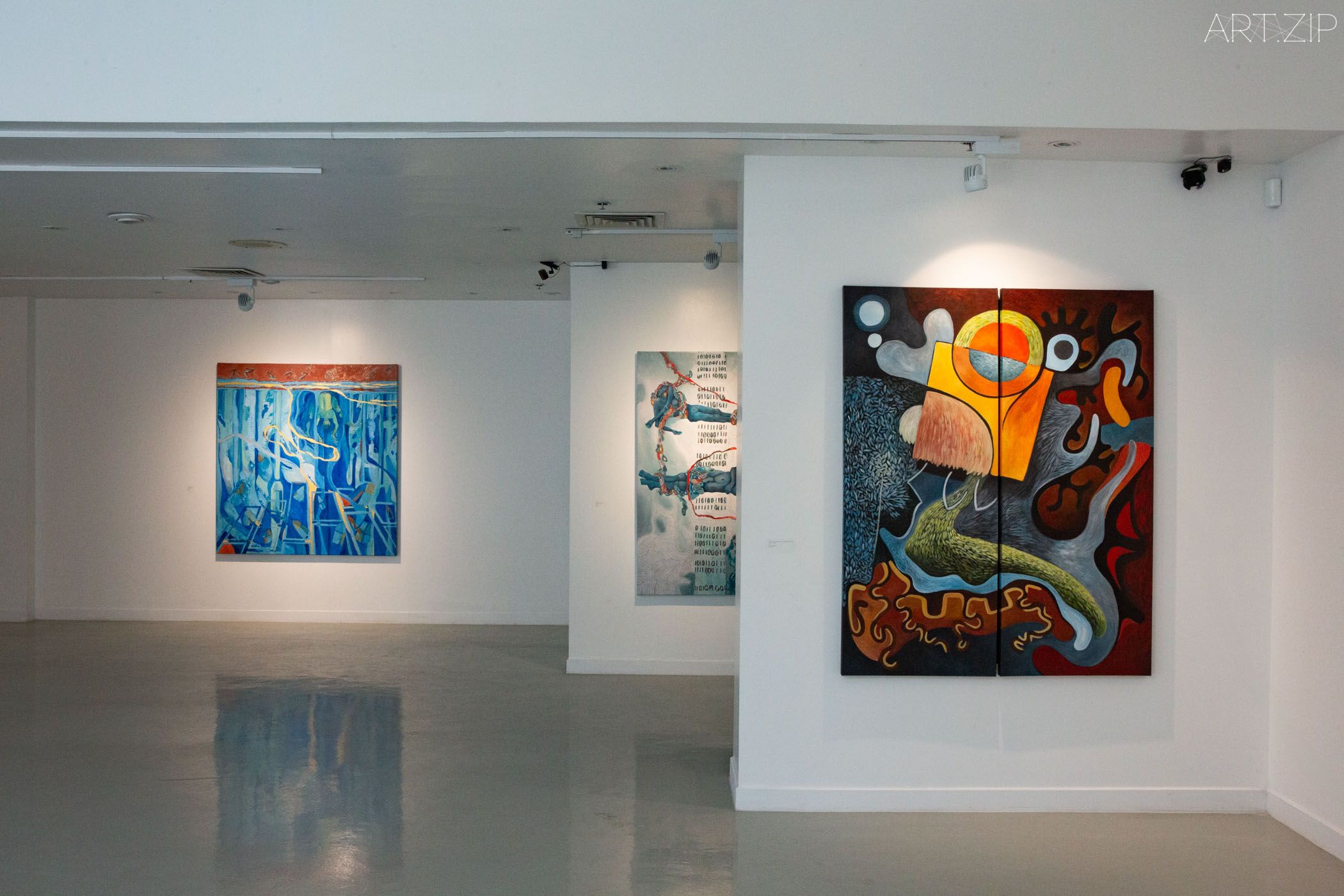
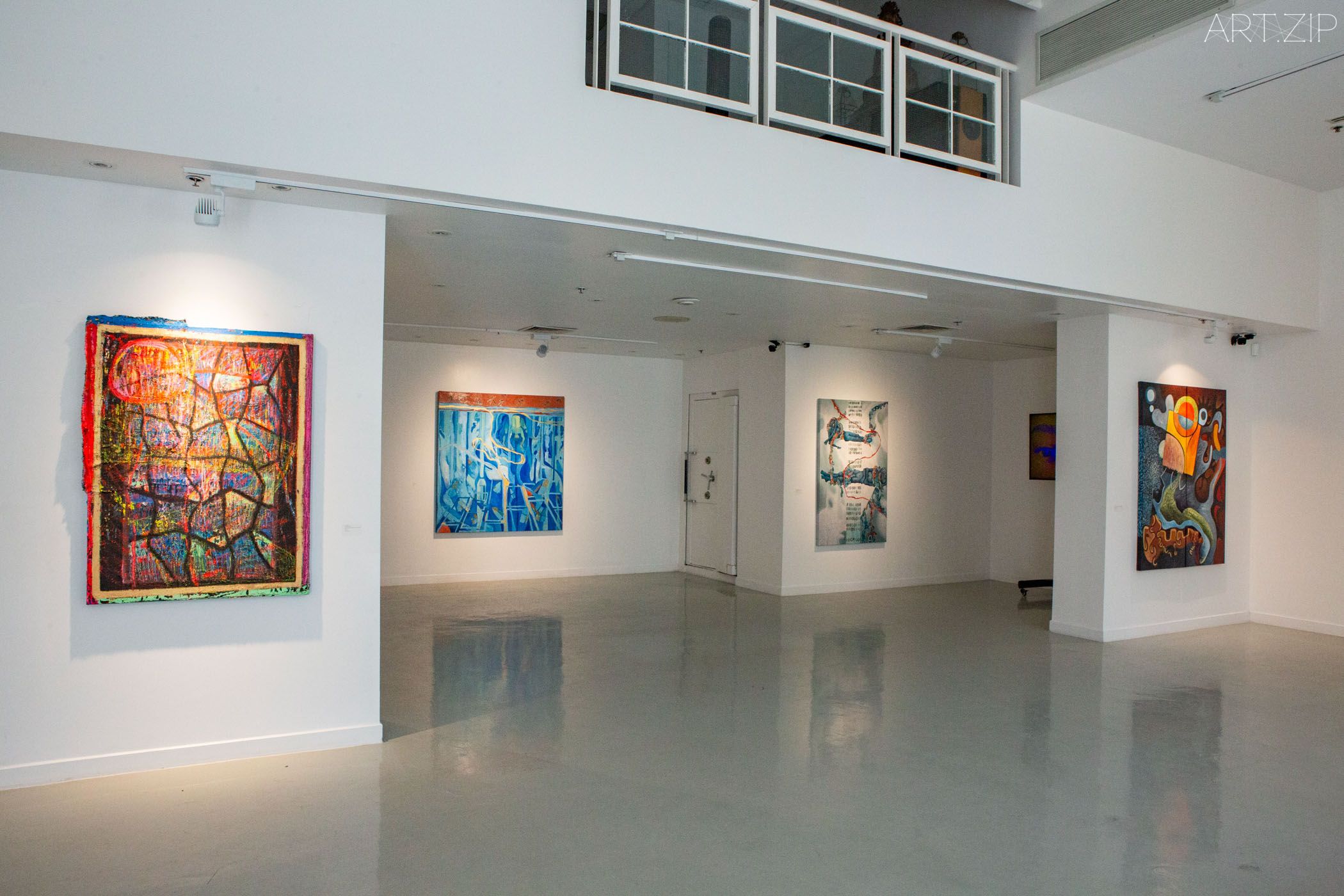
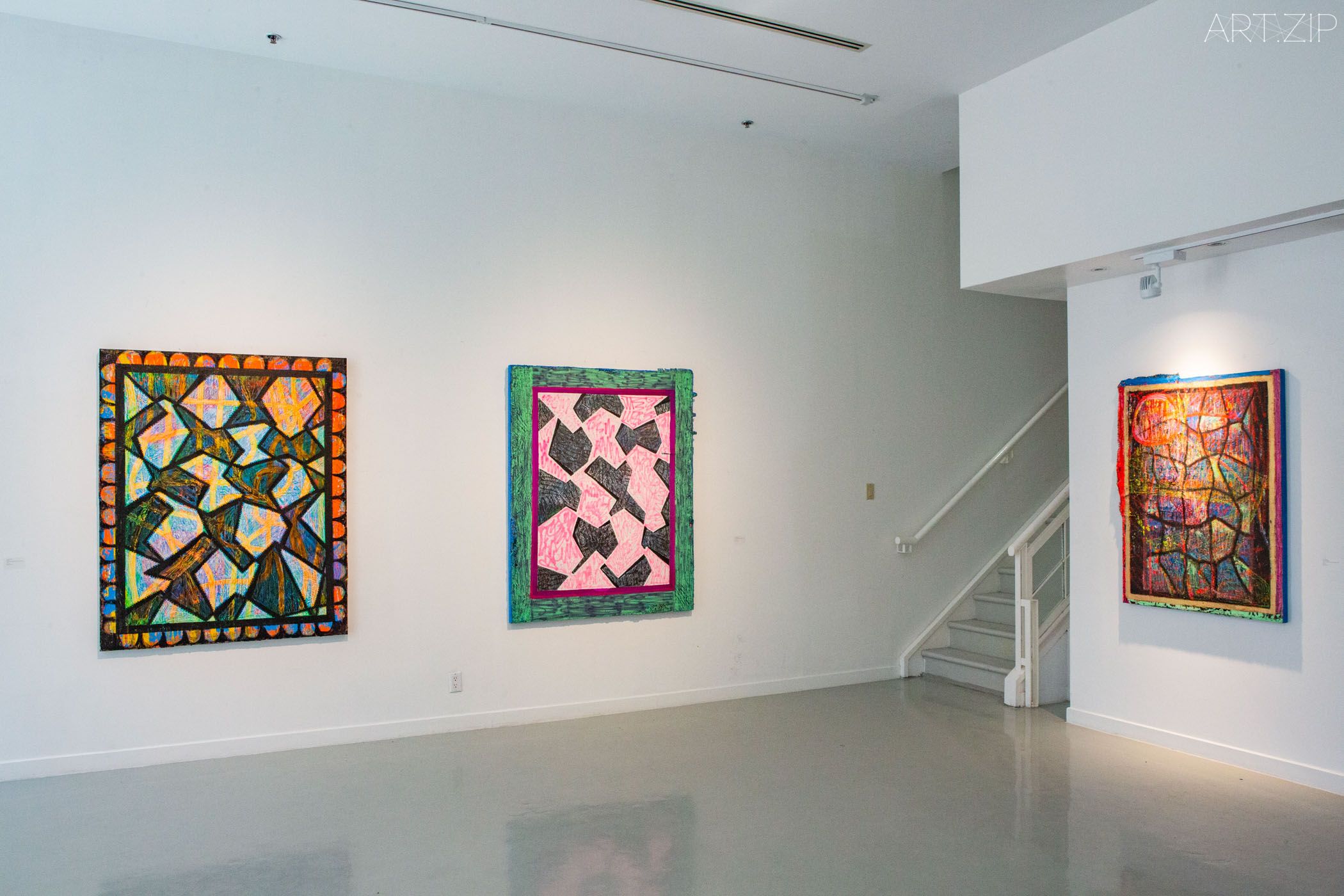
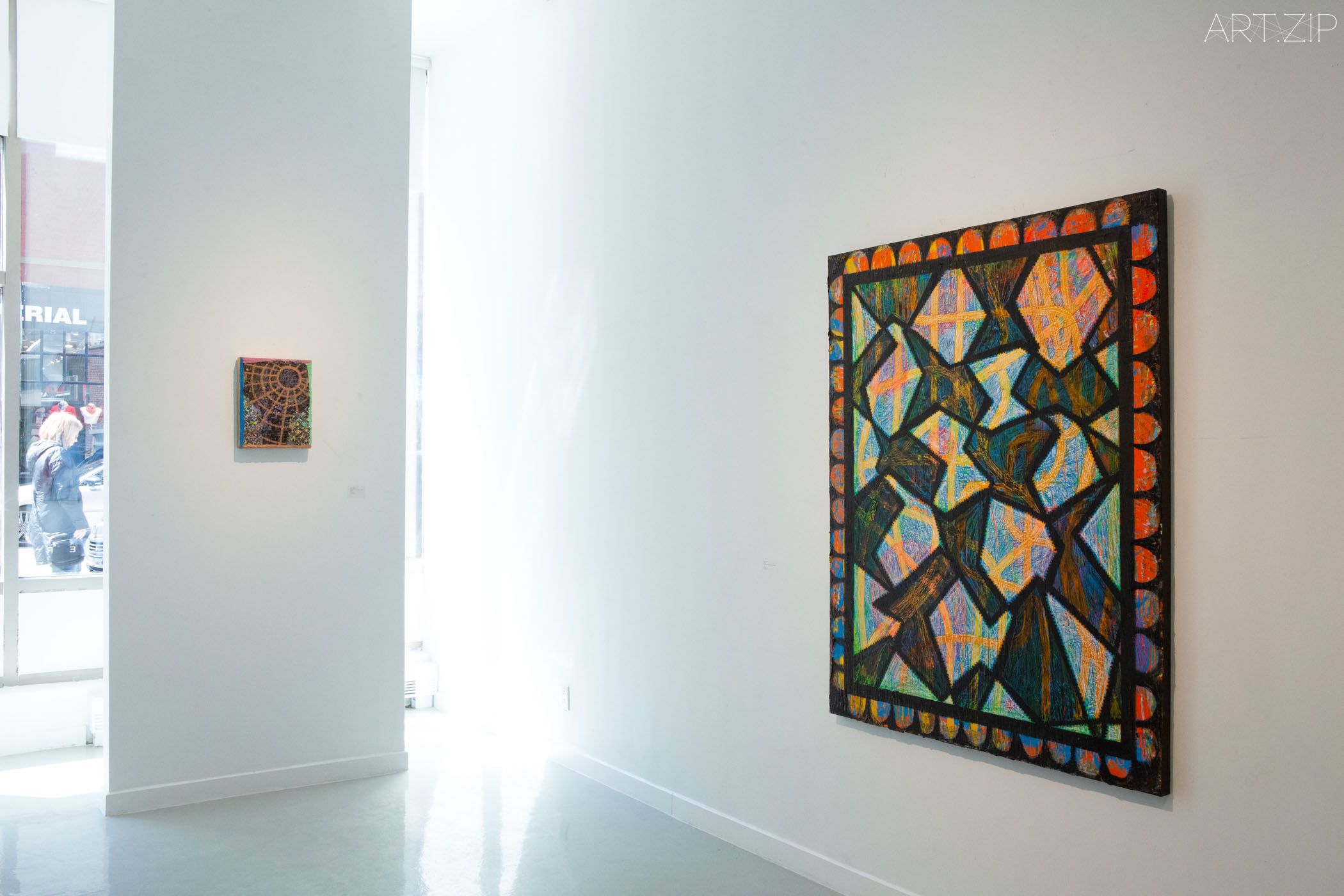
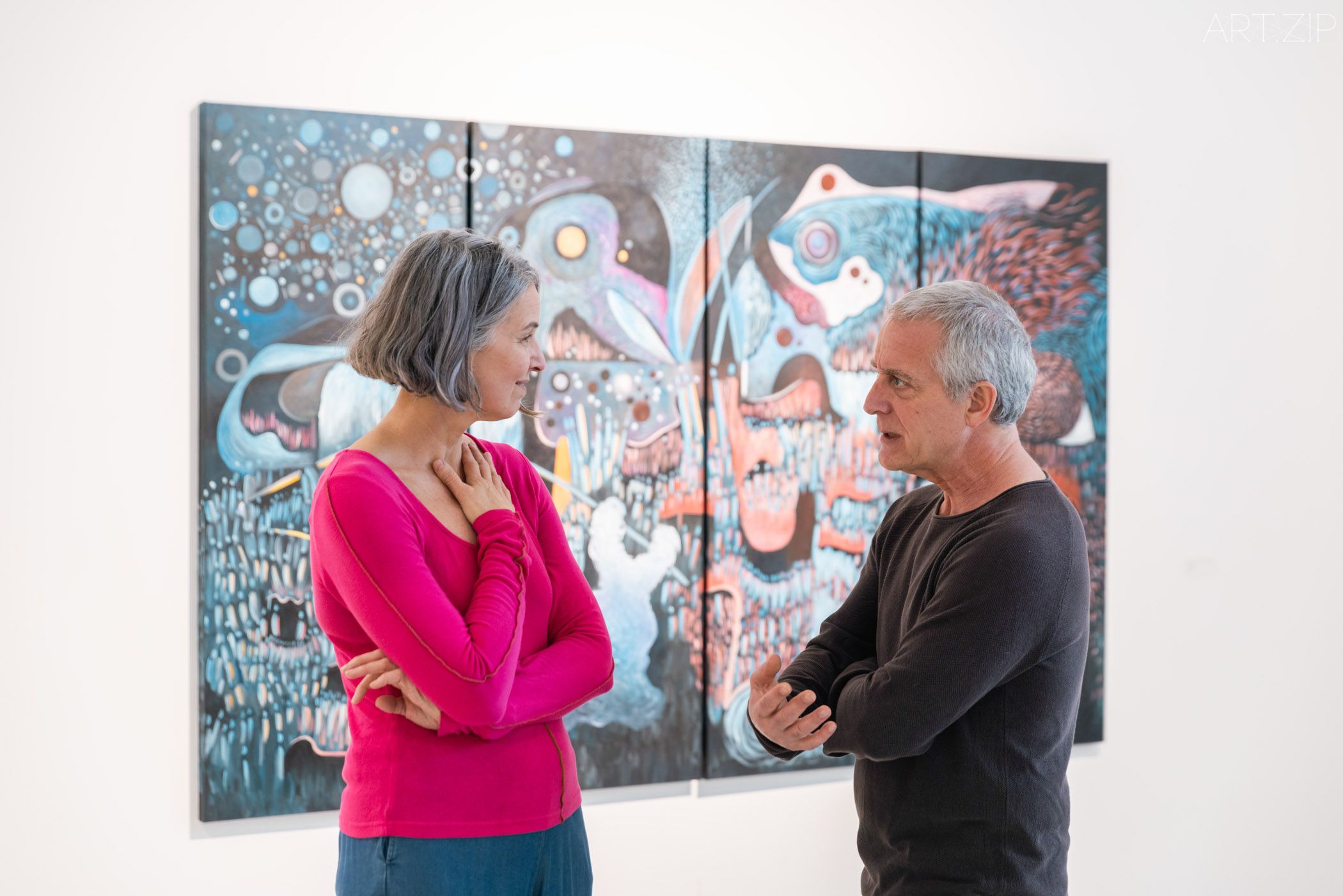
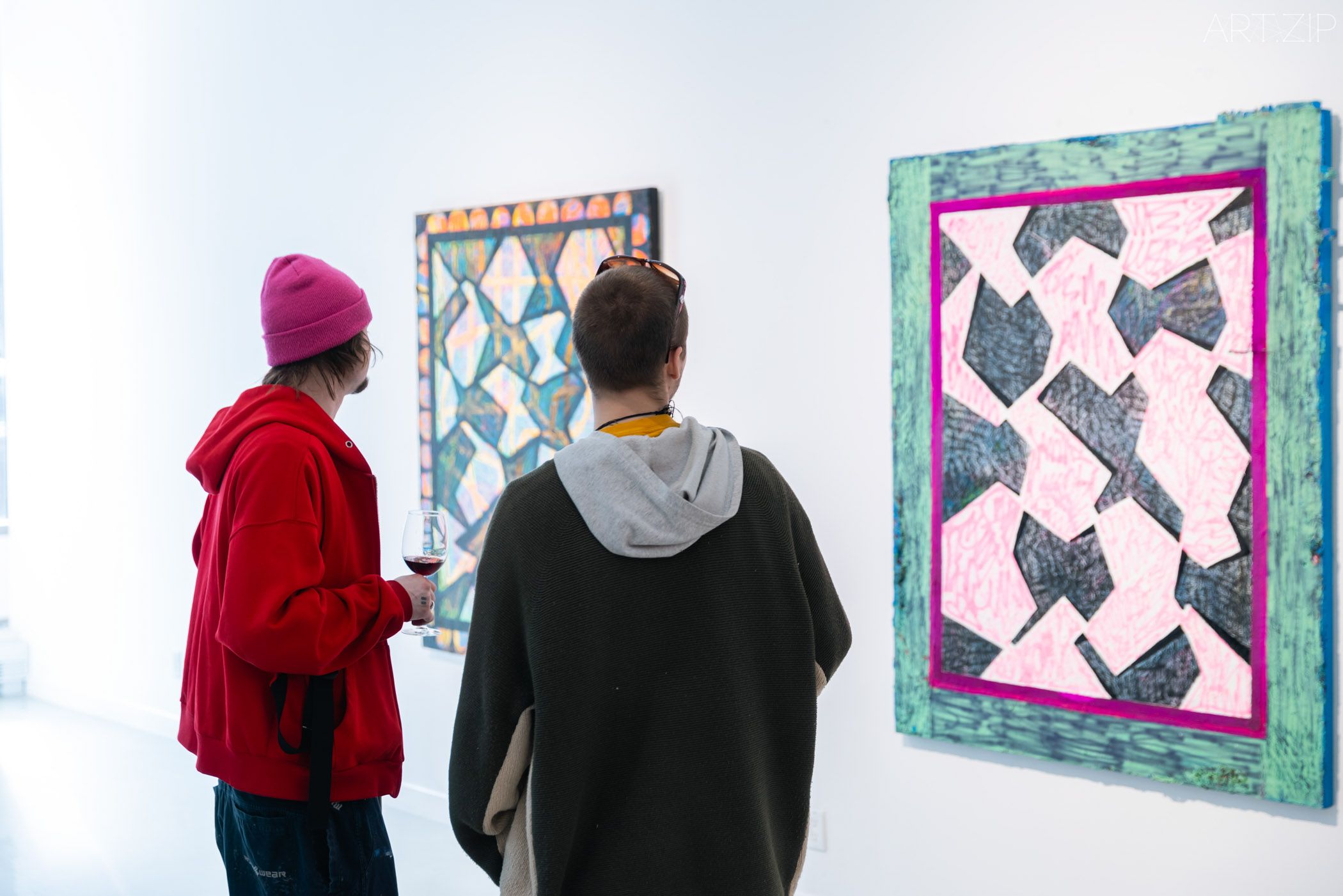
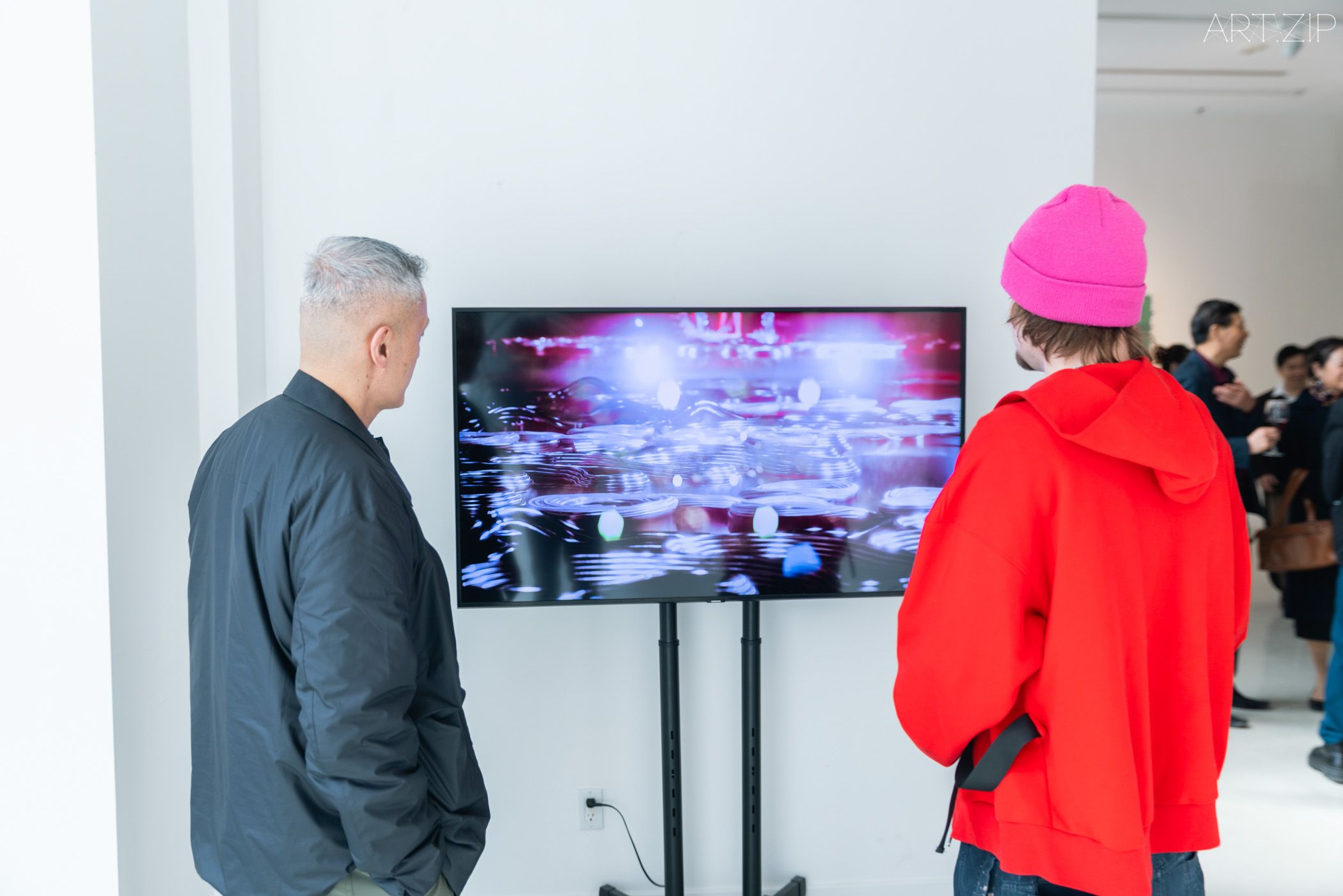
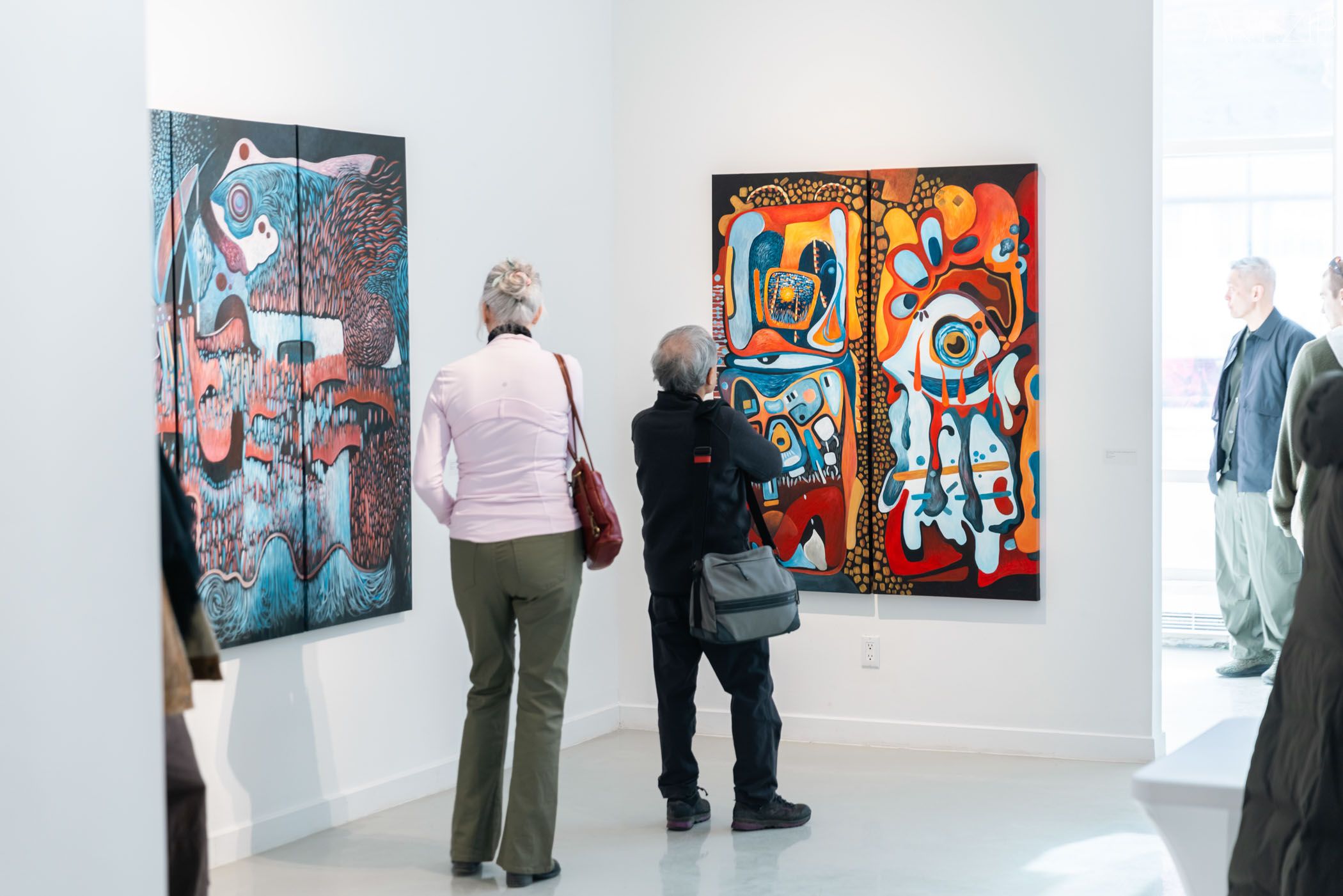
As one steps into Chupei Yu’s In Formation, a group exhibition at 1215 Gallery (Canada), one plunges into an atmosphere of movement and transition. The paintings have an ethical visual language and operate as part of a wider process of engenderment, which engages with complex issues of primal scenes and ancient epistemologies. Conversely, the moving image works with which they are paired propel the viewer from past to present, allowing for speculation about the future of humanity within techno-capitalism. Yu’s curatorial vision emerges as a pursuit of a continuously shifting rationale, in which the coexistence of analogue and digital media, contrasting yet complementary organic and graphic forms, earthy and fluorescent colours, and the tension between granular brushstrokes and the simulated tactility of screen-based art collectively articulate a condition of flux.
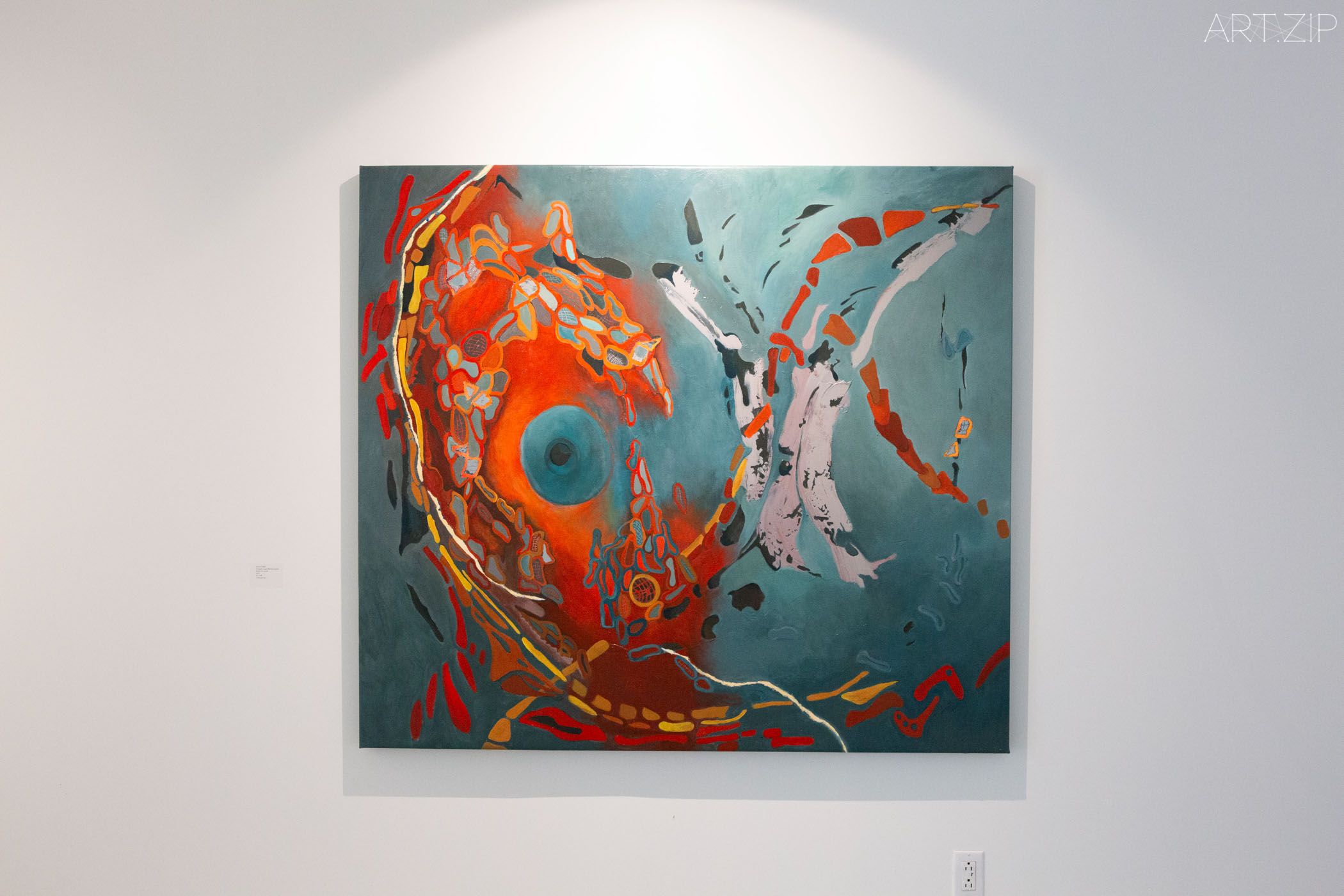
Jenny Ouellet, Marine Ballet, 2024, Acrylic on canvas, 145 × 170 cm.
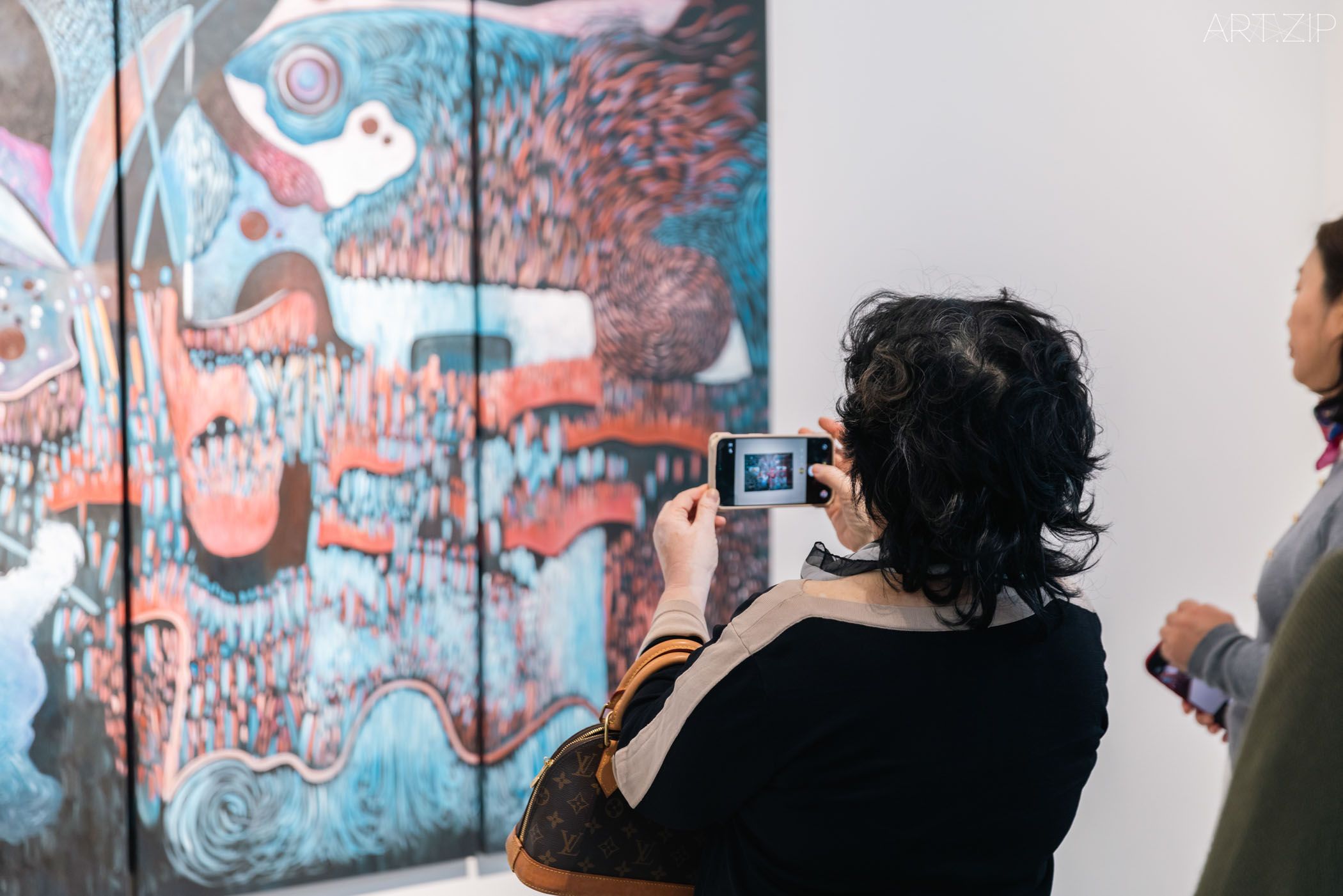
The intention here is that of pushing the viewer’s perception, requiring the full engagement of both the sensory apparatus and intuitive faculties in order to enrich the aesthetic experience. Cognition is therefore subjected to a tidal cycle of expansion and containment. For instance, when this framework invites reflection on the theme of the feminine, expansion allows the visual field of In Formation to register female bodies as biological forms reducible to microscopic structures; the iris of an eye depicted in moving image works recalls star-shaped cells. Yet, these same representations change meaning when reprocessed through containment and introspection, with body orifices becoming conduits to an inner-state dimension in which human vulnerability to the algorithm-based economy is exposed.
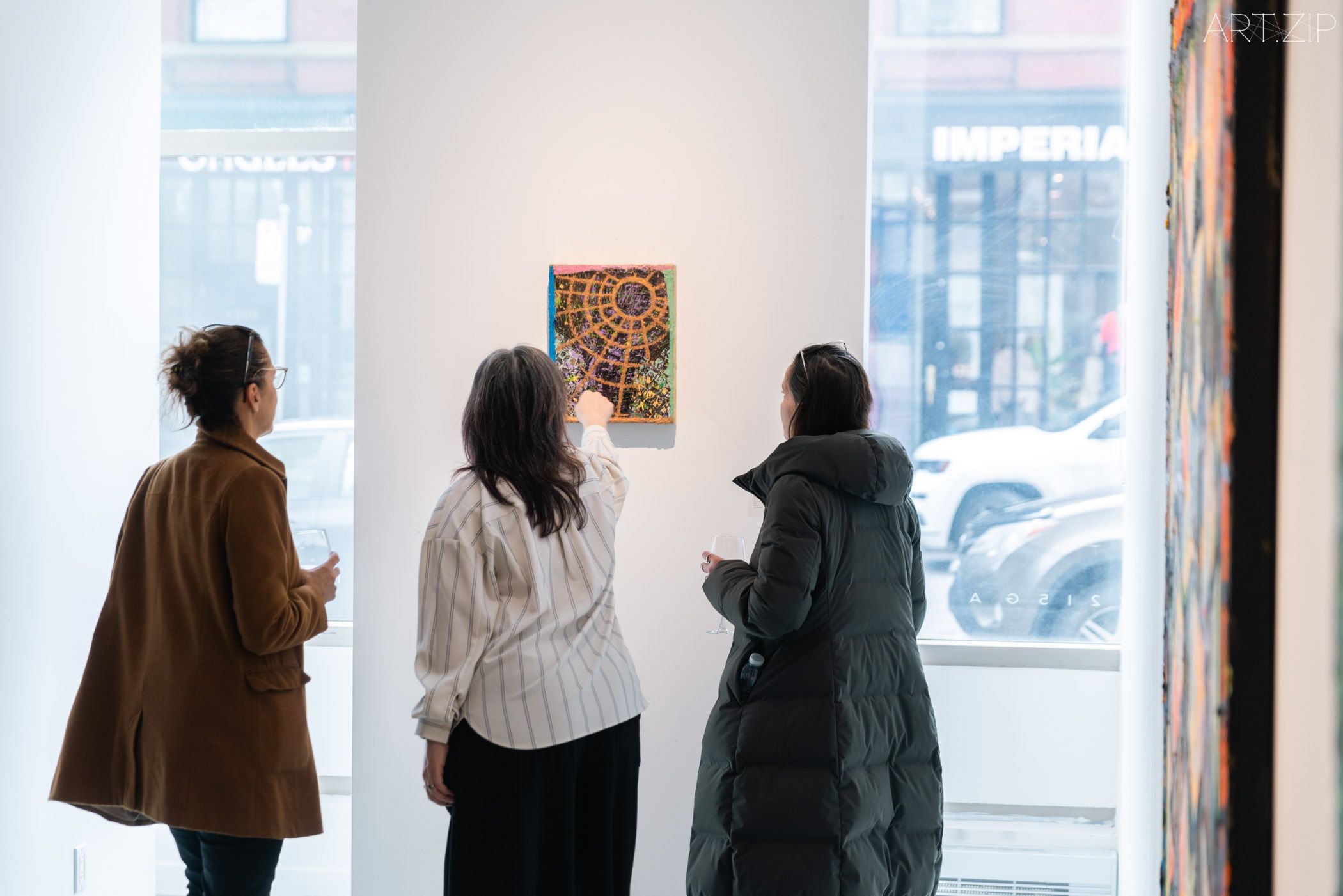
The journey is one grounded in outward spread and inward retreat, as the beholder’s attention engages with signification across the exhibition space. Once perceived, the same sign can bring to mind humanity’s lost contact with nature, as well as its endless and insidious capacity to reproduce stereotypes within virtual environments. Canvases which at first glance may be interpreted as rendering primitivism-inspired shapes may be read, under deeper analysis and after viewing the hyper-programmed visual pieces included in this exhibition, as populated by the spirit and agency of non-human beings. Similarly, after experiencing pictorial indictments of human/nature dualism and sensing the vigour with which traditional media may turn a piece of cloth into an animist landscape, digital art that functions as a critique of algorithmic information becomes more poignant.
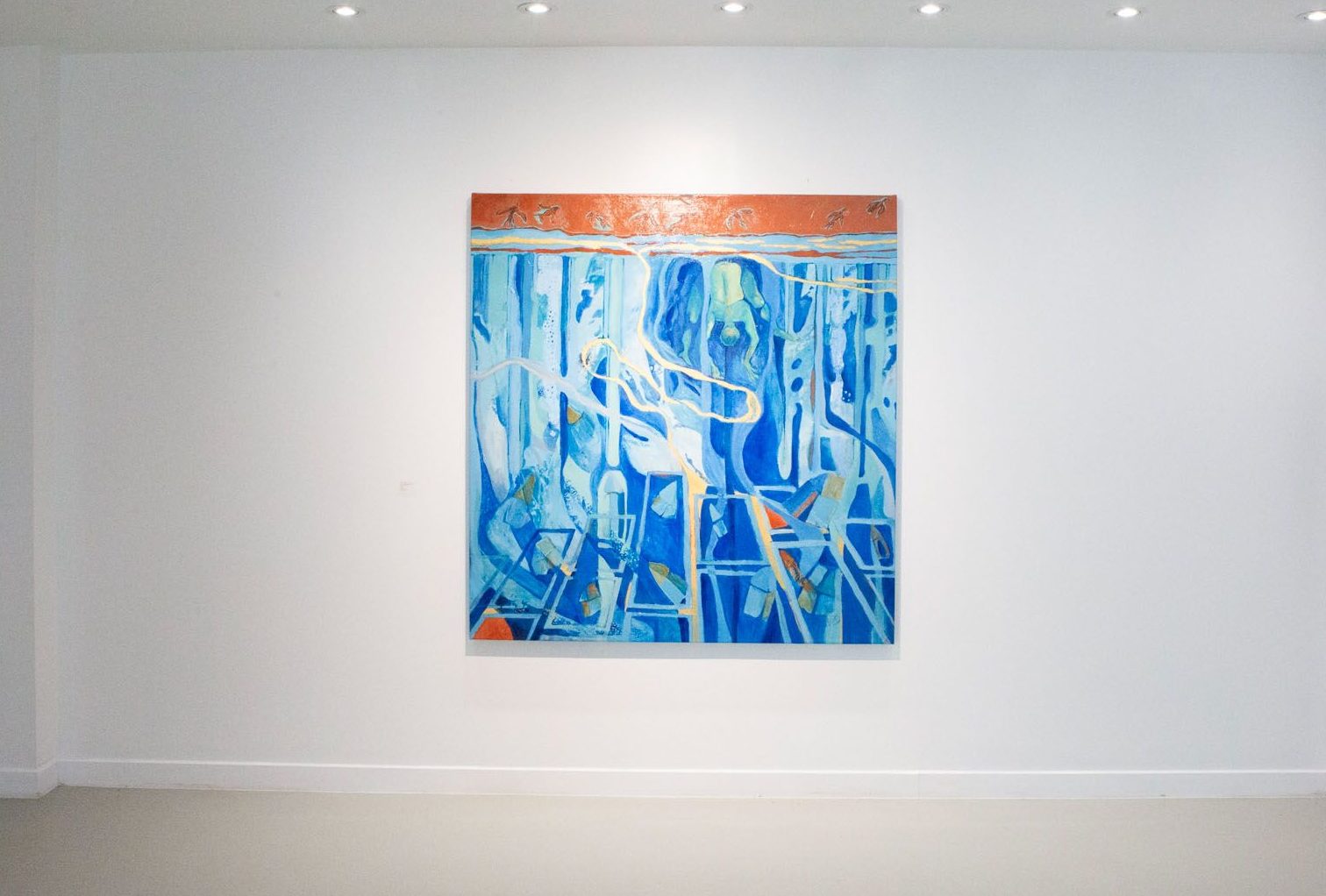
Jenny Ouellet, L’ouragan rouge (Red Hurricane), 2025, Acrylic on canvas, 132 × 147 cm.
Yu allows works that ask whether technology can be a faithful mirror of our subjectivity and human condition to generate responses precisely because they are juxtaposed with materially dense paintings. The answer is that the technological advancement generated by the human condition is a typhoon that is tearing our subjectivity apart, deconstructing and dispersing it through its lifting eyewall. What thereafter falls is no longer a reflection of our subjectivity, but a myriad of particles that we must patch together to the best of our ability in order to remain human. This is the sense of disruptive multiplicity that lingers with the viewer after stepping away from In Formation.
當你踏入于儲沛於1215 Gallery(加拿大)策劃的群展《In Formation》時,便會沉浸於一種流動與過渡的氛圍之中。這些繪畫擁有一種倫理性的視覺語言,並且作為一個更廣泛的生成過程的一部分,涉及原初場景與古老認識論的複雜議題。與此同時,與它們並置的動態影像作品則將觀者從過去推向現在,允許人們對技術資本主義中人類的未來進行推測。于儲沛的策展願景呈現為一種對持續變動之理據的追尋。在這個理據中,類比與數位媒體的共存、對比卻又互補的有機與幾何形式、大地色與螢光色,以及顆粒筆觸與基於螢幕的藝術所模擬的觸感之間的張力,共同形塑了一種流變的狀態。
此處的意圖在於推動觀者的感知,要求感官機制與直觀能力皆充分投入,以豐富審美經驗。因此,認知被置於一個擴張與收攝的潮汐循環之中。舉例而言,當這個框架邀請人們反思陰性主題時,擴張使得《In Formation》的視覺場域能夠將女性身體記錄為可被化約為微觀結構的生物形式;動態影像作品中所描繪的眼睛虹膜令人聯想到星形細胞。然而,當這些再現經過收攝與內省的重新處理後,其意義發生了轉變。身體的孔洞成為通往內在狀態維度的通道,在此維度中,人類面對基於演算法的經濟時的脆弱性被揭露出來。
這趟旅程植根於向外擴散與向內退返。觀者的注意力在整個展覽空間中與符旨進行交涉。一旦某個符號被感知,它既可以讓人想起人類與自然失去的聯繫,也可以讓人想起人類在虛擬環境中無窮且隱晦地複製刻板印象的能力。那些初看之下可能被解讀為呈現原始主義啟發之形狀的畫布,在更深入的分析以及觀看展覽中包含的高度程式化視覺作品之後,可以被理解為被非人存在物的靈魂與動能所充盈。同樣地,在經歷了對人與自然二元對立的圖像控訴,並感受到傳統媒材如何將一塊布料轉化為泛靈論的風景之後,那些作為對演算法資訊進行批判的數位藝術也變得更加深刻。
于儲沛讓那些追問技術能否忠實反映我們主體性與人類境況的作品,恰恰因為它們與物質性厚重的繪畫並置,而生發出回應。答案在於:由人類境況所催生的技術進步是一場颱風,它正在撕裂我們的主體性,通過其上升的眼壁將其解構並驅散。隨後落下的不再是我们主體性的鏡像,而是無數的微粒。我們必須盡己所能將這些微粒拼湊起來,以維持為人。這便是那種破壞性的複多性所帶來的感受,在觀者離開《In Formation》之後,依然縈繞不去。
Text by Kalinca Costa Söderlund
Published on 27th April 2026