
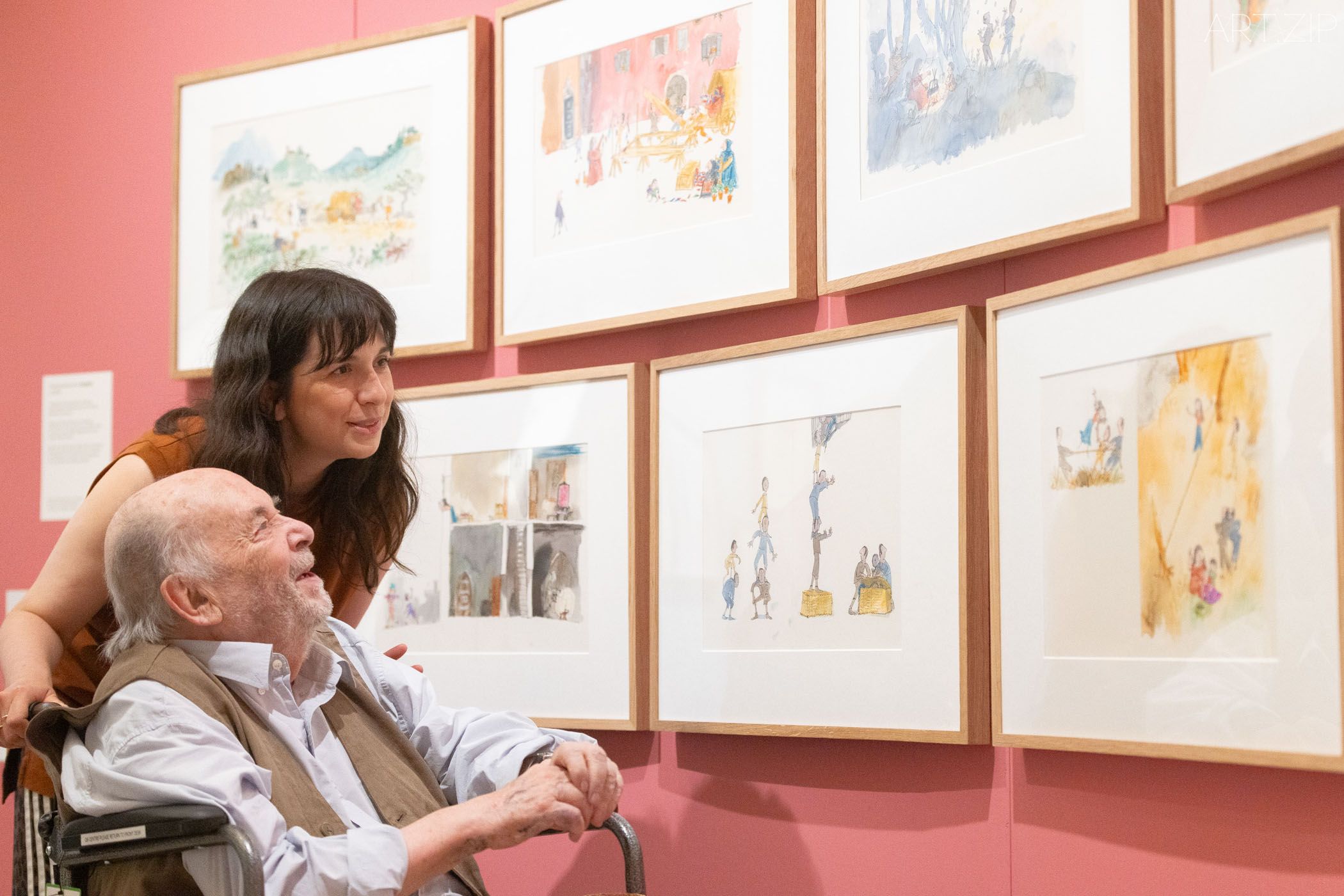
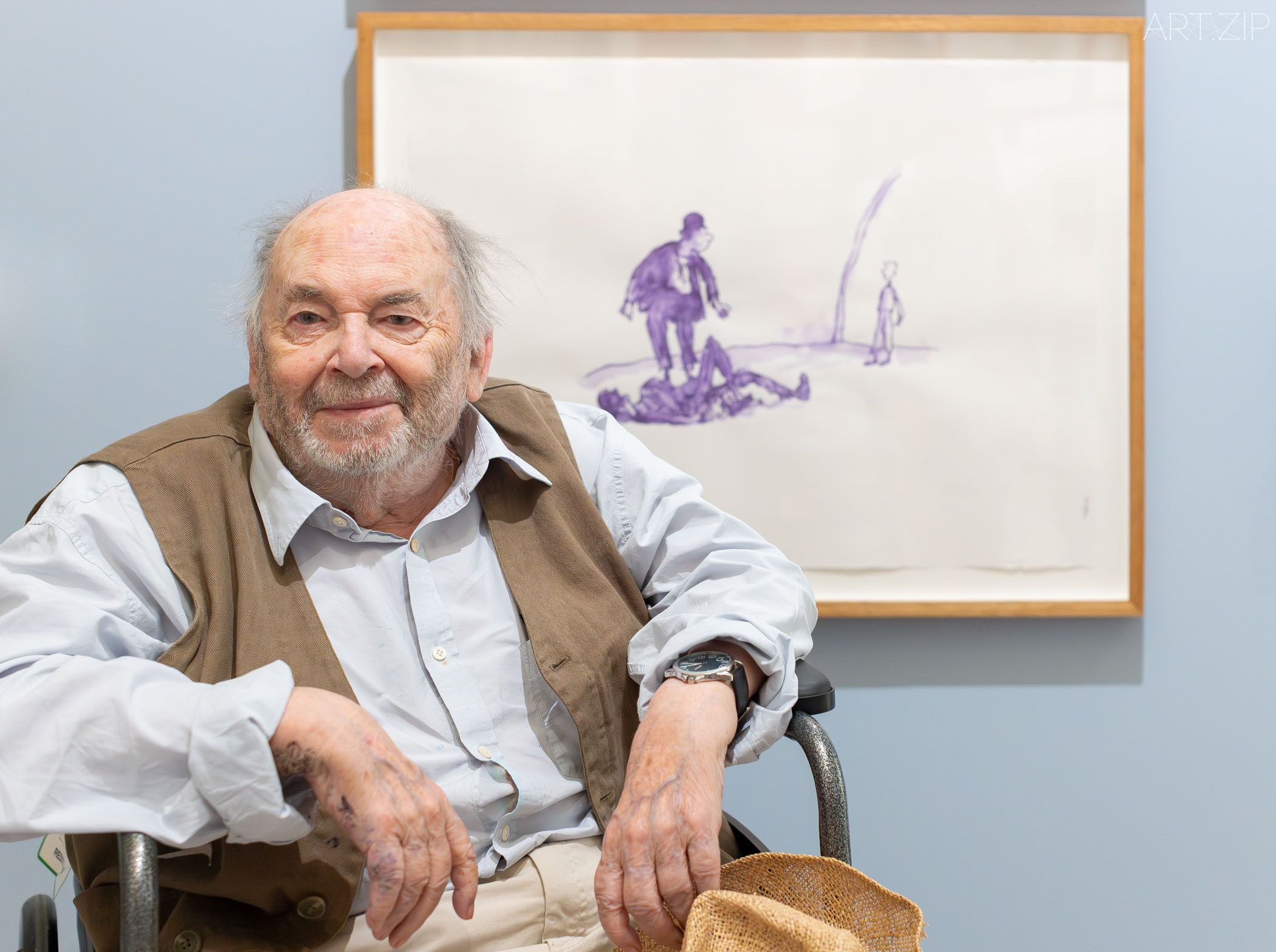
If you were to ask British children what they share as a common childhood memory, Quentin Blake’s line work would almost certainly be among the answers.
Those seemingly casual, light, almost hurried brushstrokes accompanied generations of British children as they grew up. From Charlie and the Chocolate Factory to Matilda, the wonderfully eccentric characters conjured by Roald Dahl found their definitive visual form through Blake’s illustrations. Now, at over ninety years old, this beloved illustrator finally has an arts centre bearing his name.
On 5 June 2026, the Quentin Blake Centre for Illustration officially opened in Clerkenwell, London. It is not only the UK’s first permanent centre dedicated to illustration, but also the largest public illustration space in the world. Its predecessor was the House of Illustration near King’s Cross; the new home, however, occupies a site with over four hundred years of history — a former waterworks.
From Waterworks to Illustration Centre
What makes this place remarkable is that it was never meant for art.
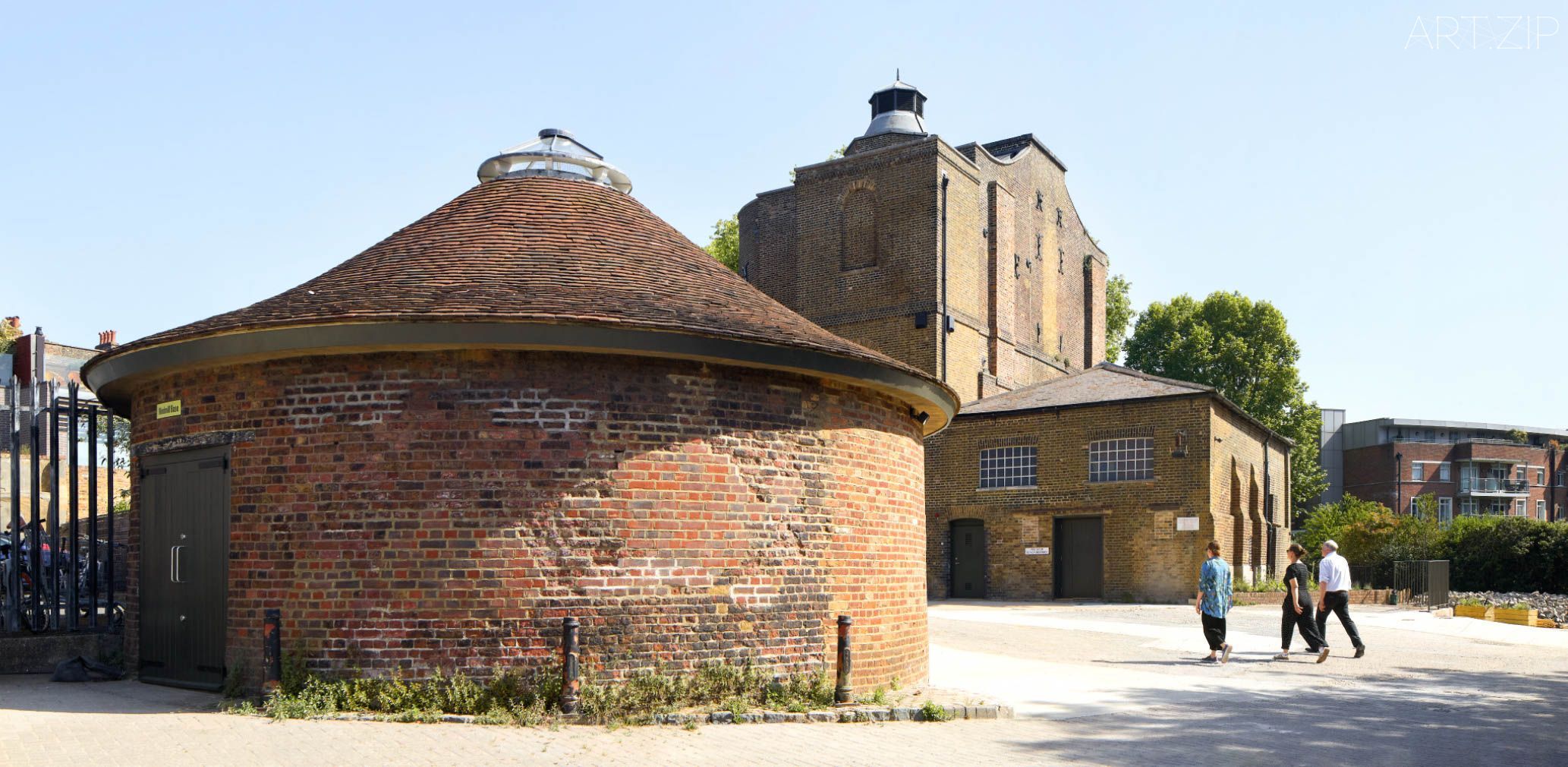
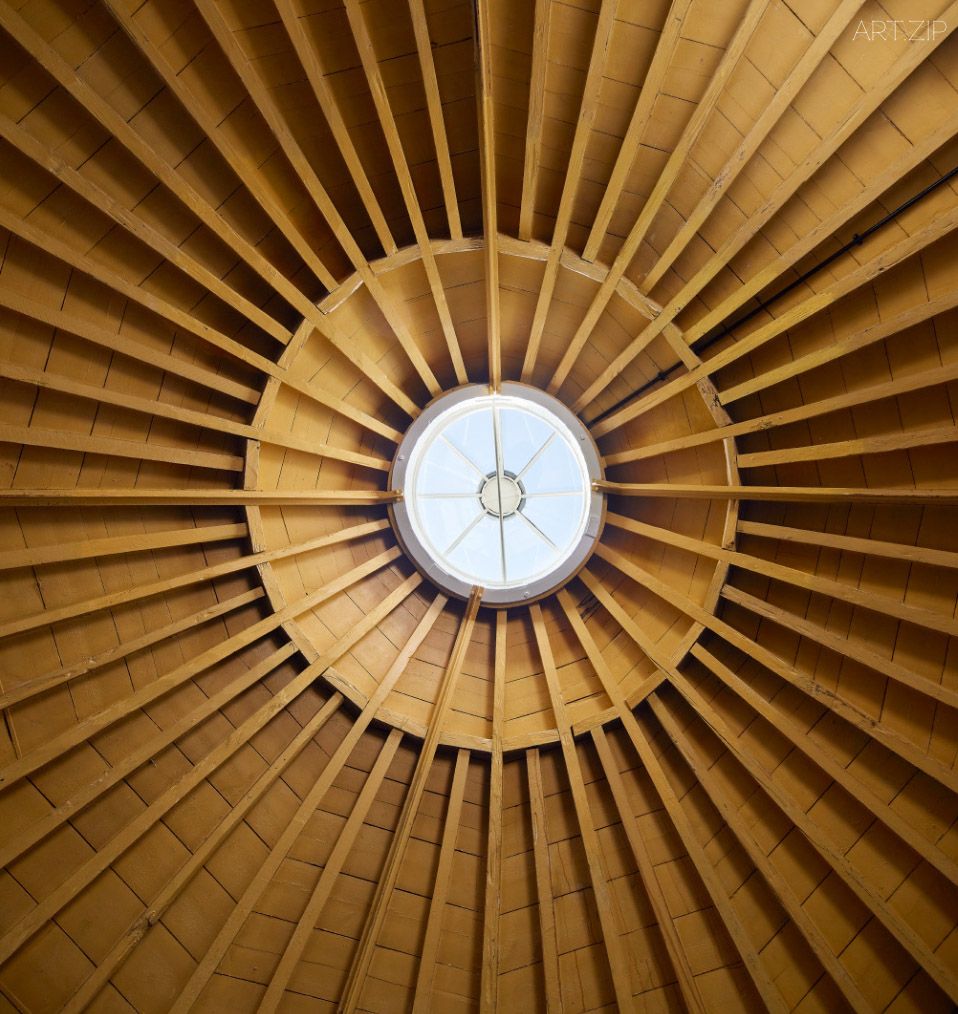
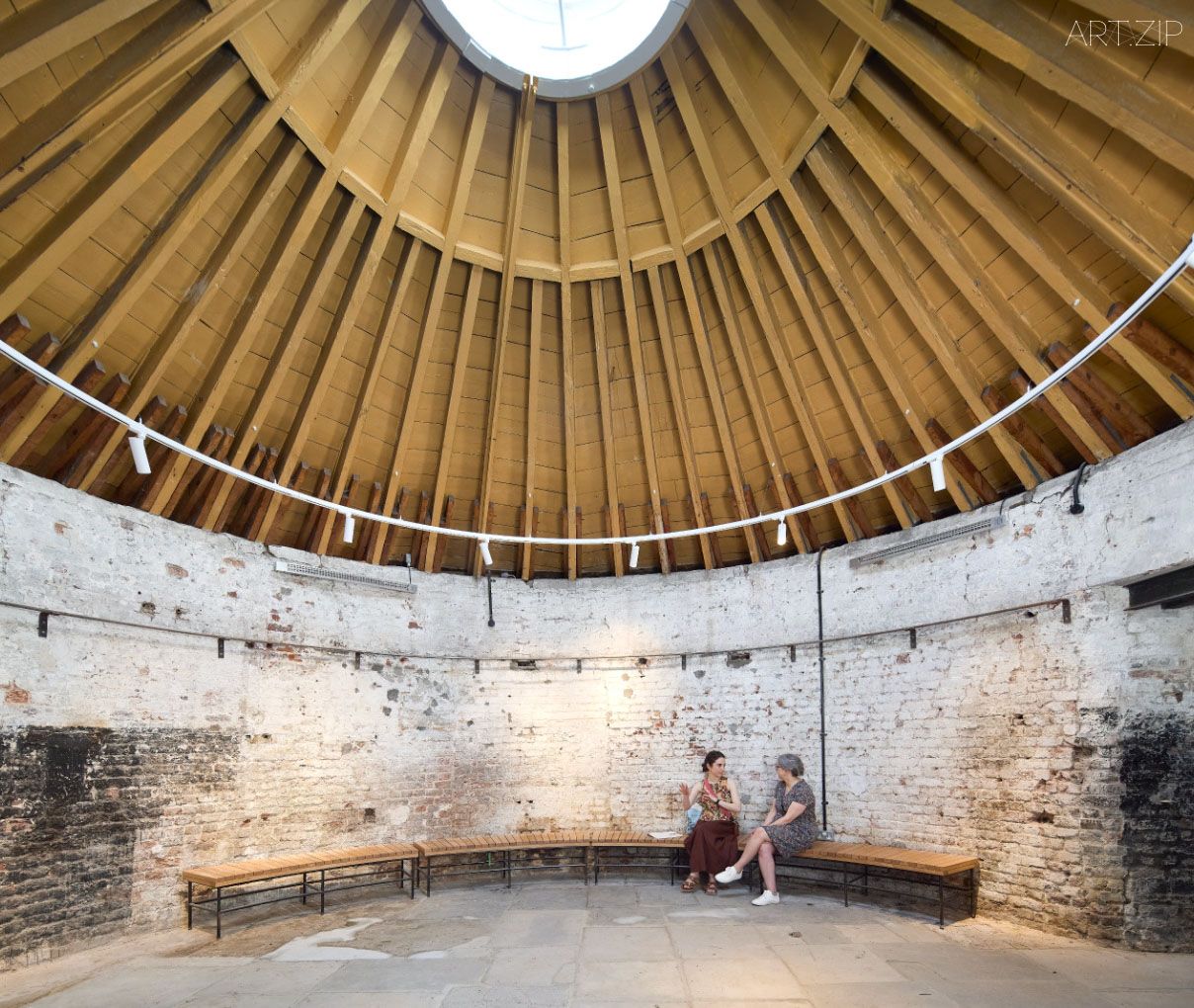
In the early seventeenth century, to address London’s water supply crisis, engineers constructed the New River, channelling water from Hertfordshire into the city. The site became part of the New River Head waterworks infrastructure. Engine houses, coal stores, the base of a windmill, and industrial buildings accumulated across different eras — together they form the layered history of this place.
Tim Ronalds Architects has now carefully restored these long-abandoned structures, preserving their original fabric wherever possible. Exposed brickwork, industrial details from another age, and the spatial traces of successive centuries have all been kept intact. Illustration has not displaced the history here — it coexists with it. Walking through the grounds, one feels a continuous sense of time folding over itself: the city’s ancient infrastructure on one side, the most vital contemporary visual practice on the other.
A Library for Reading
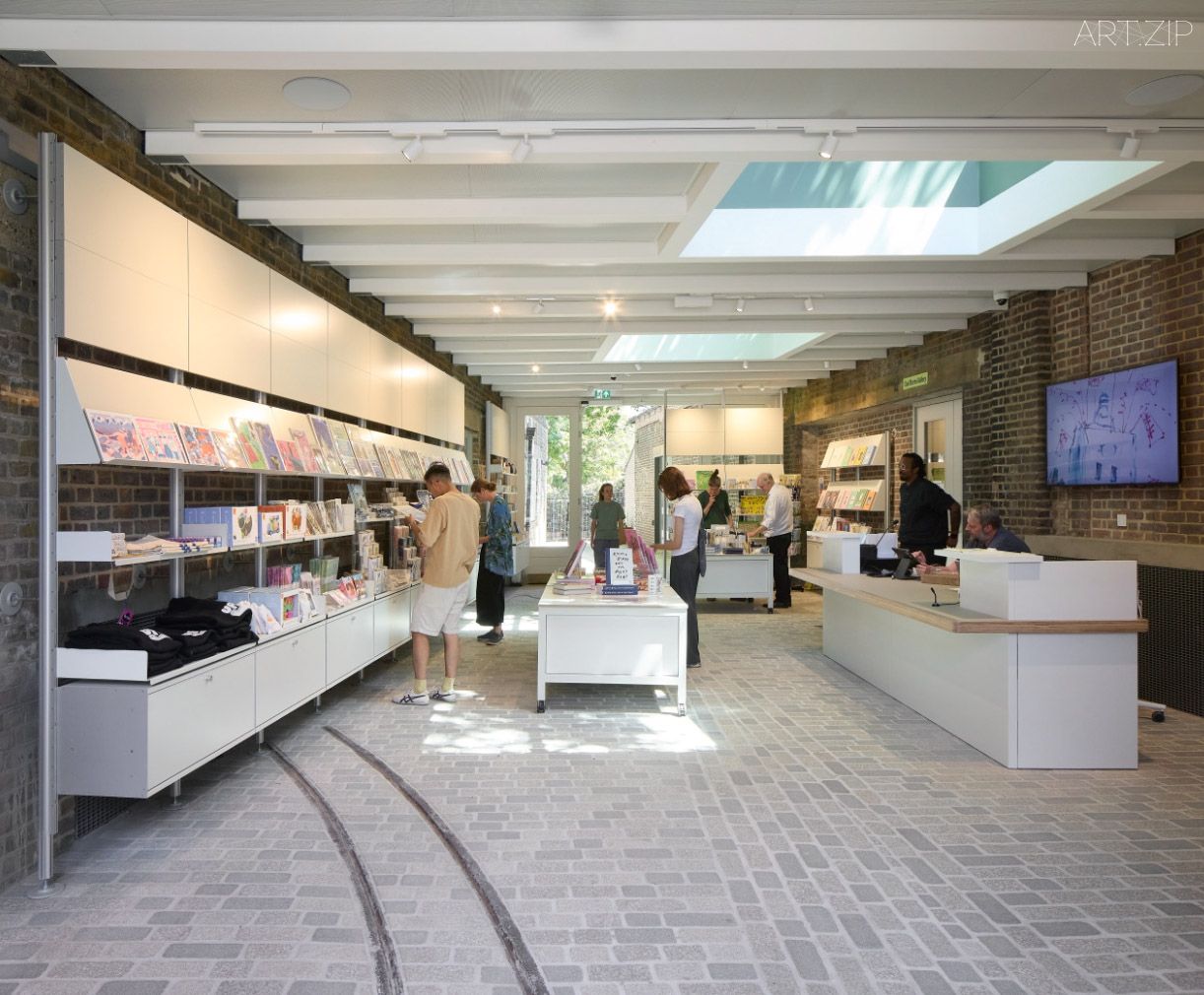
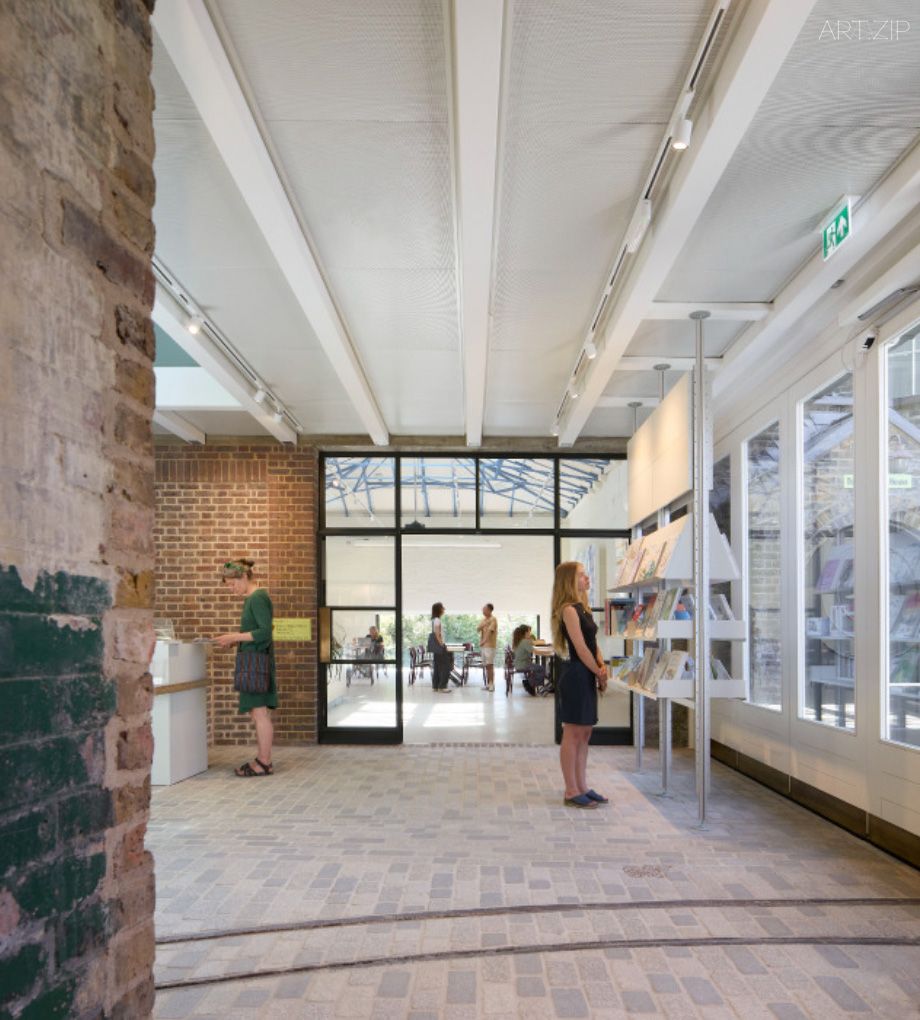
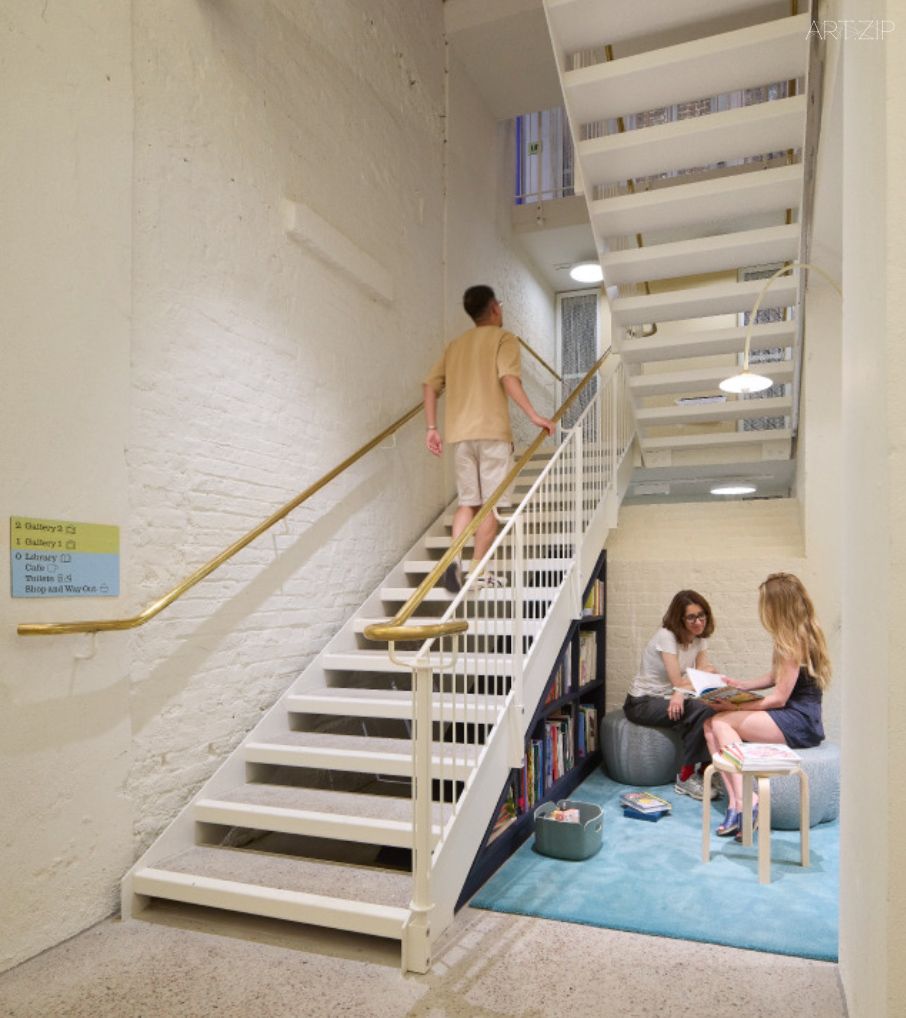
Inside the centre, it is the library on the ground floor that draws you in first.
This is the UK’s first illustration library open freely to the public. Books cannot be borrowed, but they can be read at leisure. Picture books, comics, graphic novels, and art publications are arranged quietly on the shelves. Sitting down to browse, you realise the space feels less like a conventional library and more like a place simply made for reading.
The long list of donor acknowledgements gives some sense of how rich the collection is. Flying Eye Books, Walker Books, Magic Cat Publishing, Thames & Hudson, Penguin Random House, Faber, Bloomsbury — the names read like a map of contemporary British picture book and illustration publishing.
The most interesting thing about a library is not what it holds, but what it has chosen to hold.
Murugiah’s Digital Dreamscape
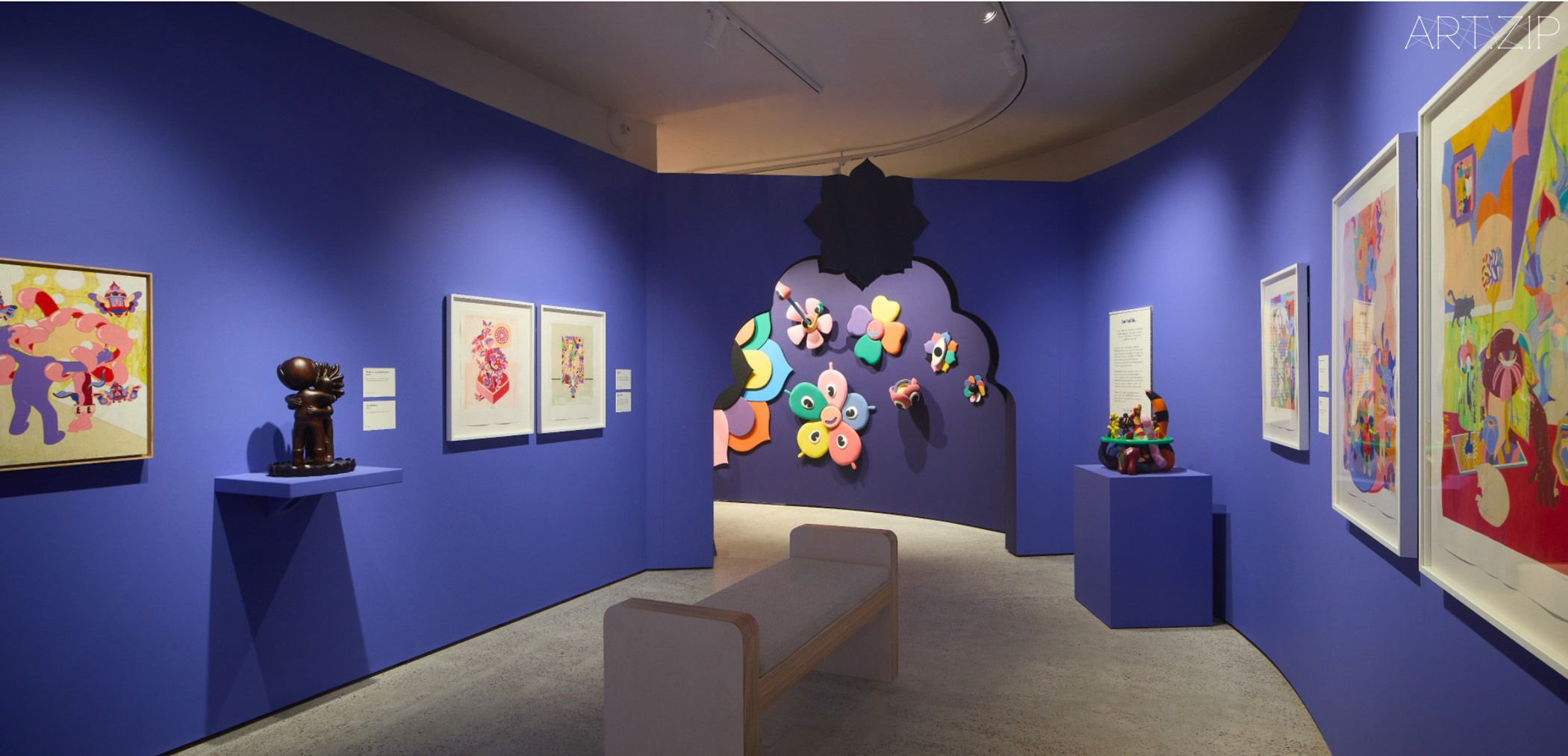
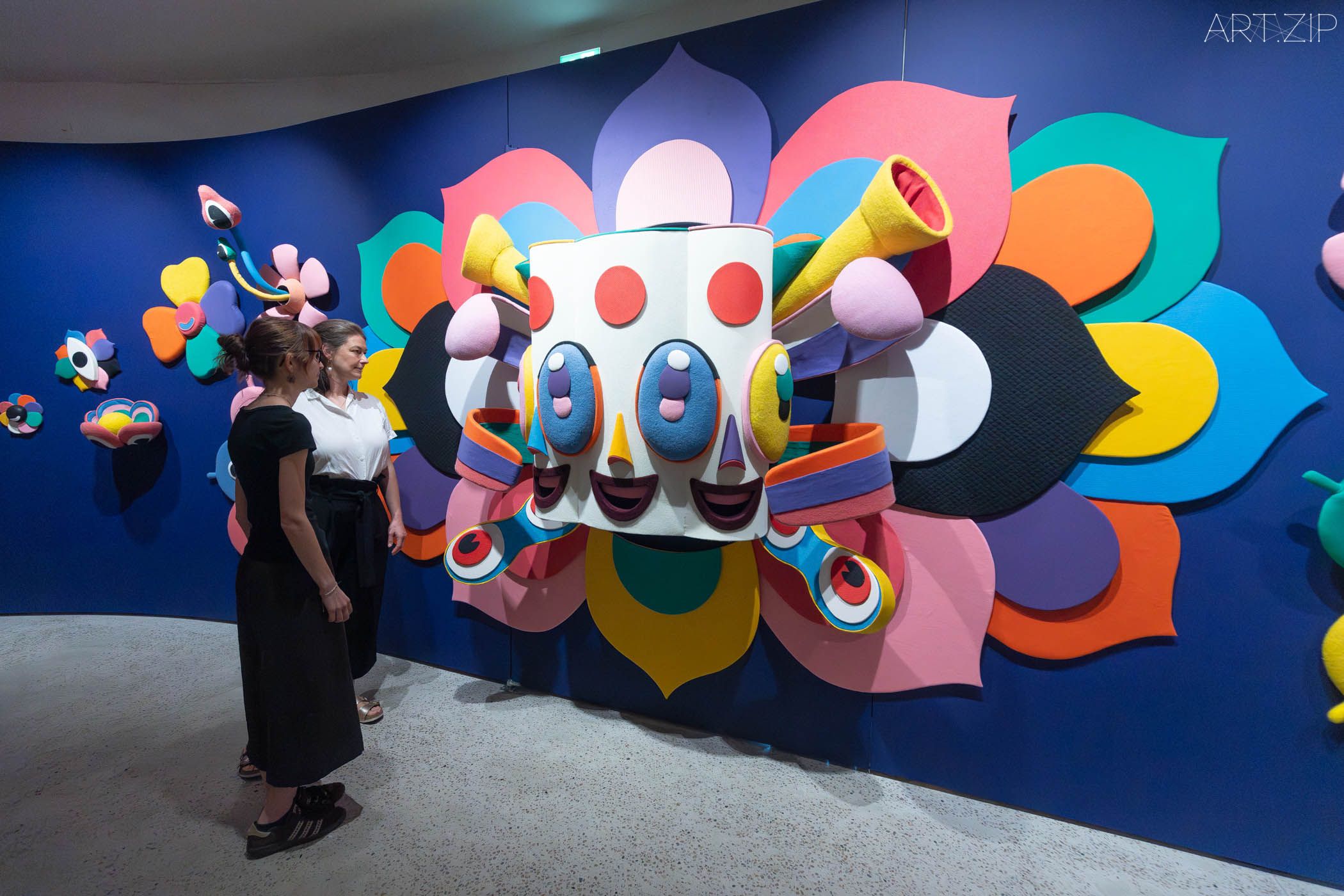
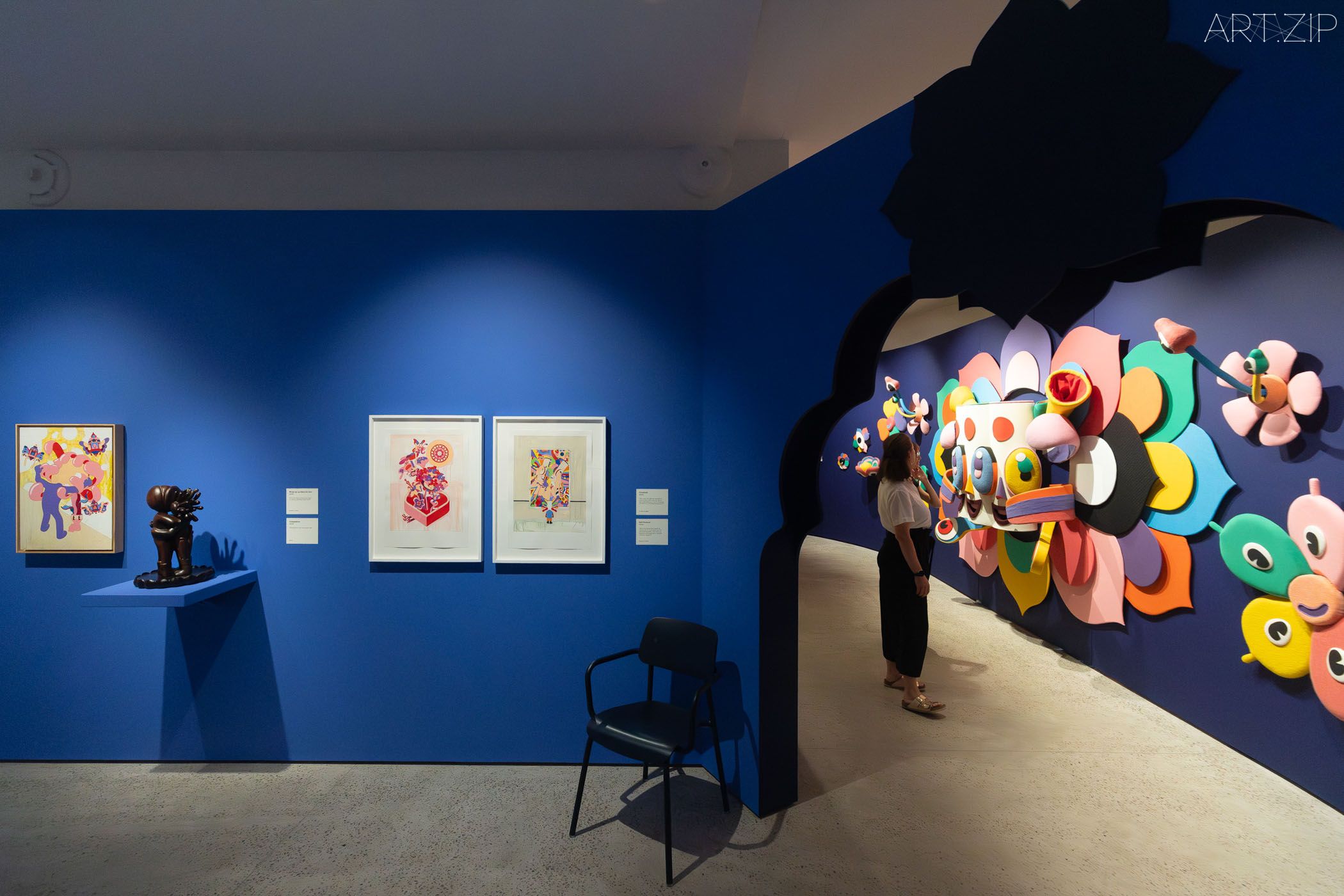
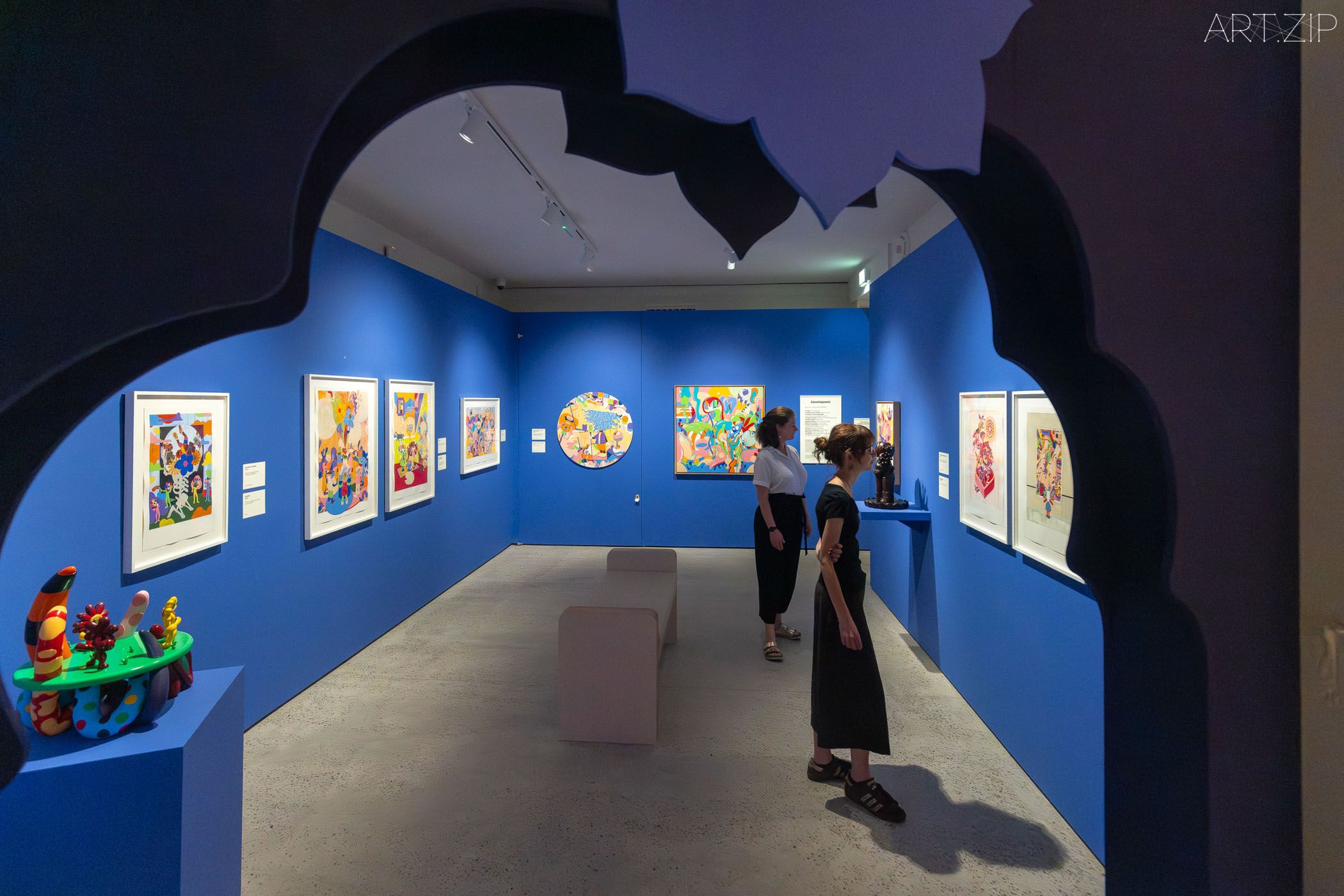
The second floor belongs to British-Sri Lankan artist Murugiah, whose solo exhibition Ever Feel Like… fills the space.
Where Blake is light and loose, Murugiah’s world pulses with saturated colour and visual intensity. Large-scale wall works consume the entire space; visitors feel as though they have stepped inside an endlessly expanding digital dream.
His path to illustration is a familiar one in many Asian households: he trained first in architecture before gradually moving towards illustration and visual art. The sustained creative output he produced during the pandemic years allowed his personal style to mature, and he has since become one of the most talked-about emerging illustrators in Britain.
The exhibition touches on identity, mental health, and the experience of growing up — yet it never feels heavy. On the contrary, those colours, vivid almost to the point of luminescence, make these complex subjects surprisingly accessible.
Here, illustration is not merely image-making. It is a language for emotion and self-understanding.
Quentin Blake’s Studio in Public
The top floor is where you finally enter Blake’s own world.
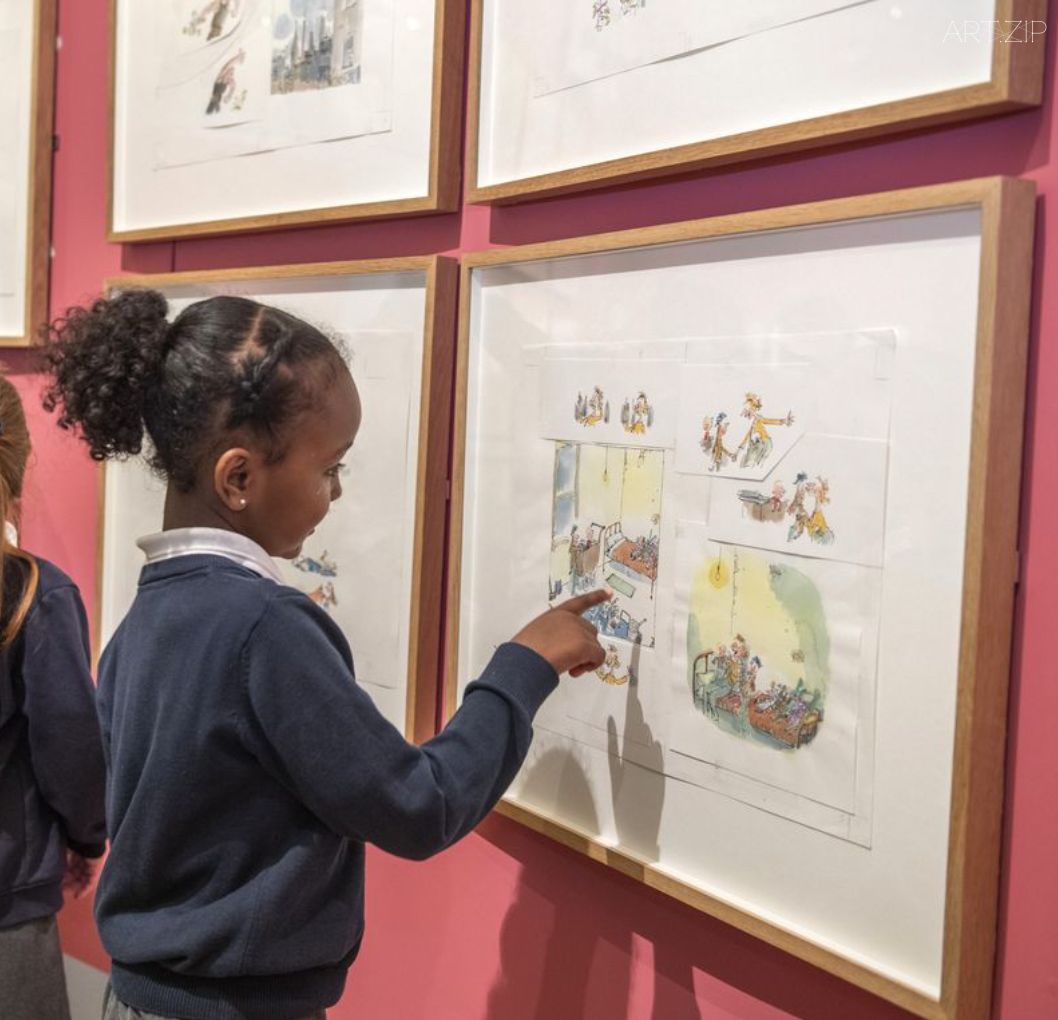
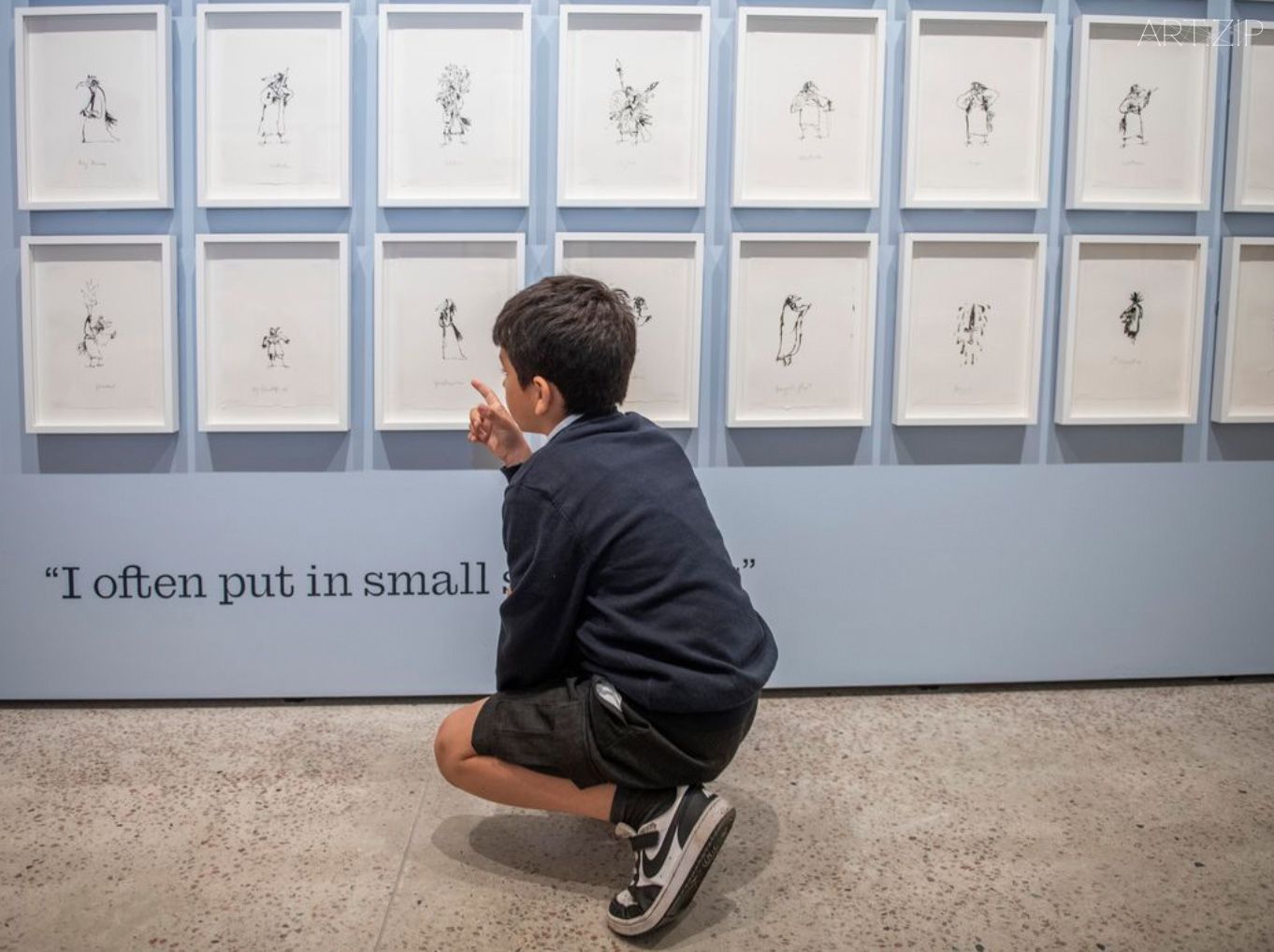
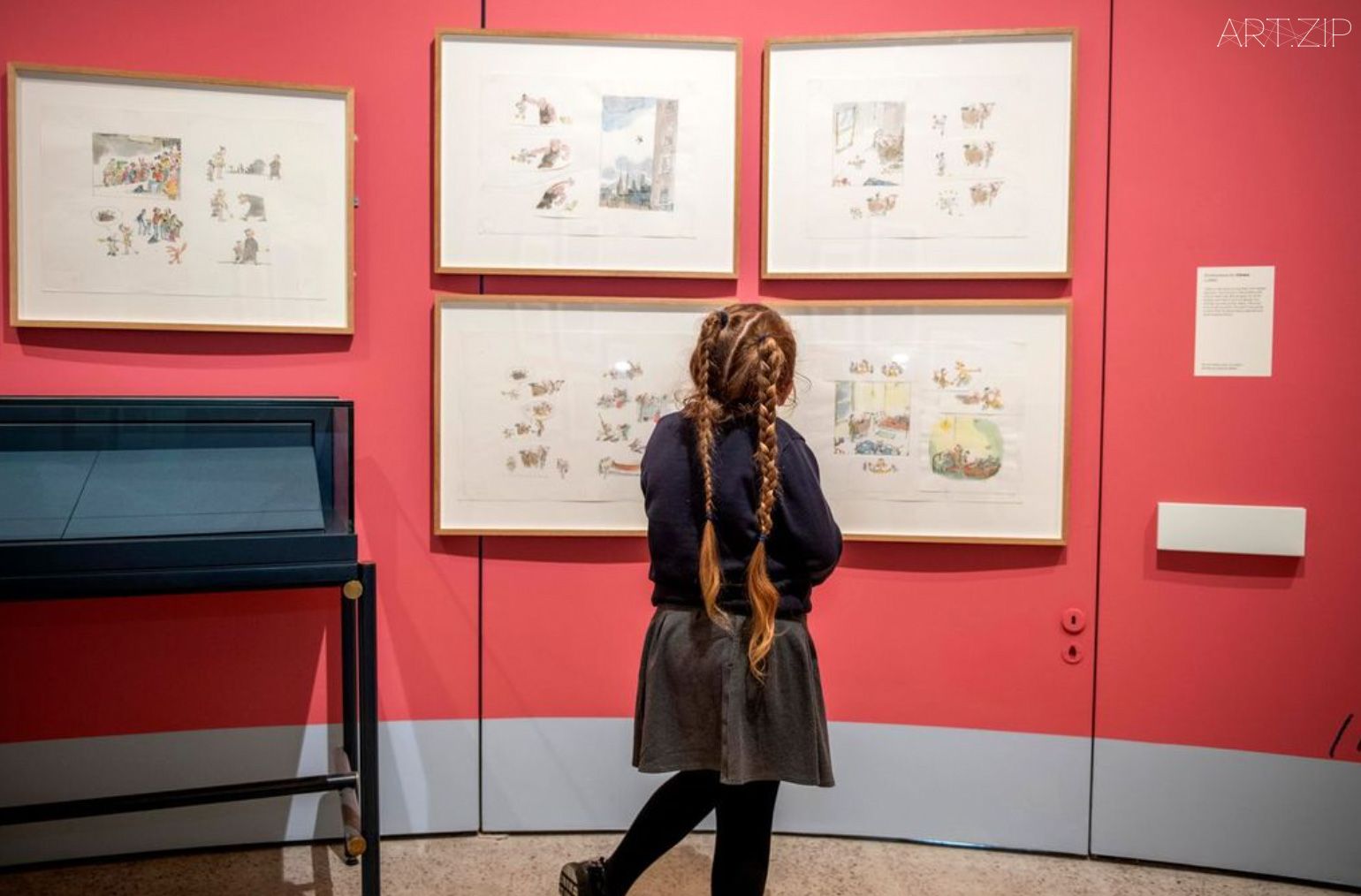
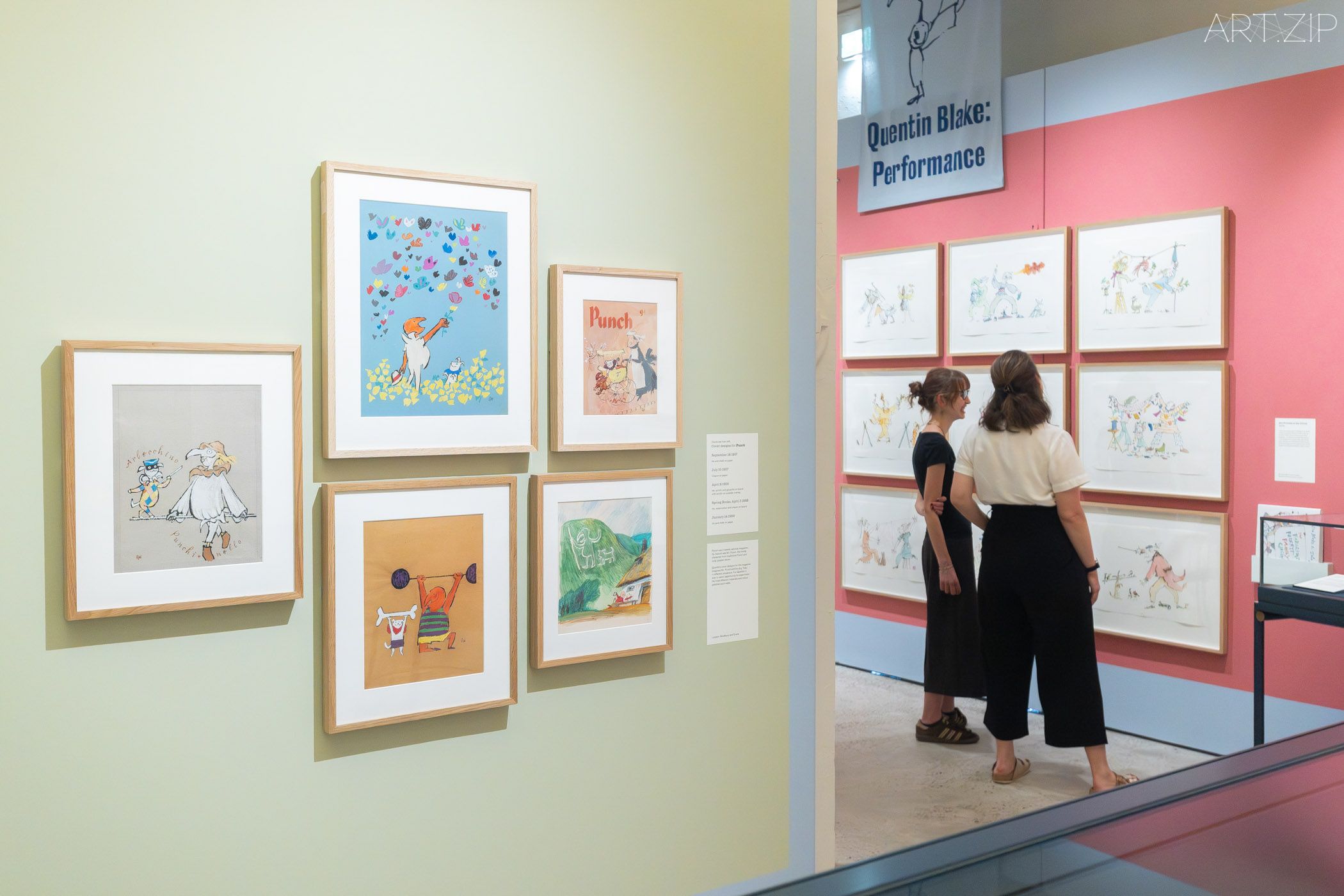
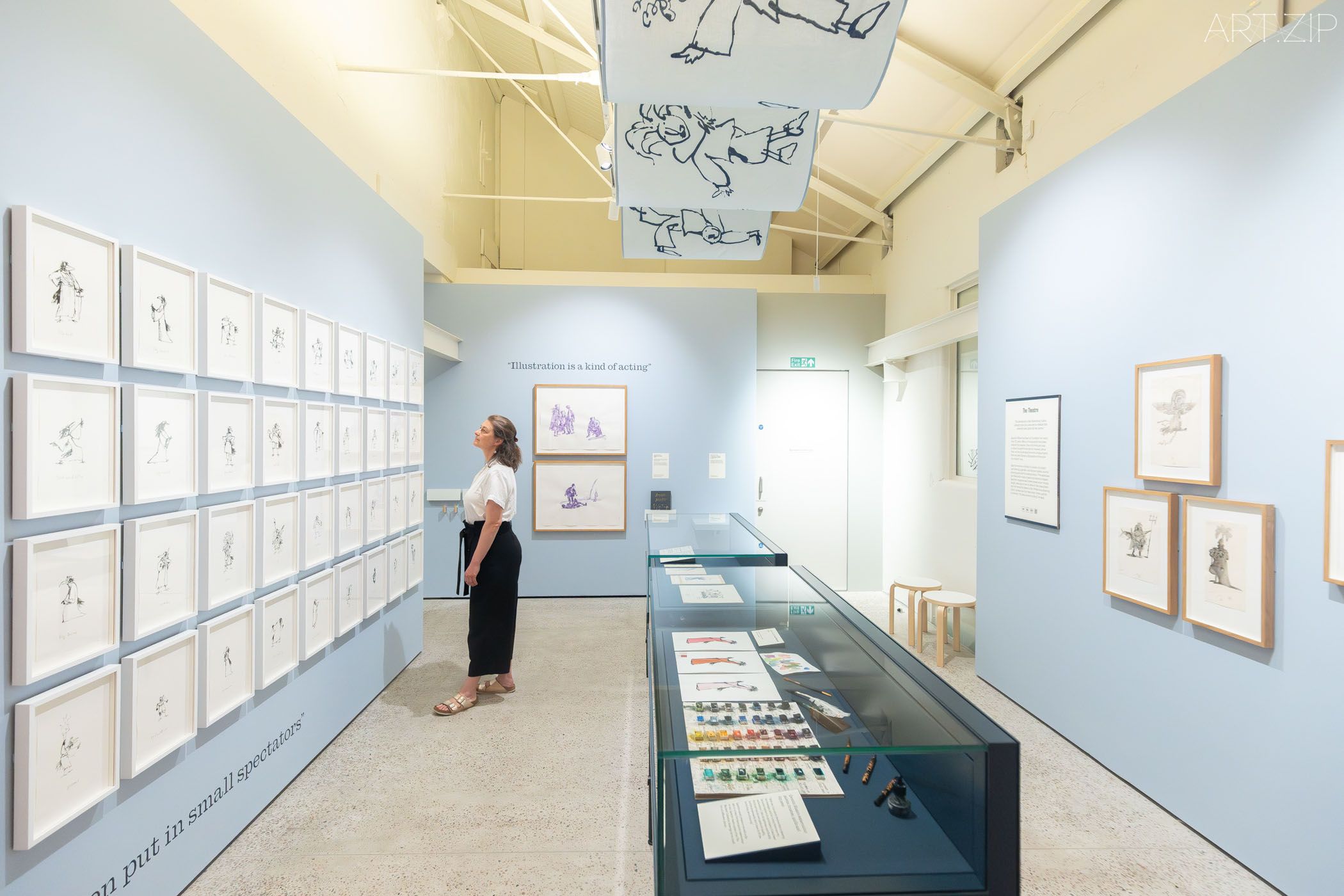
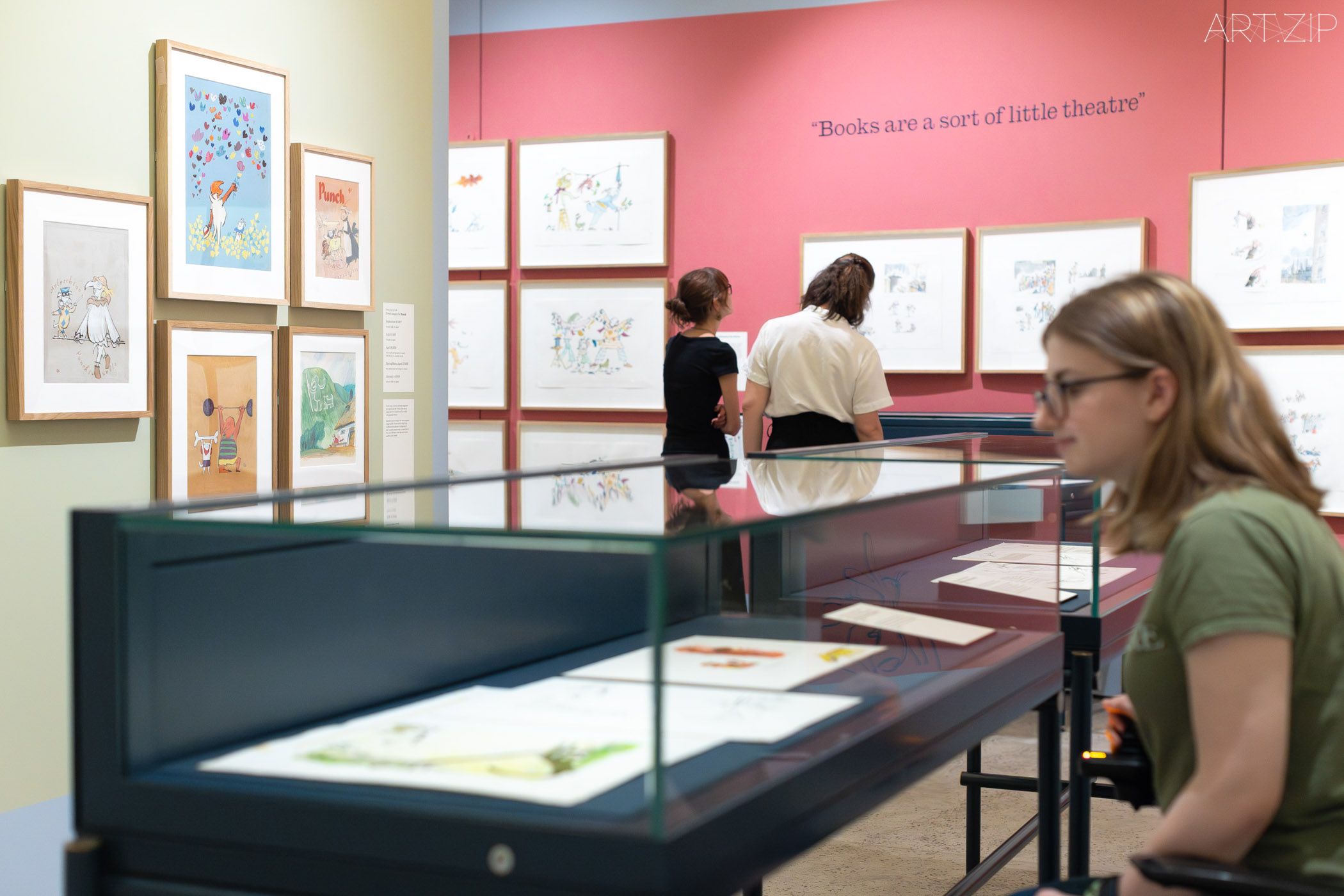
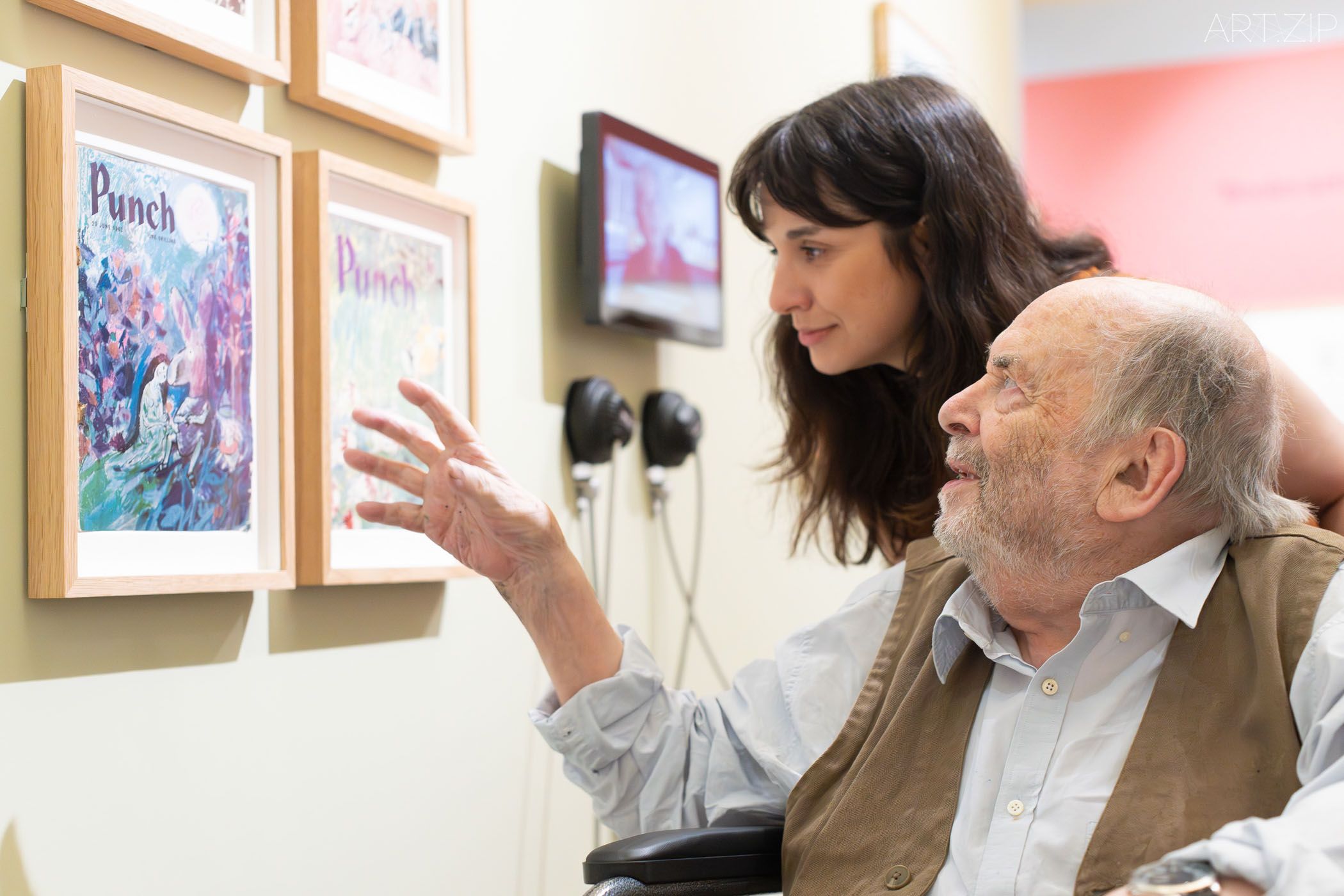
The exhibition Performance brings together over a hundred original works and manuscripts, focusing on his longstanding fascination with theatre, performance, and the movement of figures.
Here you can trace how a character slowly emerges from a handful of lines; how a book moves from a vague impulse to the finished thing a reader will one day hold. These working drawings make clear that illustration is not an outcome — it is a process of constant testing, revision, and discovery.
Illustration has long been understood as something subordinate to writing. But standing before these works, you come to see that it has a language entirely its own. It does not merely explain text. It creates another way of reading altogether.
When Comics Record the Overlooked
Running alongside these exhibitions is Queer as Comics, the UK’s first survey of queer comics history, spanning from the 1940s to the present. Alice Oseman’s Heartstopper is among the works featured.
The exhibition makes the case that comics are not simply entertainment — they are a visual language for recording the histories and lived experiences of communities that have often been rendered invisible.
As times have changed, the visual styles and narrative forms of comics have evolved, and voices once pushed to the margins have gradually found their way into the light.
The trajectory of comics from underground publication to mainstream culture reflects, in its own way, the shifting of social attitudes over time.
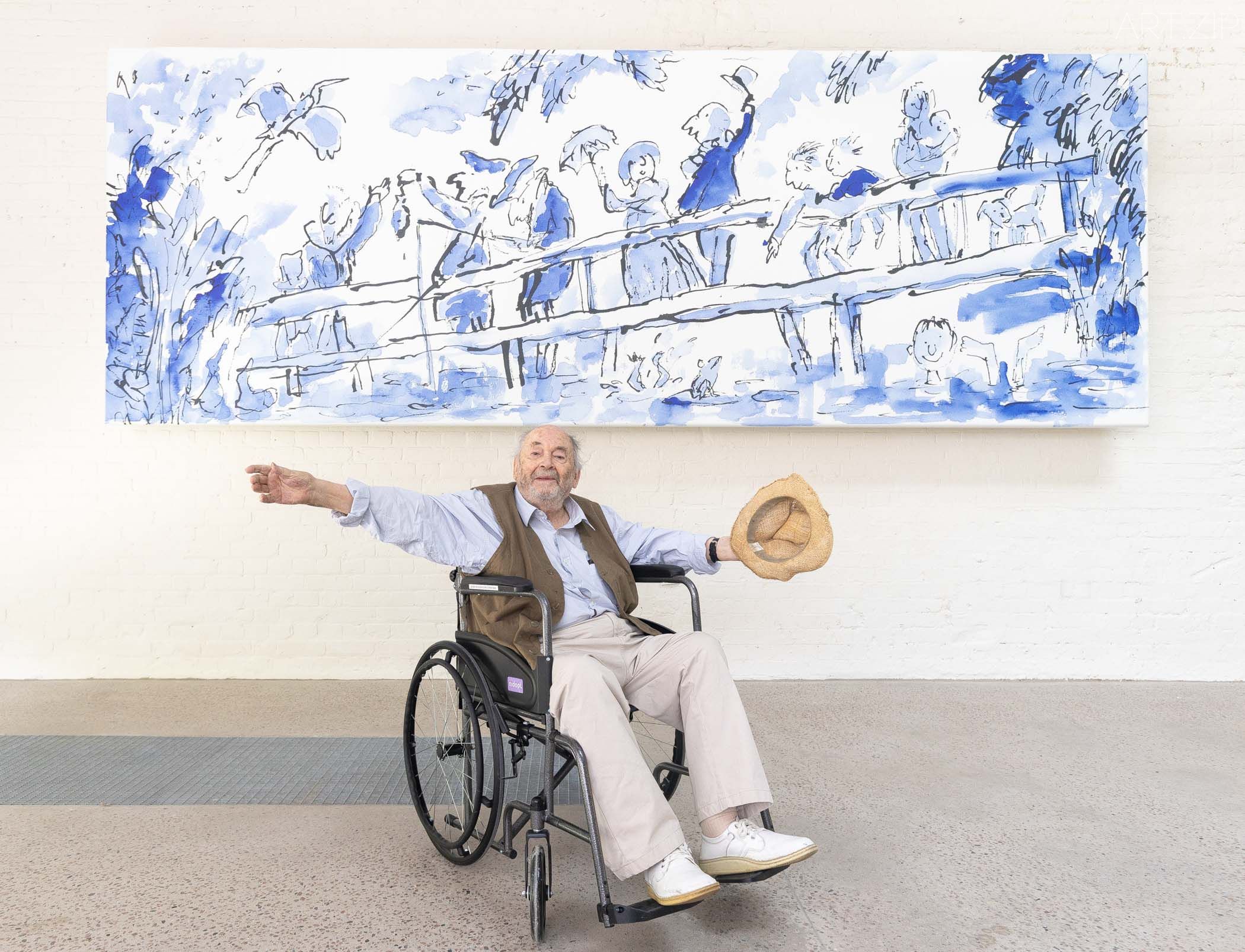
Quentin Blake beside A Bridge to the Past (2026), a new mural commissioned for the Quentin Blake Centre for Illustration
A Bridge to the Past
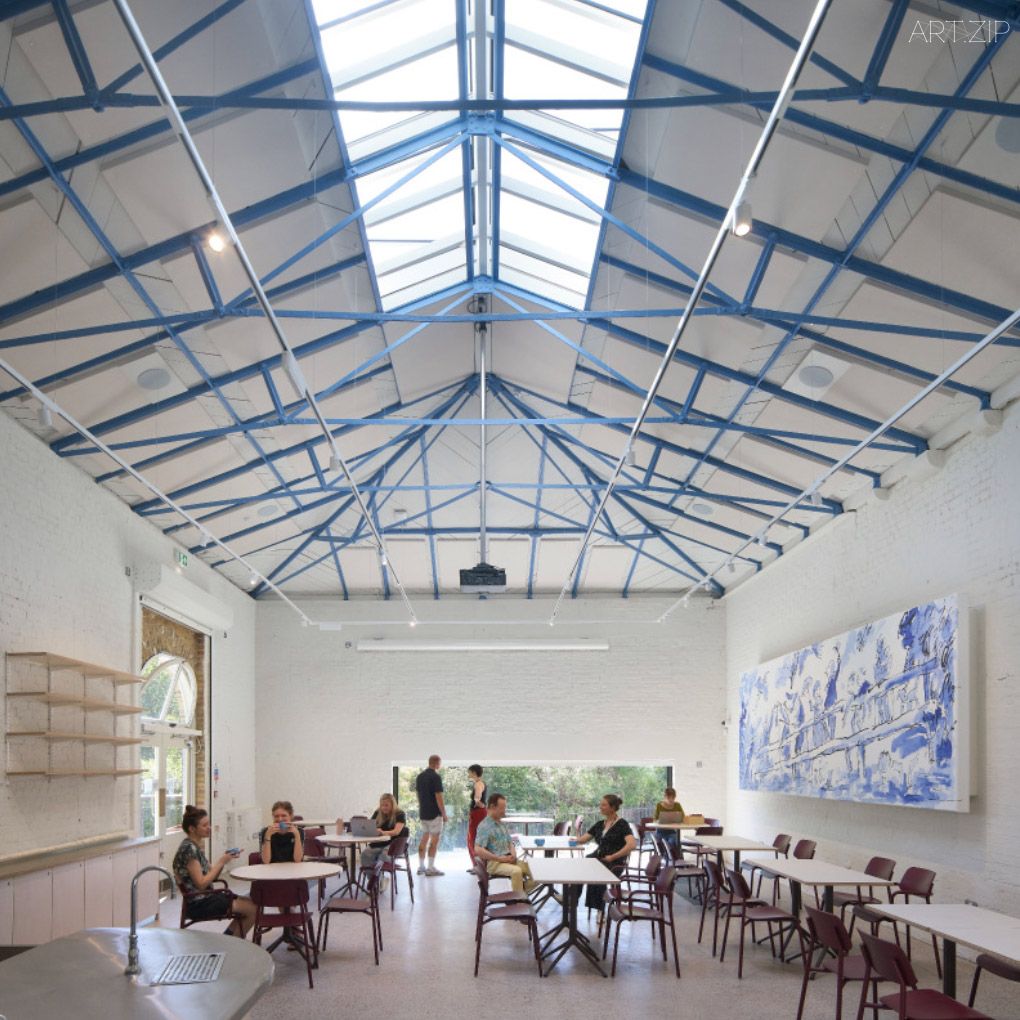
On the way out, passing through the café, you encounter a new mural Blake has only just completed: A Bridge to the Past, painted directly onto the wall.
The bridge in the painting does not exist anywhere, yet it connects people across different eras. Someone strolls. Someone fishes. Someone lingers by the water. Blake has said he needed such a bridge — to reach back towards the past.
The work draws its inspiration from the history of the New River, and speaks to this site’s identity, which has shifted and transformed across centuries. From waterworks to arts centre, from industrial relic to public cultural space — everything has been reconnected across time.
In a sense, the centre itself is that kind of bridge.
It connects picture books to fine art, children to adults, reading to looking, and the past to the future.
For a long time, illustration was considered a supporting character in the story of books.
Here, at last, it takes the lead.
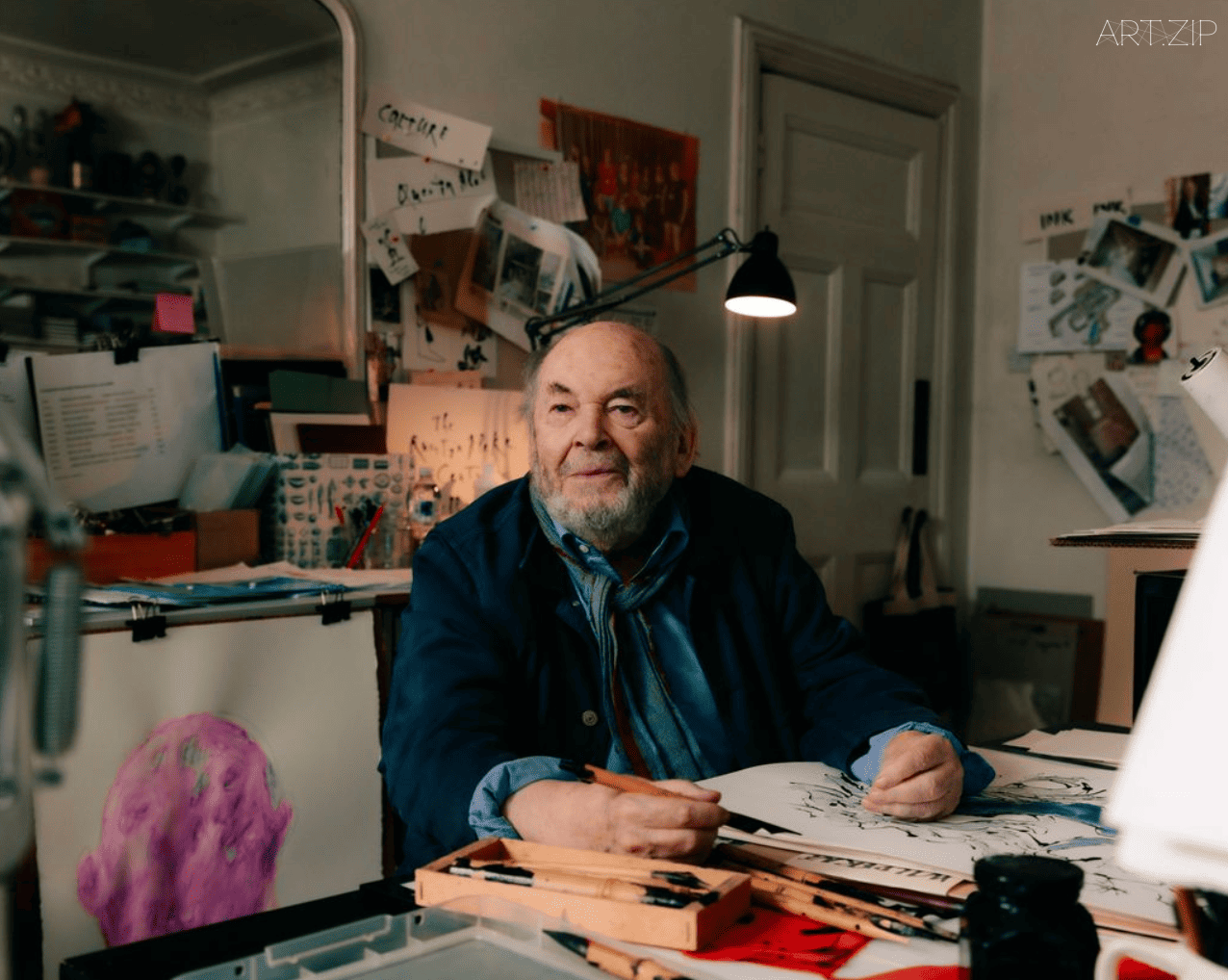
Quentin Blake © Alex Ingram 2026
如果要問英國孩子共同的童年記憶是什麼,昆廷·布萊克(Quentin Blake)的線條大概會是其中之一。
那些看似隨意、輕盈甚至有些潦草的筆觸,陪伴了幾代英國兒童長大。從《查理和巧克力工廠》到《瑪蒂爾達》,羅爾德·達爾(Roald Dahl)筆下那些古靈精怪的人物,因為昆廷·布萊克的插畫而擁有了具體的樣貌。如今,這位已經九十多歲的插畫家,終於擁有了一座以自己名字命名的藝術中心。
2026年6月5日,昆廷·布萊克插畫藝術中心(Quentin Blake Centre for Illustration)在倫敦克勒肯維爾(Clerkenwell)正式開放。這不僅是英國第一個永久性的插畫藝術中心,也是目前世界上最大的公共插畫空間。它的前身是位於國王十字(King’s Cross)的插畫之家(House of Illustration),而如今的新館,則落腳於一處擁有四百多年歷史的舊水廠遺址。
從供水工程到插畫中心
有趣的是,這裡原本並不屬於藝術。
17世紀初,為瞭解決倫敦的供水問題,人們修建了新河(New River),將赫特福德郡(Hertfordshire)的水引入倫敦。這片區域後來成為新河水源地(New River Head)水務設施的一部分。蒸汽機房、煤倉、風車基座,以及不同年代不斷擴建的工業建築,共同構成了這片場地的歷史。
如今,蒂姆·羅納德斯建築事務所(Tim Ronalds Architects)將這些廢棄多年的建築重新修復,並盡可能保留其原有結構。裸露的磚牆、工業時代留下的建築細節,以及不同年代疊加的空間痕跡,都被完整保留下來。插畫並沒有取代這裡的歷史,而是與它並存。
走在園區里,會不斷感受到一種時間交錯的感覺:一邊是幾百年前的城市基礎設施,一邊是當代最活躍的視覺創作。
一座關於閱讀的圖書館
走進中心,一樓最吸引人的是圖書館。
這是英國第一個專門面向公眾開放的插畫圖書館。雖然圖書不能外借,卻可以自由閱讀。繪本、漫畫、圖像小說等藝術出版物被安靜地擺放在書架上。坐下來翻閱的時候,會發現這裡其實更像一個閱讀空間,而不是傳統意義上的圖書館。
長長的捐贈致謝名單,這裡有多少有意思的圖書。飛眼書屋(Flying Eye Books)、沃克書屋(Walker Books)、魔法貓出版(Magic Cat Publishing)、泰晤士與哈德遜(Thames & Hudson),到企鵝蘭登書屋(Penguin Random House)、費伯出版社(Faber)、布魯姆斯伯里(Bloomsbury)等出版社,都能在名單中找到。這些名字幾乎構成了英國當代繪本與插畫出版生態的一張地圖。
一個圖書館最有意思的並不是它收藏了什麼,而是它選擇收藏什麼。
穆魯基亞的數字夢境
二樓是英國斯里蘭卡裔藝術家穆魯基亞(Murugiah)的個展《你是否曾感覺……(Ever Feel Like…)》。
與昆廷·布萊克的輕盈不同,穆魯基亞的世界充滿高飽和度的色彩與強烈的視覺衝擊力。巨大的牆面作品幾乎覆蓋整個空間,觀眾像是進入了一個不斷擴張的數字夢境。
他的經歷也很有意思。和許多亞洲家庭的孩子一樣,他最初學習的是建築設計,後來才逐漸轉向插畫與視覺藝術創作。疫情期間持續不斷的創作,讓他的個人風格逐漸成熟,也讓他成為近年來英國最受關注的新一代插畫藝術家之一。
展覽探討身份認同、心理健康與成長經驗等主題,卻並不沉重。相反,那些鮮艷到近乎發光的色彩,反而讓這些複雜議題變得更容易進入。
在這裡,插畫不只是圖像,而是一種關於情緒與自我認知的表達方式。
昆廷·布萊克的創作現場
來到頂樓,才真正進入昆廷·布萊克的世界。
展覽《演出(Performance)》展出了超過一百件原作與手稿,聚焦他長期以來對戲劇、表演與人物動作的興趣。
在那裡,可以看到一個角色如何從最初的幾根線條慢慢長出來;也可以看到一本書是如何從一個模糊想法,最終變成讀者熟悉的模樣。
這些手稿讓人意識到,插畫並不是一個結果,而是一個不斷試探、修改與發現的過程。
很多時候,人們會把插畫理解為文學的附屬品。但站在這些作品前,會意識到插畫其實擁有自己的語言。它不僅僅是在「解釋」文字,而是在創造另一種閱讀方式。
當漫畫記錄被忽視的故事
與此同時,館內還舉辦了《酷兒漫畫(Queer as Comics)》展覽。
這是英國首個系統梳理酷兒漫畫發展的展覽,時間跨度從 1940 年代延續至今。艾麗絲·奧斯曼(Alice Oseman)的《《心跳漏一拍(Heartstopper)》也出現在其中。
展覽讓人看到,漫畫不僅是一種娛樂形式,也是一種記錄邊緣群體歷史與身份經驗的視覺語言。
隨著時代變化,漫畫的畫風與敘事方式不斷演變,而那些曾經被忽視的聲音,也逐漸獲得被看見的機會。
從地下出版物到進入主流文化,漫畫的發展軌跡某種程度上也映照著社會觀念的變化。
一座連接過去與未來的橋
離開的時候,經過咖啡廳,昆廷·布萊克剛剛完成的新壁畫《通往過去的橋(A Bridge to the Past)》就在牆上。
畫中的橋並不存在,卻連接著不同年代的人們。有人散步,有人釣魚,有人在水邊停留。昆廷·布萊克說,他需要這樣一座橋,去連接過去。
這幅作品的靈感來自新河的歷史,也回應著這片場地數百年來不斷變化的身份。從供水設施到藝術中心,從工業遺址到公共文化空間,一切都在時間中被重新連接起來。
某種程度上,這座藝術中心本身也像這樣一座橋。
它連接著繪本與藝術,連接著兒童與成年人,連接著閱讀與觀看,也連接著過去與未來。
長期以來,插畫總被認為是書里的配角。
而在這裡,它終於成為了主角。
Text by 撰文 x Shoran Jiang 姜嘯然