

When “Defining the Future of Creative Content” was announced as the theme of the 2026 London Book Fair, a compelling vision of publishing’s future began to take shape during the fair’s hour-long online press briefing. Supported by comprehensive industry data, the presentation sketched an optimistic picture: rising book sales across genres, expanding global circulation, and increasingly fluid international collaborations. Stories born on the page now travel freely between print, screen, and streaming platforms, suggesting a renewed vitality for the written word.
As slide after slide outlined the fair’s three-day programme, this vision of the future grew clearer, and so did an underlying logic worth pausing over. Nearly all of the featured speakers were creators whose work had already proven its ability to move successfully across media formats. Their writing had been adapted into film, television, or audio, positioning them as exemplary figures within a content economy built on circulation and transformation. What was being highlighted, then, was not writing alone, but a model of creative value already validated by cross-media success.
Creative work, of course, has never existed in isolation. Dickens wrote serialized novels for both livelihood and readership; twentieth-century popular fiction developed alongside the cinematic imagination; genre fiction and IP-driven narratives have long carried the promise of visual adaptation. What feels distinct today is that this industrial logic is no longer implicit. Adaptation is no longer a possible afterlife of a book, it increasingly becomes the premise of creation itself.
Where a book was once considered successful and then adapted, it is now often celebrated because it can be adapted. This shift invites a necessary question: is this the creative future we truly envision?
In an era increasingly shaped—and overwhelmed—by screens, reading has undeniably become more difficult to sustain as a shared cultural practice. Yet this difficulty does not necessarily mean that reading must reshape itself in screen-friendly terms in order to survive. Within dominant industry narratives, reading is frequently reframed as the origin point of intellectual property, while readers are imagined as audiences-in-waiting—viewers who have not yet entered a cinema or logged onto a streaming platform. In this framework, the book becomes one component in a platform-driven content pipeline. “Reading for all,” once an idealistic aspiration, begins to resemble a strategic reinterpretation under platform capitalism.
Compared with screen industries, publishing has long occupied a more marginal position within the cultural economy. From a survival standpoint, it is understandable that the industry seeks to assert its relevance through adaptability and cross-media translation. Yet when a book’s value is measured primarily by its legibility to screen industries, literary existence alone no longer seems sufficient. An industry that repeatedly emphasizes its capacity to be transformed and connected may also be revealing a deeper anxiety: that creation must now prove its utility in advance in order to be taken seriously.
If we begin the creative process already assuming that stories must ultimately move to screens, what role does the page still play? If the future is mapped out in terms of format and market value before creation even begins, can writing still exist for its own sake?
Faced with the expanding influence of screen culture, publishing has embraced cross-media strategies to reaffirm the vitality of books. Yet perhaps the more urgent question is not how publishing might coexist with screen industries, but what kind of future we are imagining in the first place. When every vision of tomorrow is aligned with platform logic, visual potential, and adaptability, what happens to the works, and the creators, that refuse to conform to that framework?
Before the future is fully written for us, perhaps we can still preserve a small space for reading and writing that does not need to prove its worth in advance—a space where creation is allowed to exist, simply, for its own sake. And perhaps, this March, the London Book Fair will still offer us a space of imagination—not yet fully defined, not yet entirely claimed.
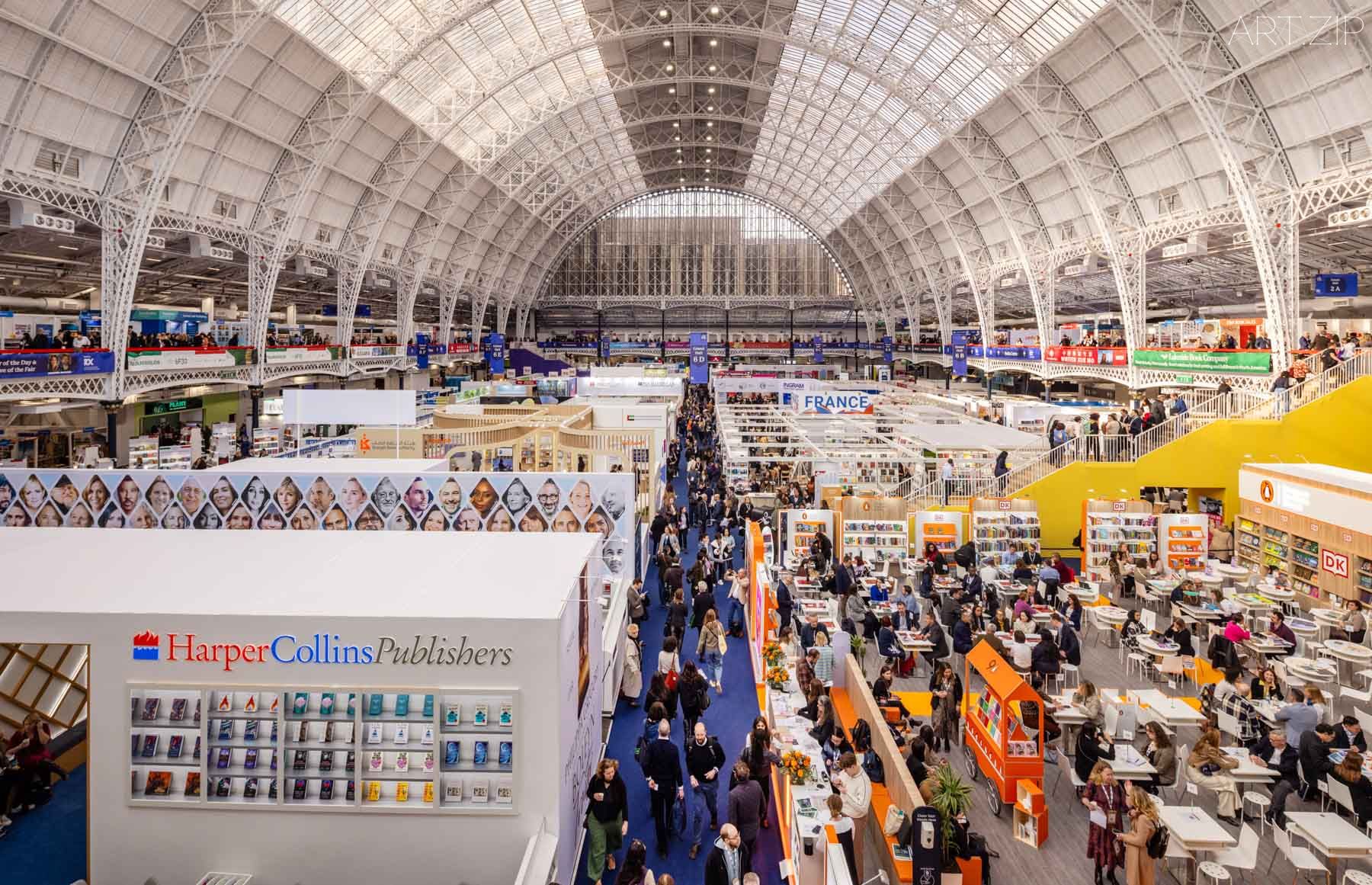
Grand Hall at London Book Fair
以「Defining the future of creative content」為主題的 2026 年倫敦書展(London Book Fair),在一場為期一小時的媒體發佈會中,借助宏觀產業數據,呈現出一幅關於出版業與書籍走向的「未來圖景」。各類書籍的銷量增長、出版行業的跨國流通與合作,無不展現出一種令人振奮而明朗的前景。優秀作品被改編為電影與電視劇,書中的故事在紙張與流媒體之間不斷流轉,彷彿迎來一場嶄新的重生。
在這場媒體發佈會中,幻燈片一頁頁展示著為期三天的書展日程,也不斷勾勒著關於創意內容的「未來想象」。與此同時,一種值得警惕的甄選邏輯悄然顯現:即將在書展上亮相的受邀嘉賓,幾乎清一色都是跨媒介能力早已被高度驗證過的創作者——他們的作品早已完成從書籍到影視或聲音媒介的成功轉譯。在這樣的遴選之下,被展示的已不只是優秀的寫作本身,而是一套經過驗證、被反復確認可行的內容流通路徑。
創作這件事,或許從文學誕生之初便從未是絕對純粹的。狄更斯書寫連載小說,為了生計,也為了報紙銷量;二十世紀的通俗文學,本就與電影工業相互滋養;類型小說與 IP 寫作,也早已以「可視化」為潛在前提。然而,當這種產業化邏輯被公開而堂而皇之地陳述時,改編不再只是創作之外的可能出路,而逐漸成為創作的初衷。
從前,一本書很好,它後來被拍成了影視作品;而如今,一本書很好,是因為它能夠被拍成影視作品。這真的是我們所期待的、關於創作的未來嗎?
在當下被屏幕層層包裹的時代,「全民閱讀」確實變得日益困難。但這種困難,或許並不意味著閱讀必須通向屏幕,才能重新獲得生機。在產業敘事中,閱讀被重新定義為 IP 的源頭,讀者被想象為尚未走進影院或打開流媒體的潛在觀眾,而書籍則在這一過程中,悄然成為平台邏輯主導的內容生態中的一個環節。某種程度上,「全民閱讀」甚至荒誕地變成了平台經濟對閱讀方式的一次重譯。
相較於屏幕產業,出版行業長期處於被邊緣化的位置。站在行業生存的角度,這種在資本與平台話語面前努力證明自身仍然「有用」的焦慮,並非難以理解。如果一本書無法被翻譯為影視工業所能理解的語言,它似乎就難以被視為「成功」的內容。當一個行業反復強調「我還能轉化」「我還能聯動」時,或許也無意中揭示了另一種現實:它已不再被允許,僅僅因為自身的存在而獲得尊重與足夠的生存空間。
如果從一開始就假定創作的內容與方向終將走向屏幕,我們以這樣的前提投入寫作,那麼紙頁的意義究竟何在?當未來被提前設定,創作是否仍能被允許只是為了創作本身而發生?
面對屏幕產業的強勢擴張,出版行業試圖通過跨媒介實踐與成功案例,證明書籍依然擁有廣闊的生命力與現實價值。問題或許並不在於未來的創作將如何與屏幕產業共生,而在於:當所有關於未來的想象都被提前校准為平台化、可視化與可改編的方向時,那些拒絕完全進入這一邏輯的創作與創作者,是否仍然值得被看見?
至少,在未來尚未被徹底定義之前,閱讀與寫作仍然值得為自身保留一小塊不必急於證明價值的空間。或許,三月的倫敦書展,仍將為我們提供更多尚未被完全定義的想象空間。
Text by 撰文 x Dr. Hening Zhang 張鶴寧