

The Zurbarán exhibition at the National Gallery is the first major monographic exhibition in the UK devoted to the Spanish Baroque master Francisco de Zurbarán (1598–1664). Alongside Diego Velázquez and Bartolomé Esteban Murillo, Zurbarán was one of the leading painters of seventeenth-century Spain. His work is celebrated for its naturalism, directness and deep emotional power, ranging from soaring altarpieces and life-size depictions of saints to intimate paintings made for private devotion and contemplation.
Almost fifty paintings are arranged across seven rooms, following two threads at once: the chronology of a career and the iconography that shaped it. The exhibition moves from major commissions for the religious orders of Seville and successive treatments of saints and the Immaculate Conception to intimate devotional works and the Hercules paintings commissioned in 1634 for the Hall of Realms in Philip IV’s Buen Retiro Palace in Madrid. Different facets of Zurbarán’s art are brought into dialogue within a single space.
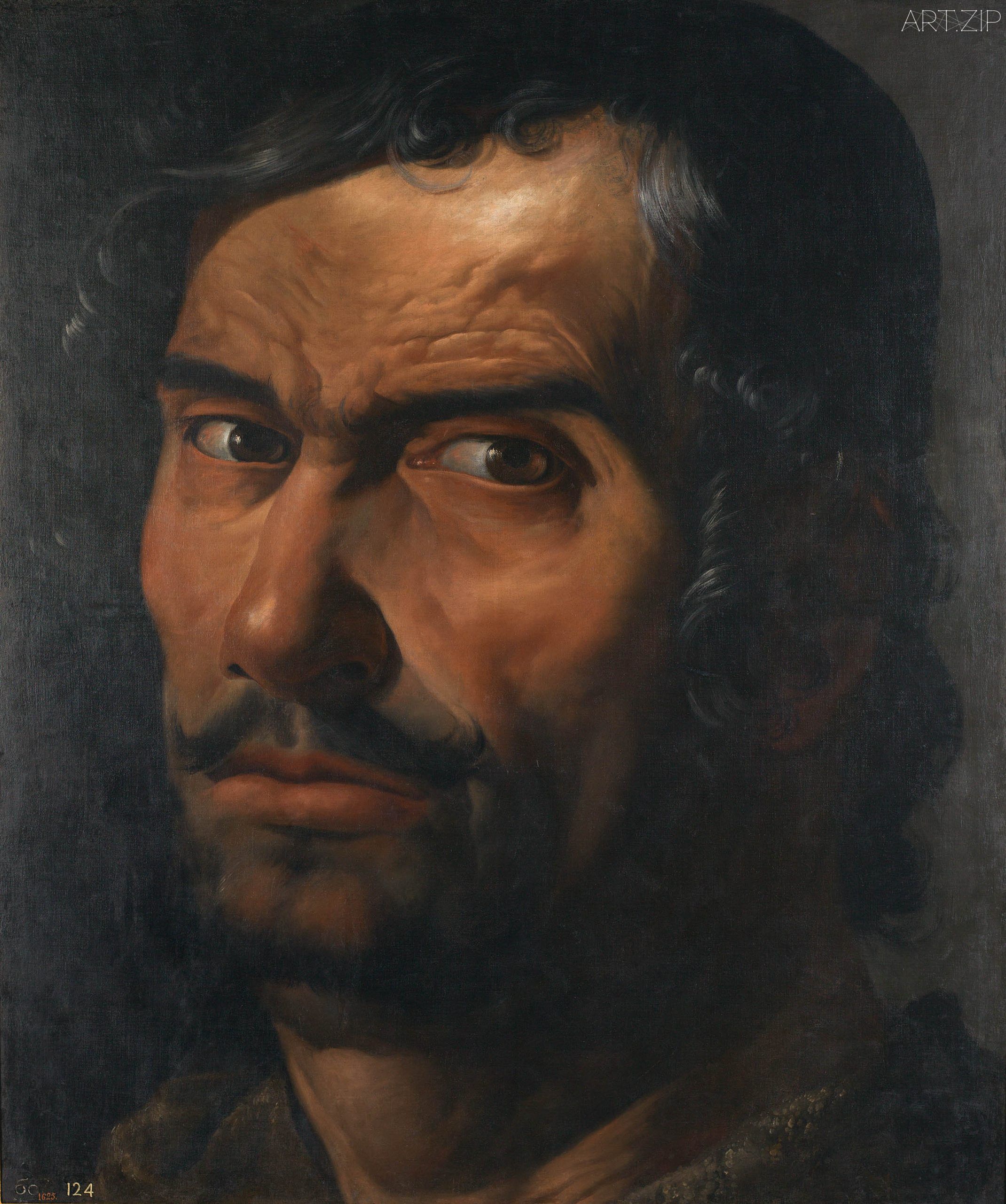
Attributed to Francisco de Zurbarán Colossal Head, about 1635 Oil on canvas, 246 x 205 cm Museo Nacional del Prado, Madrid © Photographic Archive Museo Nacional del Prado
Room to Breathe
The National Gallery has been generous with these paintings. Large rooms hold only a handful of works, with real distance between them. There is no crowding of information, no prescribed route hurrying you towards the next canvas. The result is an exhibition with a slow, quiet rhythm.
You can stand back and watch a figure occupy an entire wall; you can move close and study the fall of a fold, the thickness of leather, the softness of wool, the light resting briefly on the glaze of a jar. This openness is not merely spatial, it also lengthens the time you spend looking. In almost every room there is a painting that stops you short. Freed from competing for attention, each one gradually discloses its own scale, its own weight, its own force.
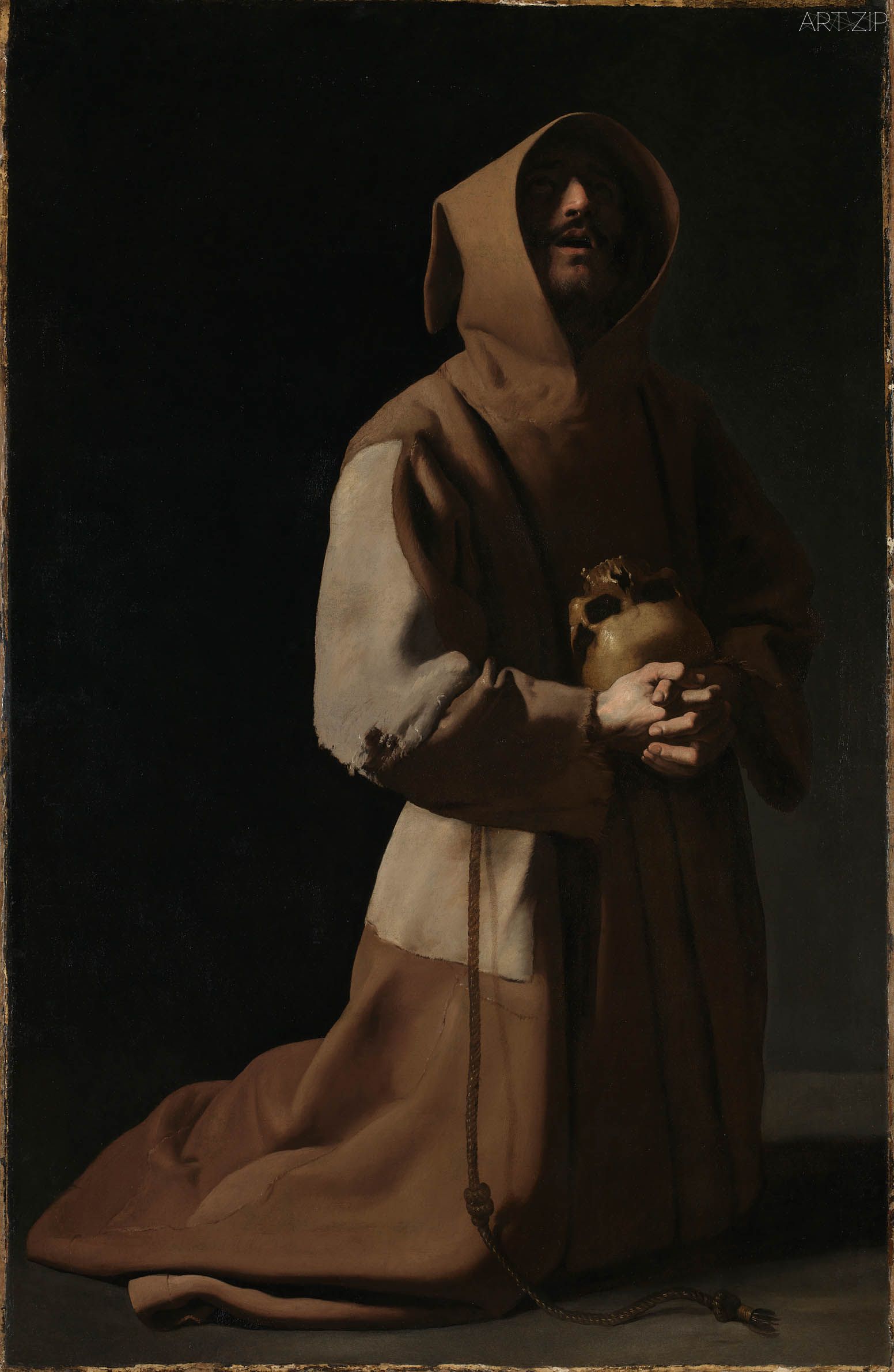
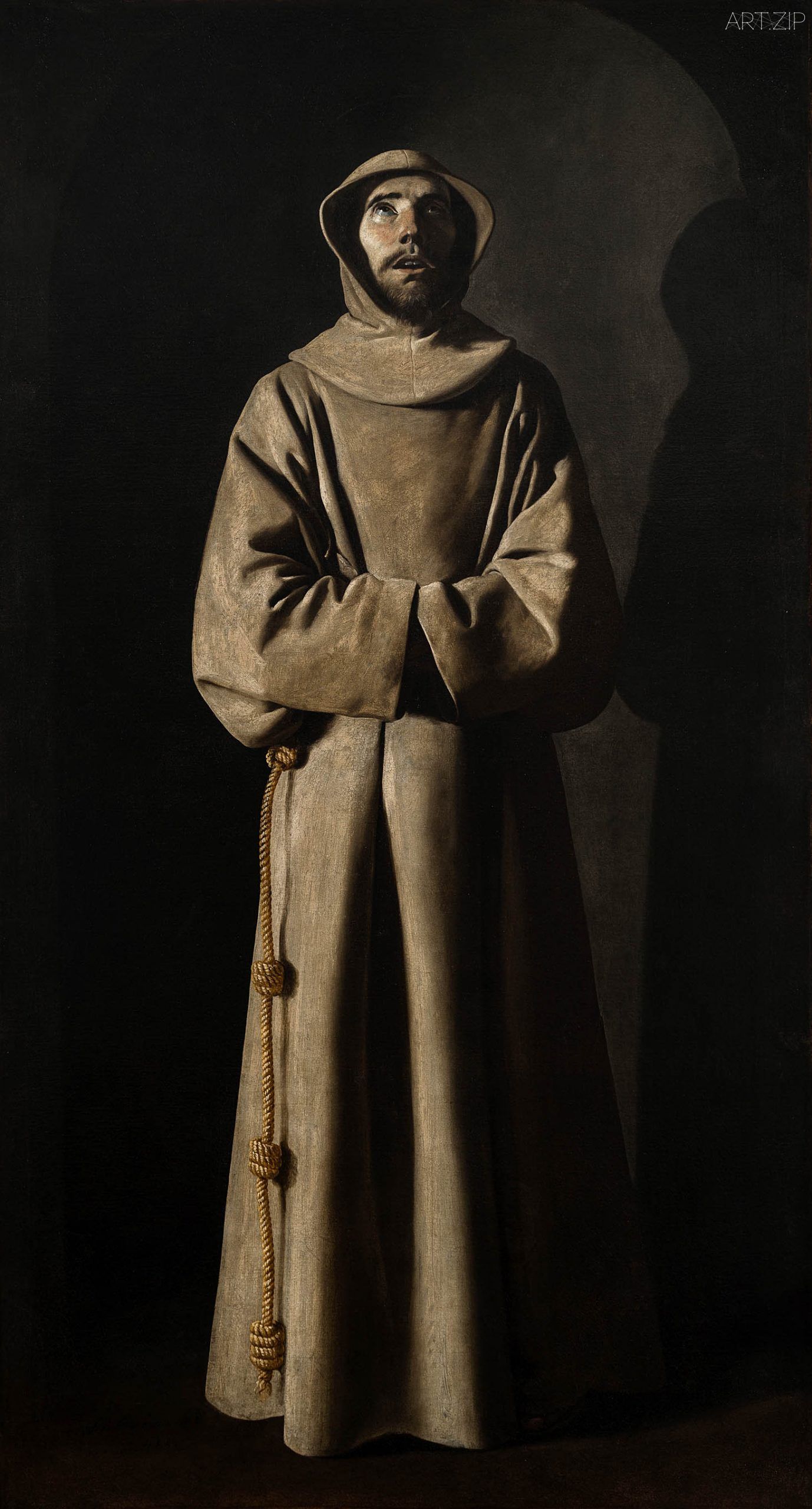
The hang suits Zurbarán particularly well. He tends to lift his figures out of any narrative setting: a saint stands alone before a dark ground, face, hands and habit picked out by a concentrated light, as though the figure had just stepped out of the darkness and into the room. The empty wall around the painting amplifies the effect. Looking becomes less a matter of reading a religious story than of meeting someone face to face, in near silence.
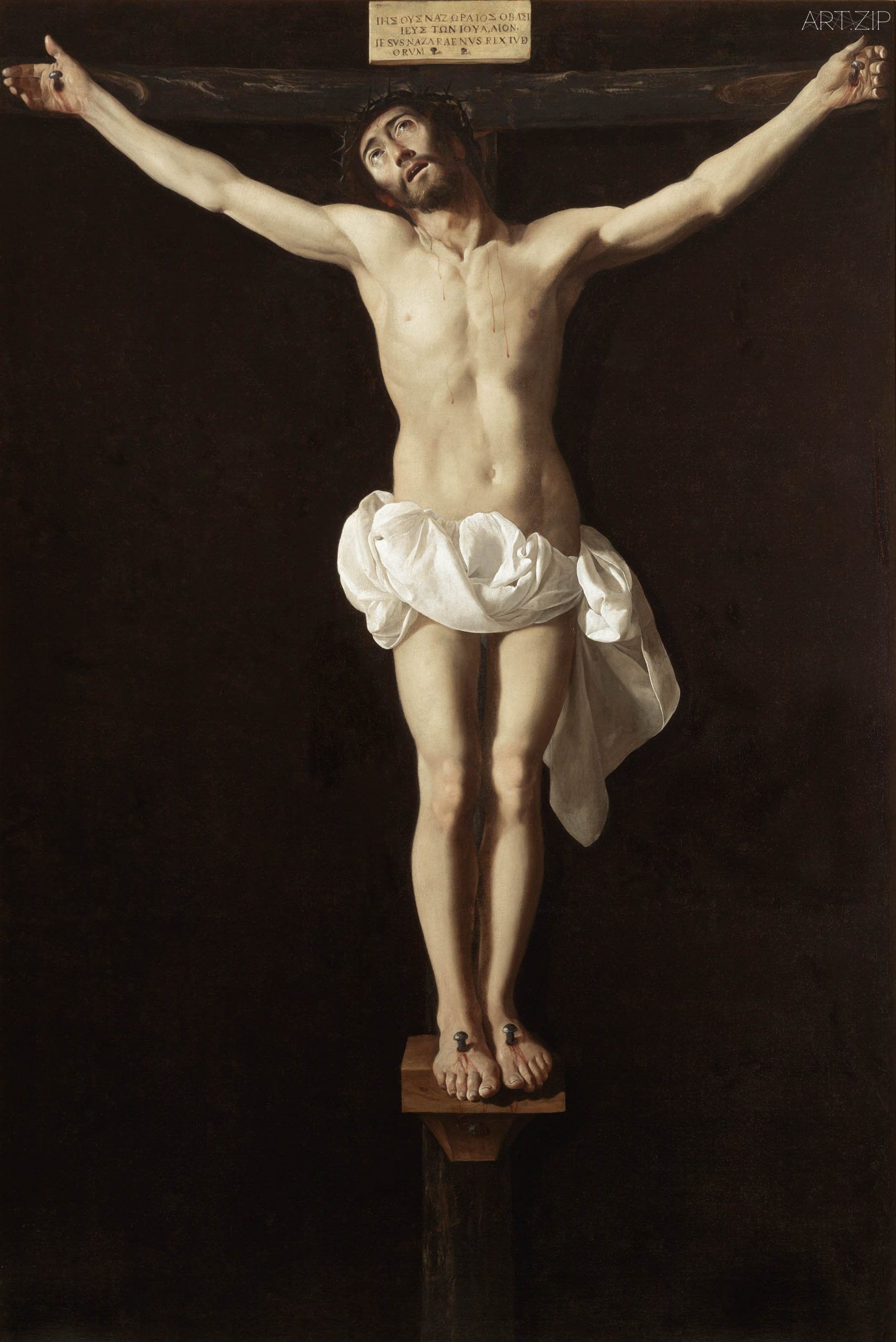
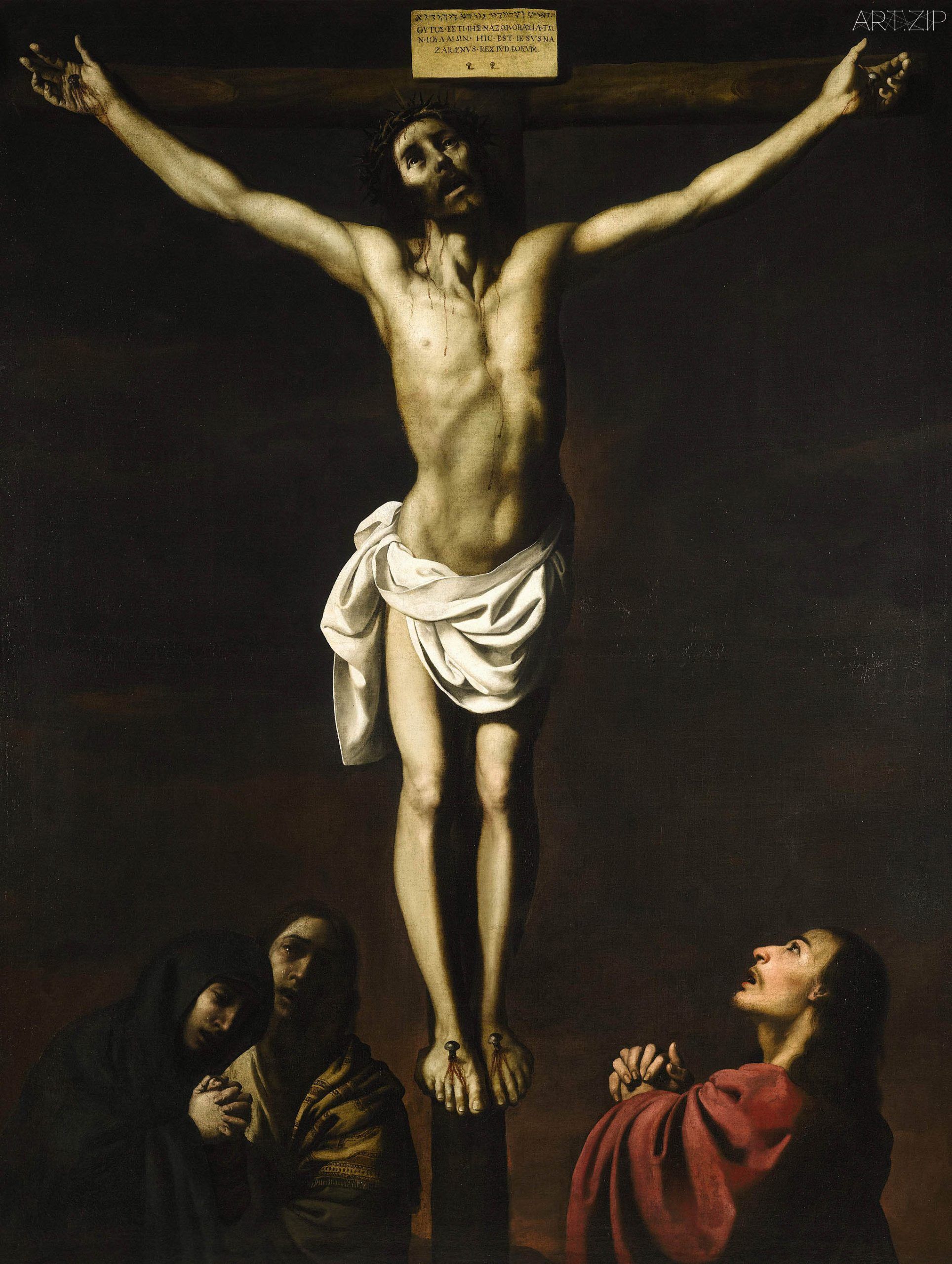
Among all these monumental works, The Crucifixion (1627) offers perhaps the most direct way into Zurbarán’s art. Lent by the Art Institute of Chicago, it is also the earliest of his surviving paintings to carry a signature and a date.
There is no landscape here, and almost no narrative scaffolding, only a near-total blackness, a single concentrated light, and the body of Christ brought to the very front of the picture plane. Light travels across the chest, the arms, the legs, giving the body a volume that verges on sculpture. According to an eighteenth-century account cited by the National Gallery, viewers who saw the painting in the dimly lit sacristy of San Pablo el Real in Seville mistook it for a sculpture.
That anecdote anticipates one of the exhibition’s central concerns. Zurbarán’s art repeatedly tests the border between image and object, between seeing and touching.
Faith Made Solid
Zurbarán’s religious paintings strike you first as grand, even sublime. Saints, friars and the crucified Christ appear at life size, with bodies of genuine weight. They do not float in some remote and abstract heaven; they enter our space, with skin, weight, cloth and breath.
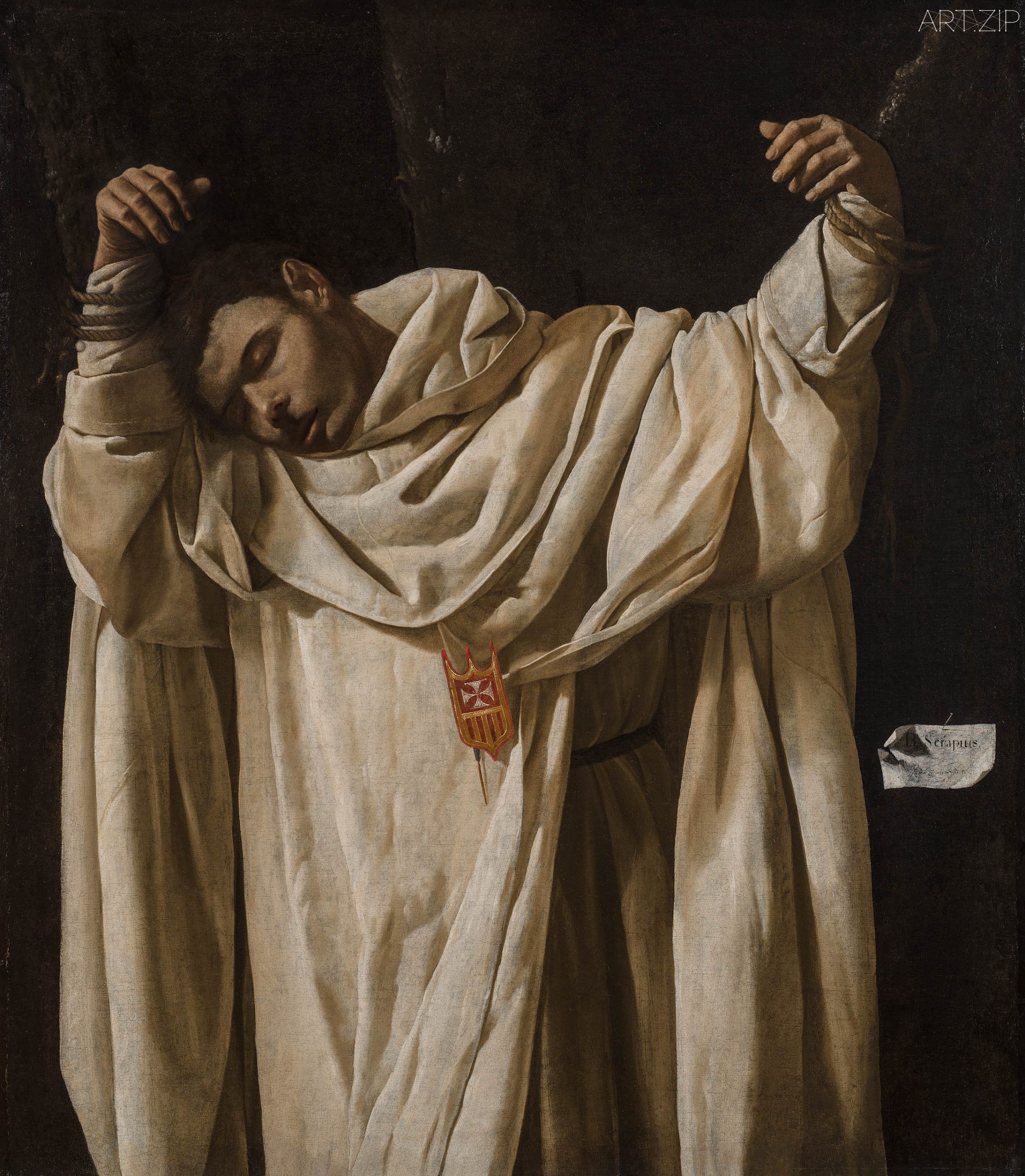
Yet none of this grandeur depends on spectacle or ornament. It comes instead from restraint. Zurbarán strips away whatever the picture does not need, until a single figure, a white habit, or a lamb with its feet bound can bear the emotional load of the whole canvas. The dark ground compresses the space around the figure; the concentrated light lifts a face, a pair of hands, a heavy robe out of the black. The surface is still, but under it the pressure is considerable.
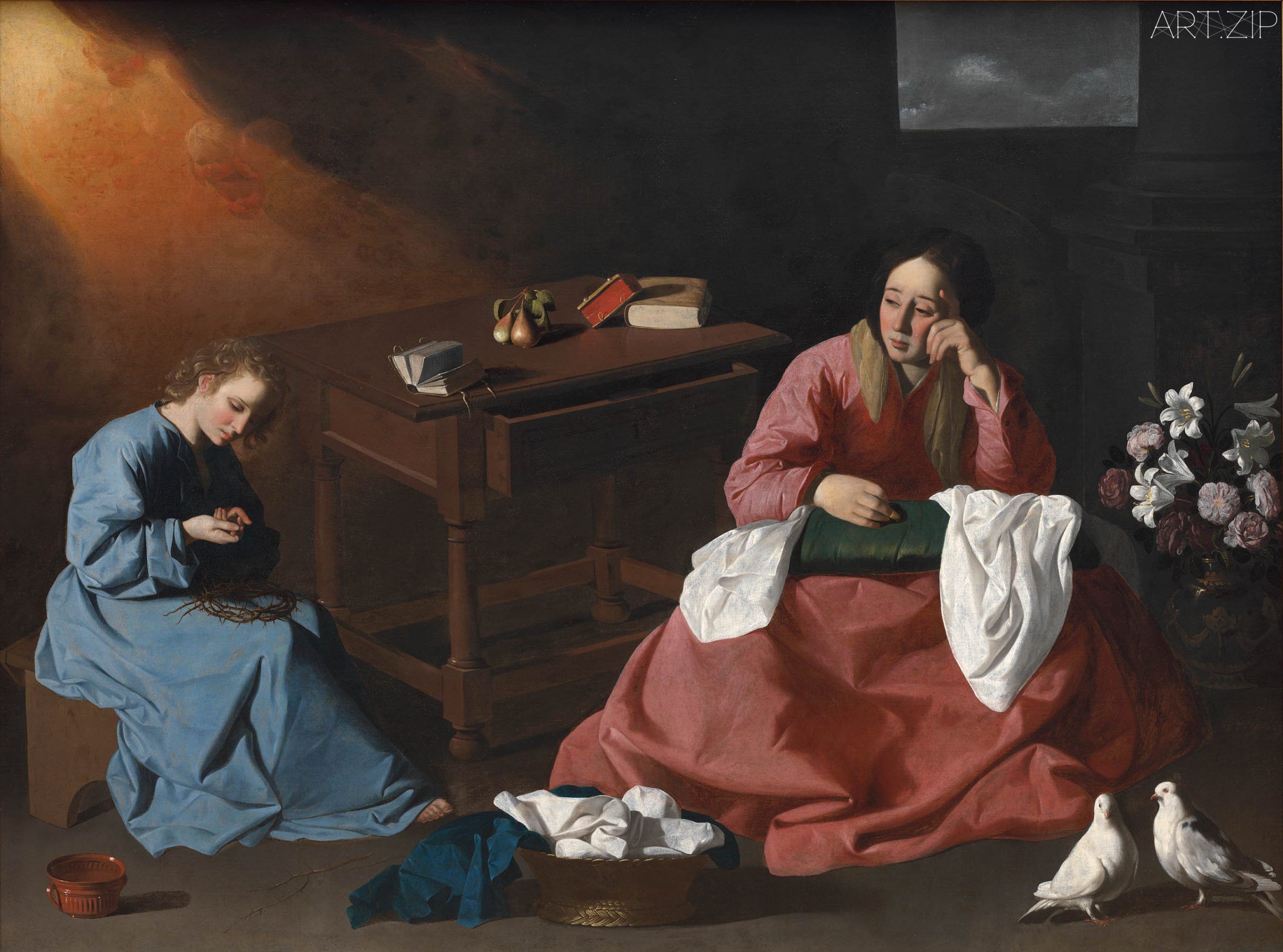
Cloth here is never merely something worn. It is part of how a figure’s inner life is made visible — which is the subject of the room titled The Fabric of Saints. Zurbarán’s father was a haberdasher, and he may have developed an early sensitivity to textiles; the religious processions, ceremonial displays and theatrical performances of seventeenth-century Seville would also have shaped his visual imagination. Wool, embroidery, leather and cord each have their own weight and texture under his brush. A friar’s habit seems to drag downwards with the body inside it; embroidery rises faintly under raking light; coarse wool appears soft and warm. It is this near-obsessive attention to material that prevents his saints from becoming remote religious emblems. They remain people, apparently from our own world.
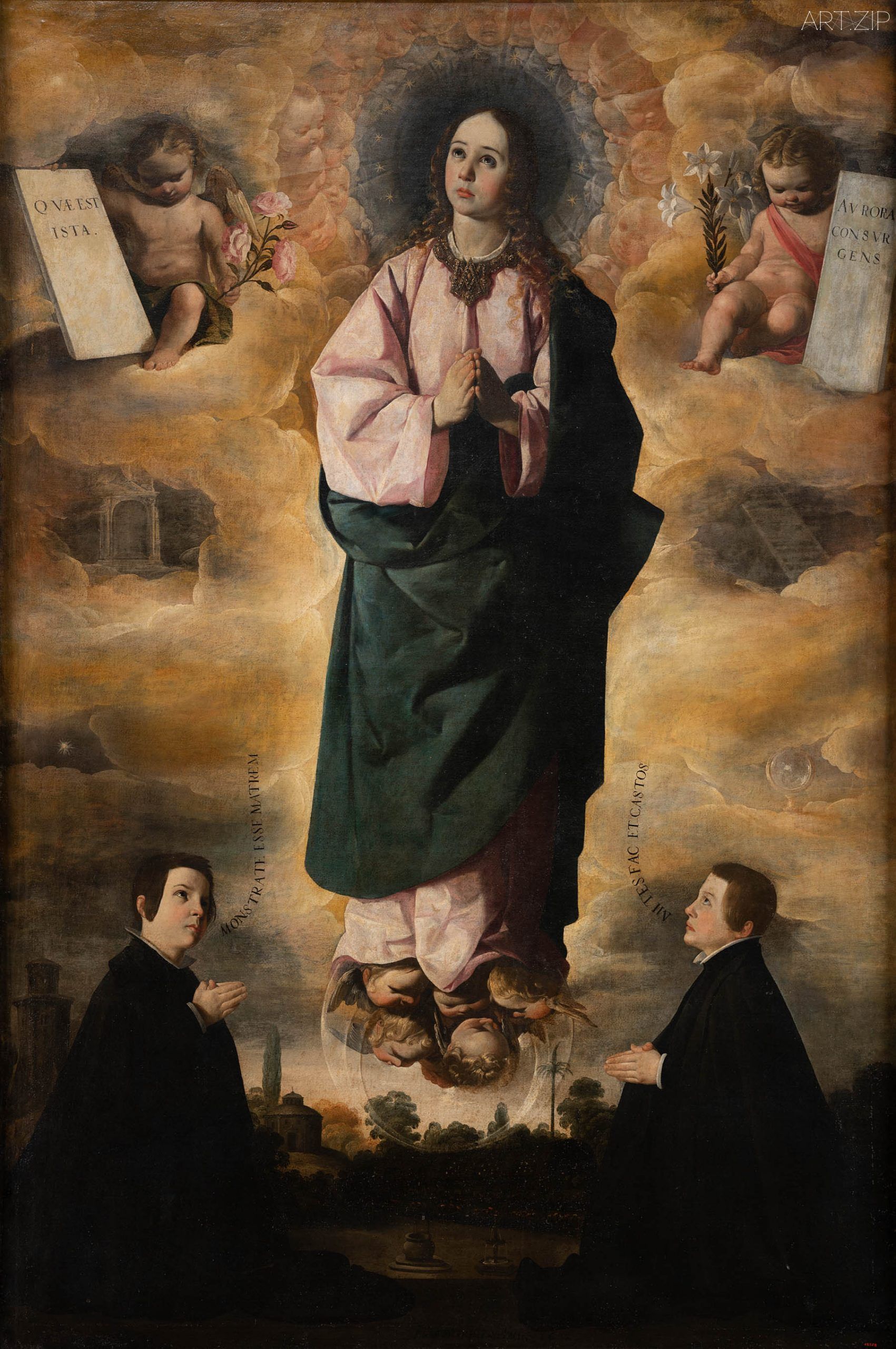
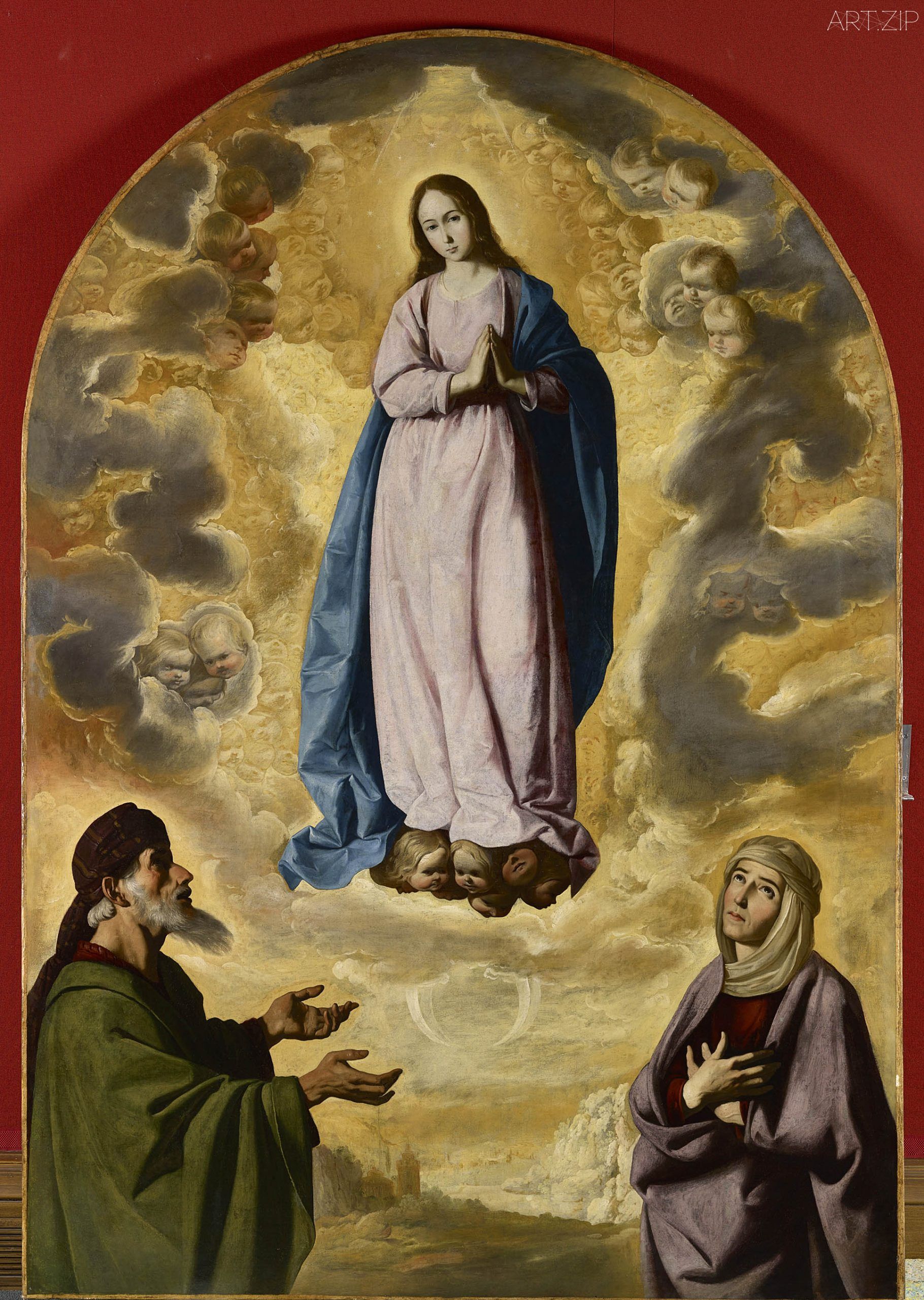
The following room turns on the Immaculate Conception, placing treatments from different points in his career side by side. Within a fixed iconographic frame, the poses shift, the colour shifts, the light and the space shift. What becomes visible is a painter returning to a familiar subject and looking, each time, for another route to a feeling that is never quite the same twice.
From Solitary Saints to Expansive Visions
If Zurbarán is best known for solitary figures emerging from darkness, the large narrative paintings here reveal something more intricate, and more inventive.
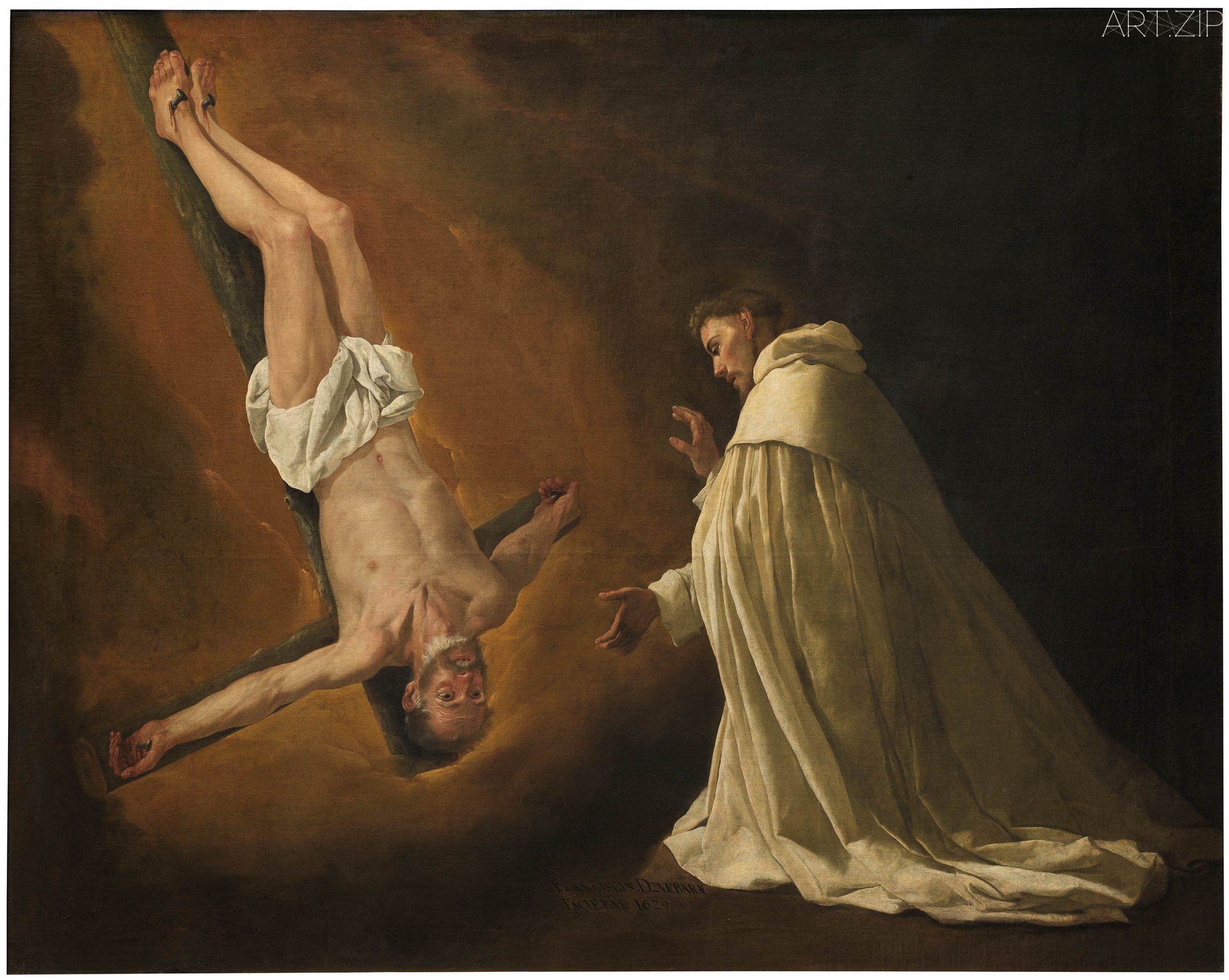
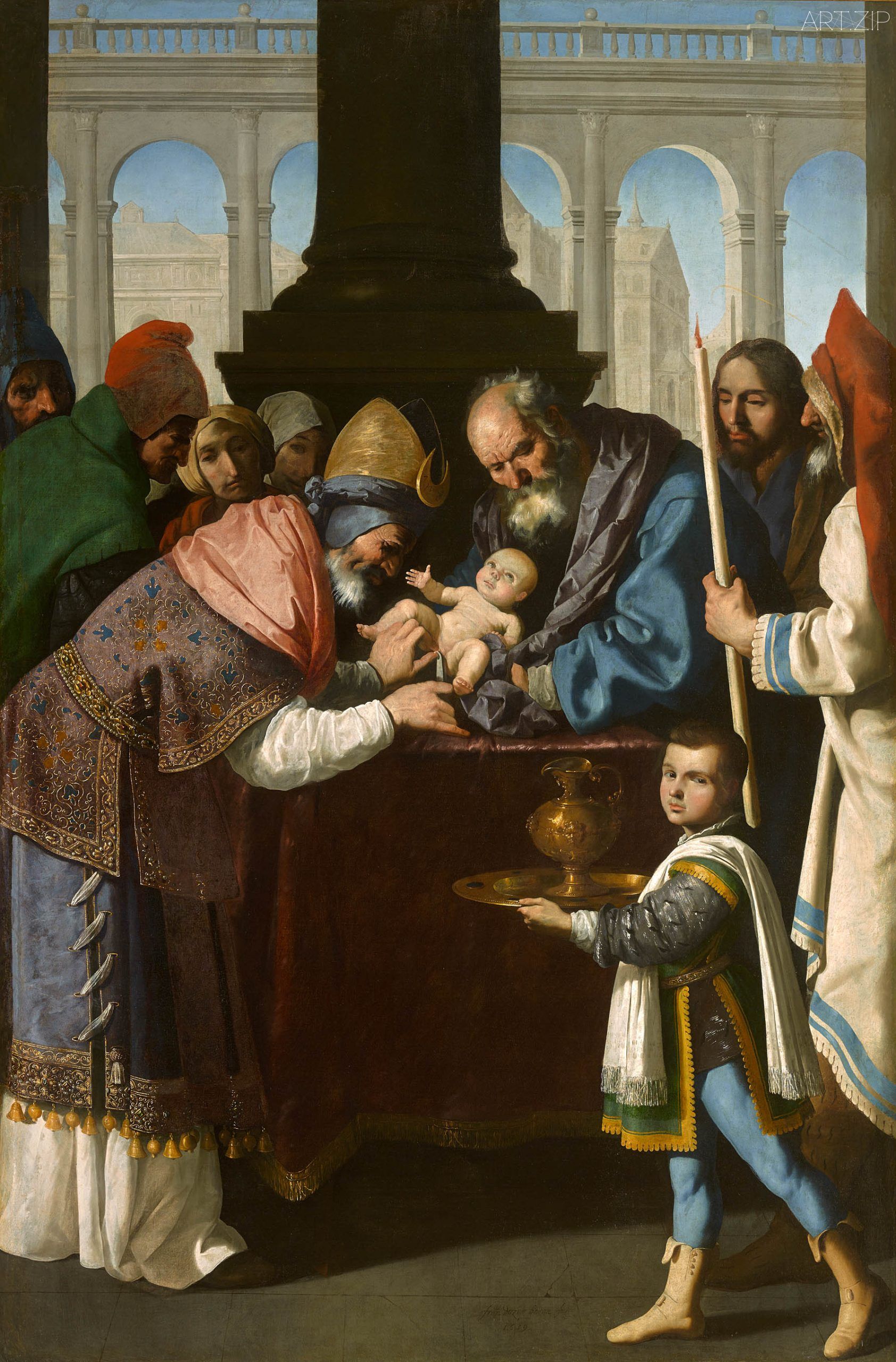
In works such as The Vision of Alonso Rodríguez, the figures are no longer isolated. They are distributed across foreground, middle ground and background, their poses, costumes and lines of sight answering one another and drawing the eye slowly through the picture. Bright white, red, ochre and deep blue emerge in layers out of the gloom, distinguishing figures and spatial planes while setting the visual tempo of the whole.
These are not simply scenes with more people in them. A foreground figure brings the viewer in; the middle ground carries the main action; architecture, cloud or vision at the back opens the space further still. Figures overlap without confusion; the narrative is dense, but the centre of gravity stays clear. Zurbarán’s art, in other words, cannot be reduced to plainness, silence and restraint. When a subject calls for scale, he can supply it — layered colour, carefully staggered groupings and a genuinely inventive sense of composition, holding order and drama together and giving religious visions and collective events their full dramatic force.
In 1634 he received the most prestigious commission of his career: an invitation to Madrid to work on the decoration of the Buen Retiro Palace. He produced twelve paintings for the Hall of Realms, a room some thirty-five metres long. Two from the Hercules series — Hercules and Cerberus and Hercules and the Cretan Bull — are shown here together.
Mythological hero replaces saint; bare muscle replaces the heavy habit. Yet the method — light pushing the body forwards out of the darkness and towards the viewer — remains unchanged.
The Quiet Brilliance of Ordinary Things
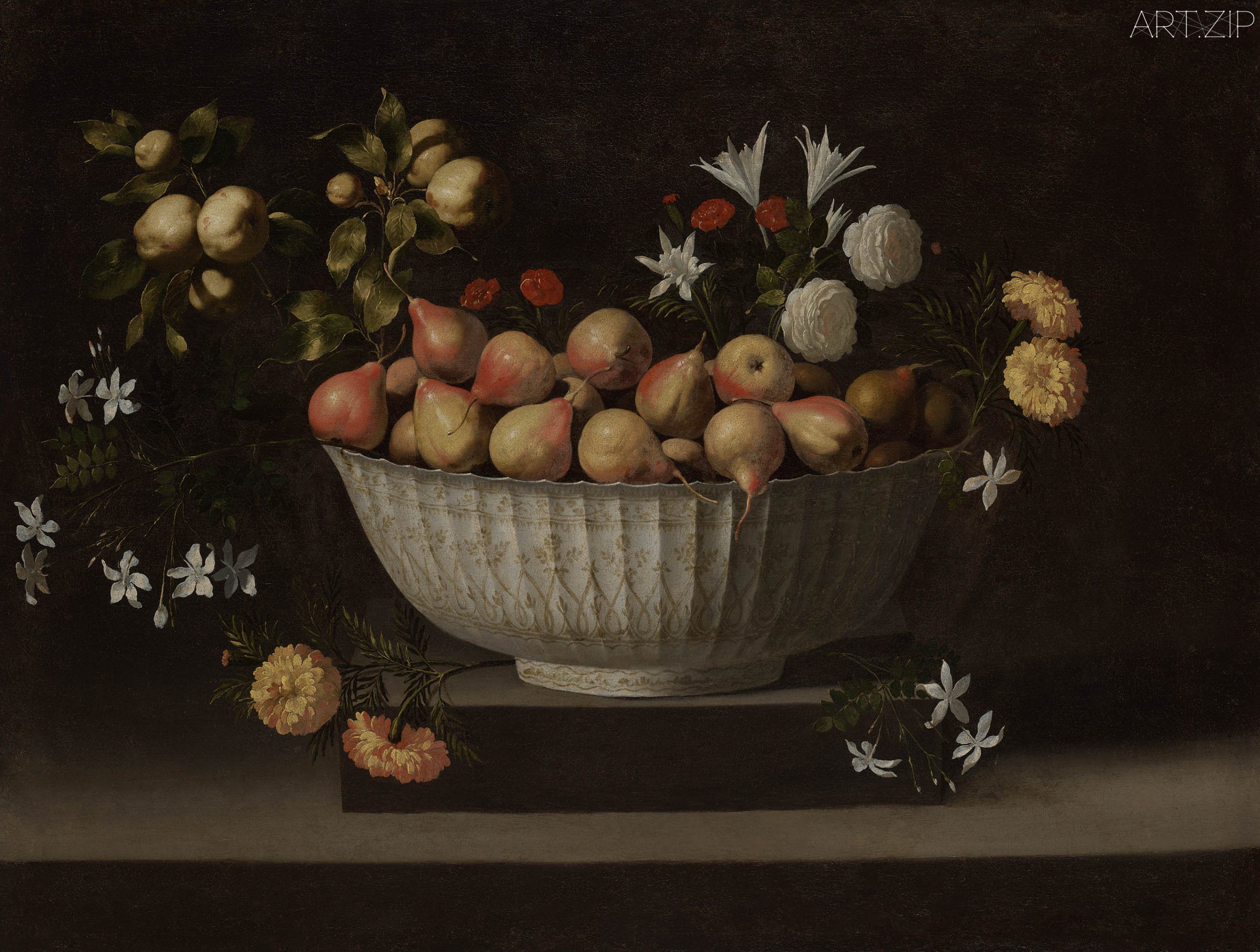
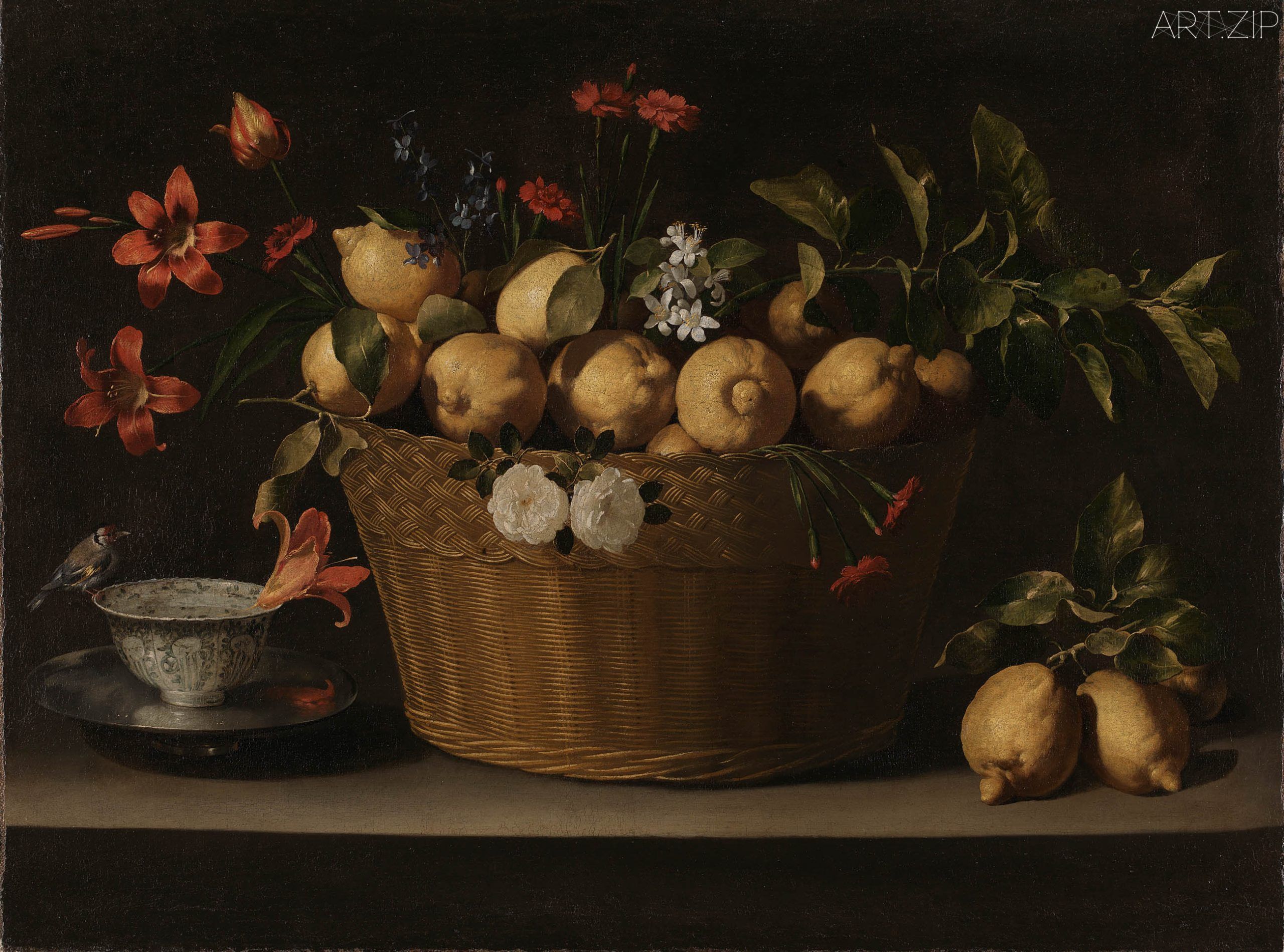
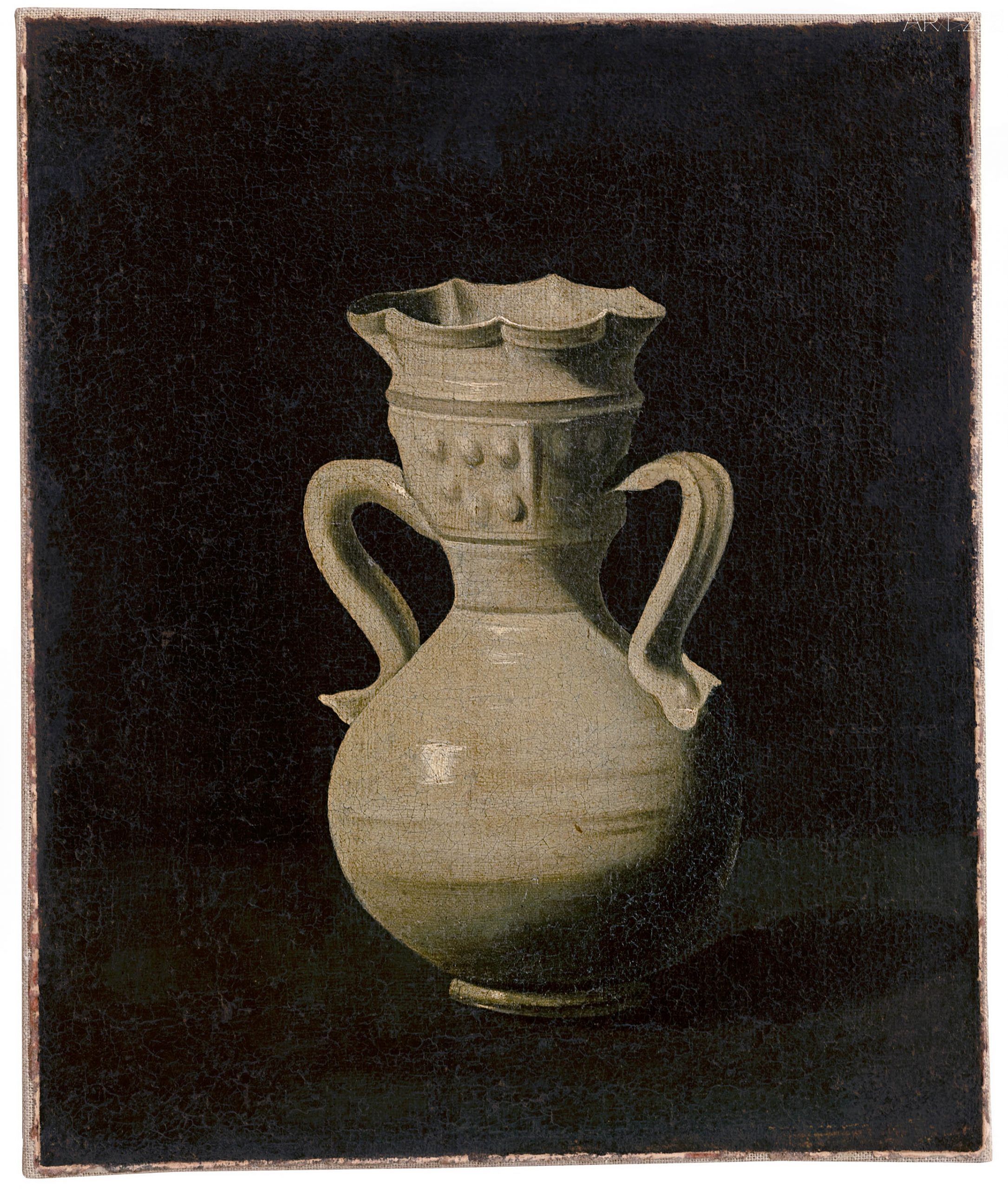
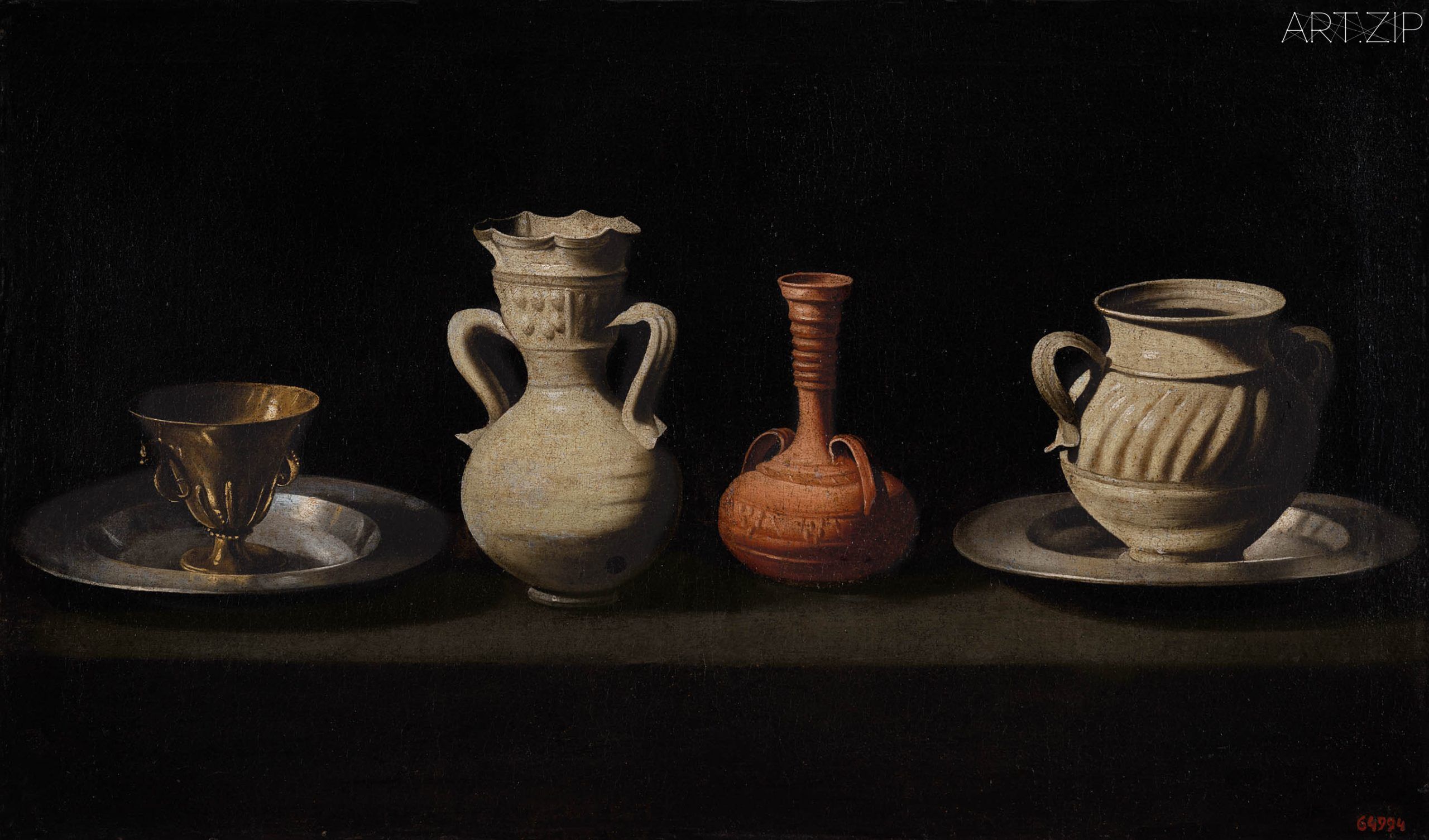
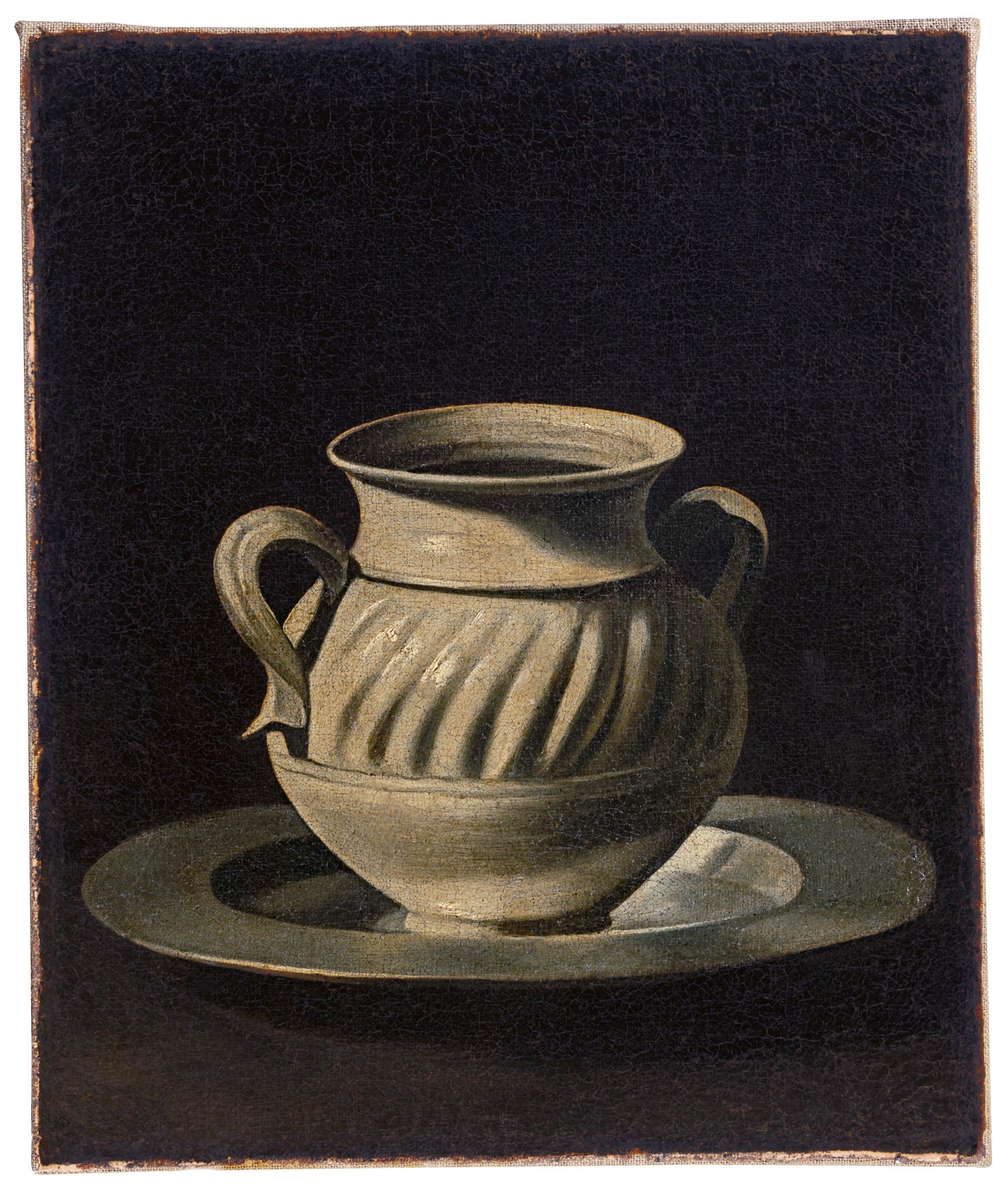
Besides the gravity of the religious work, Zurbarán’s still lifes feel more delicate and intimate. He is thought to have painted no more than ten in his life, which makes the sixth room a rare opportunity. The Norton Simon Foundation’s Still Life with Lemons, Oranges and a Rose hangs for the first time alongside the National Gallery’s A Cup of Water and a Rose. Through exact control of light, space and arrangement, everyday objects acquire a quiet, almost meditative intensity. Four still lifes by his son Juan de Zurbarán are shown in the same room, allowing the different approaches of father and son to material, light and colour to come into dialogue.
White ceramic, clear glass, ripe fruit, open blossoms, all are painted with such immediacy that you can hardly stop yourself from reaching out. The coldness of glazed pottery, the thickness of peel, the transparency of glass, and the softness of petals: each material declares itself differently under the same light. Fruit and flowers glow, saturated and full, as though competing to display life at its most radiant.
And yet none of this brilliance is loud. The objects keep a precise distance from one another, set out in sequence on a bare ledge, as if placed within a silent order. However vivid the colour, the picture holds to something close to ritual calm.
Under Zurbarán’s hand, looking at a cup, a rose or a few lemons becomes an act of slow contemplation. Ordinary things stop being objects of use or admiration, and take on a gravity that is very nearly religious.
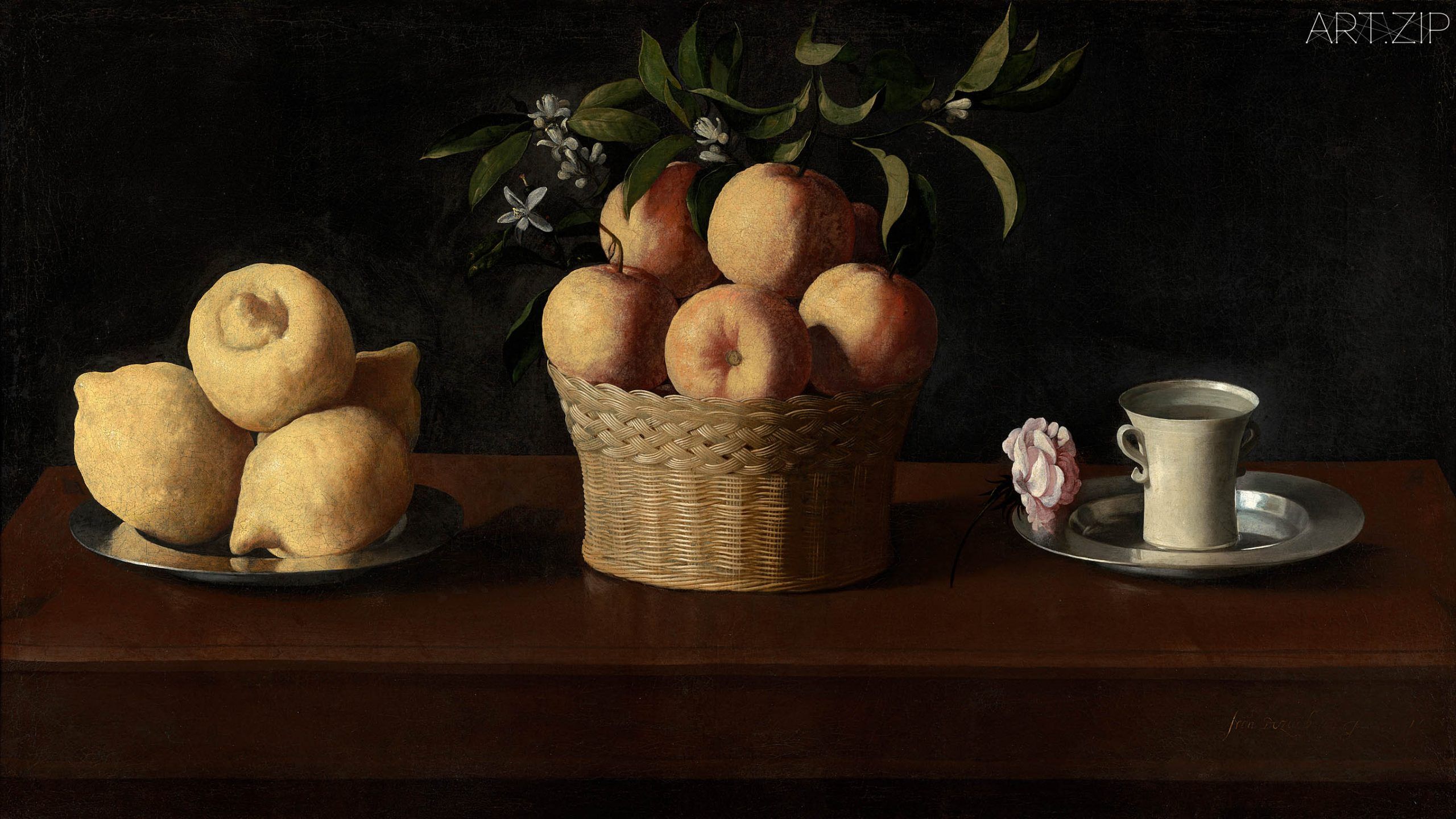
Still Life with Lemons, Oranges and a Rose, 1633 Oil on canvas, 62.2 × 109.5 cm The Norton Simon Foundation, Pasadena, California © The Norton Simon Foundation
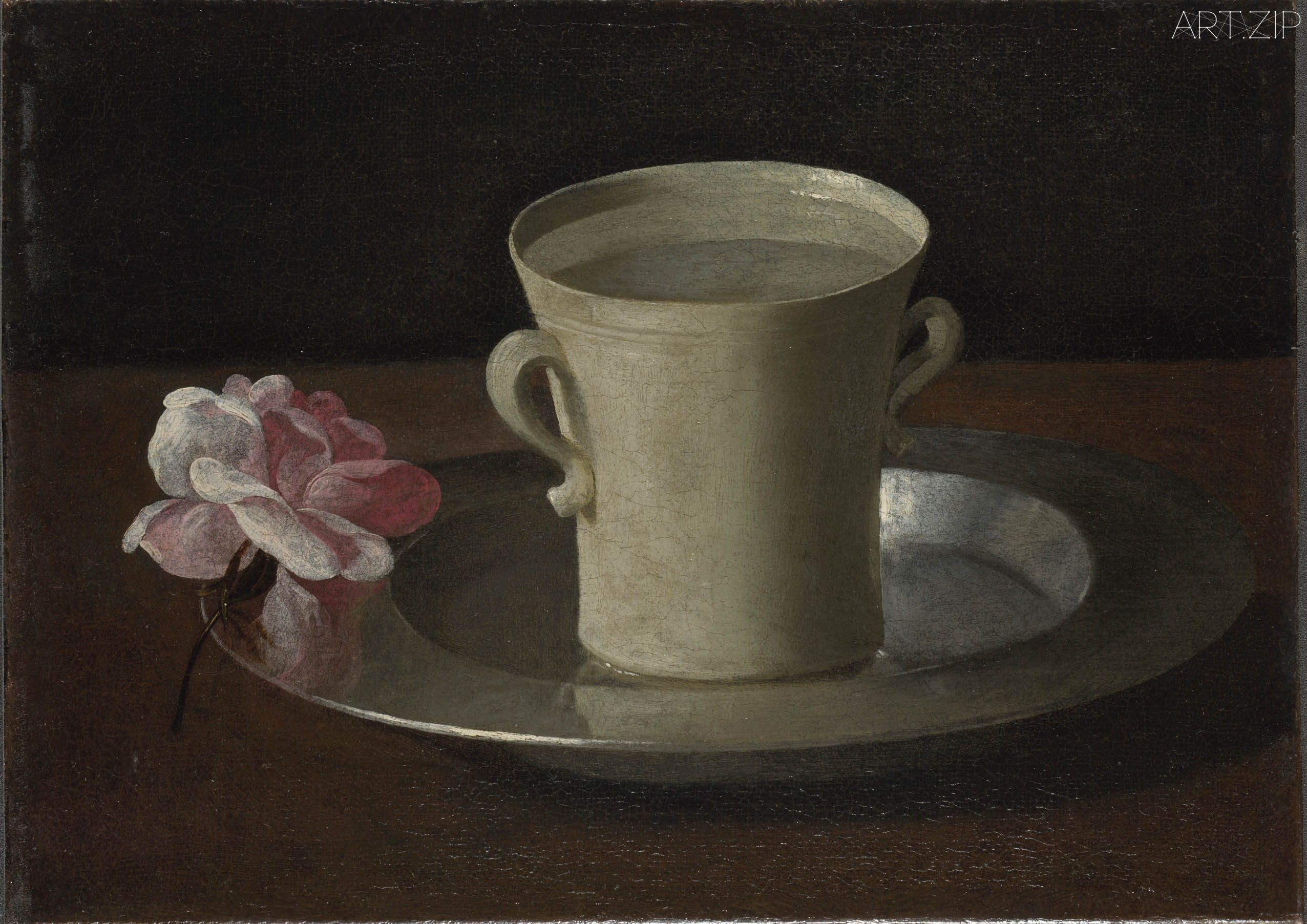
Francisco de Zurbarán A Cup of Water and a Rose about 1630 oil on canvas 21.2 × 30.1 cm © The National Gallery, London
A Glowing Mass of White
As the exhibition draws to a close, it turns towards the small paintings Zurbarán made for private devotion and contemplation. They no longer overwhelm by size, yet they lose none of their power. In the Prado’s Agnus Dei, a lamb lies on a stone ledge, its feet bound. The sacrifice has not yet taken place, but it already feels inevitable. The composition is almost empty; the fleece, by contrast, is dense and particular — a faintly glowing mass of white pressed against limitless black. It is at once an animal observed and rendered with exactness, and an emblem of Christ’s sacrifice. It is precisely through this specific, soft and vulnerable body that religious meaning finds its most immediate form.
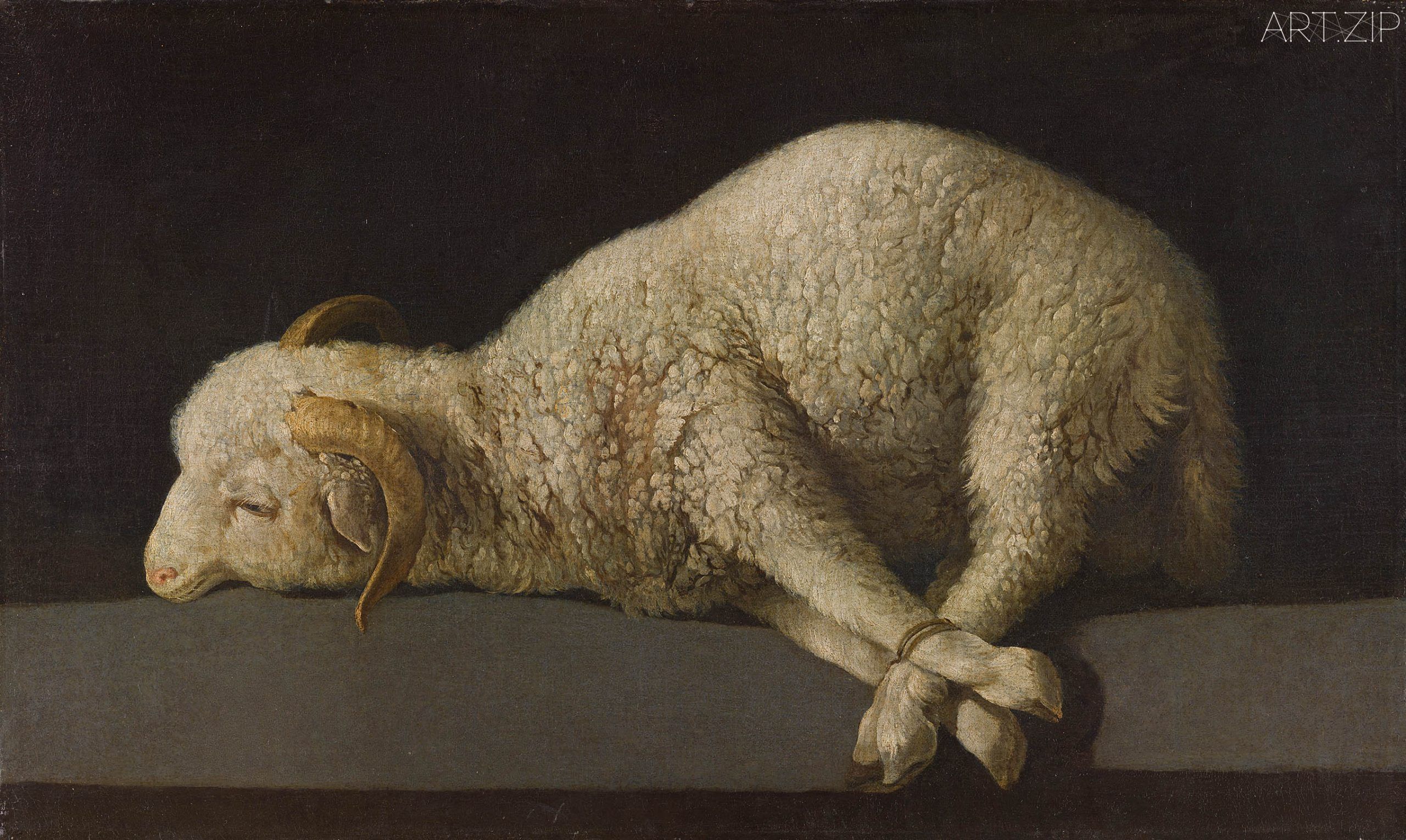
Francisco de Zurbarán Agnus Dei, 1635 – 1640 Oil on canvas, 37.3 x 62 cm Museo Nacional del Prado, Madrid © Photographic Archive Museo Nacional del Prado
Influenced by the realism of Caravaggio and his followers, Zurbarán used concentrated light, dark grounds and sculptural form to give religious figures an unusually powerful presence. However, he does not stop at rendering the visible world. What is distinctive about his art, perhaps, is the way the weight of matter becomes the means by which the spiritual is felt: the more exactly he paints a length of cloth, a spray of flowers, a lamb or a body, the closer the painting comes to what cannot be painted directly.
The National Gallery’s spacious, restrained hang allows that force to emerge in its own time. What the exhibition reveals is not a single fixed style, but an artist repeatedly measuring, over and over, the almost invisible line between the monumental and the intimate, the real and the visionary, matter and spirit.
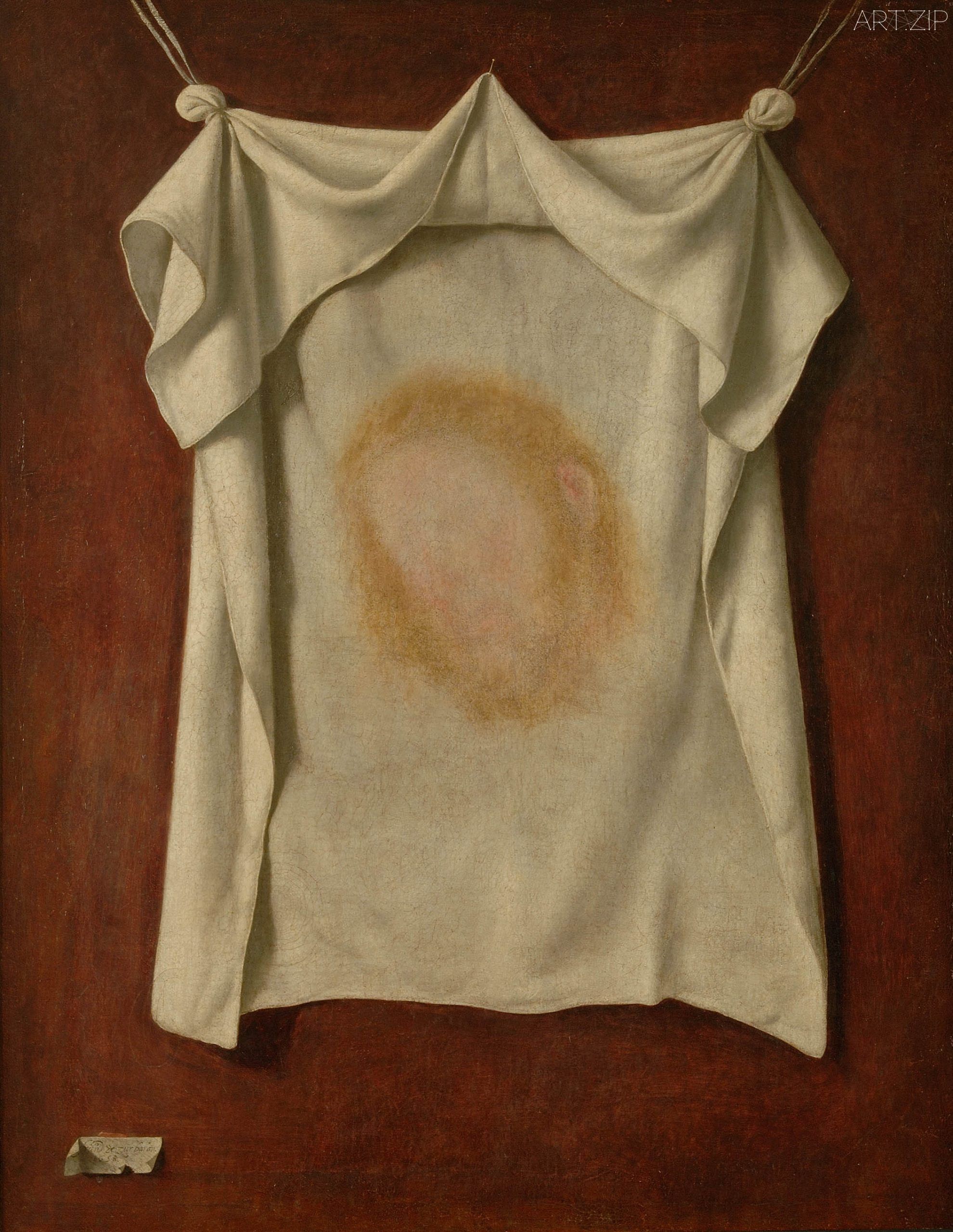
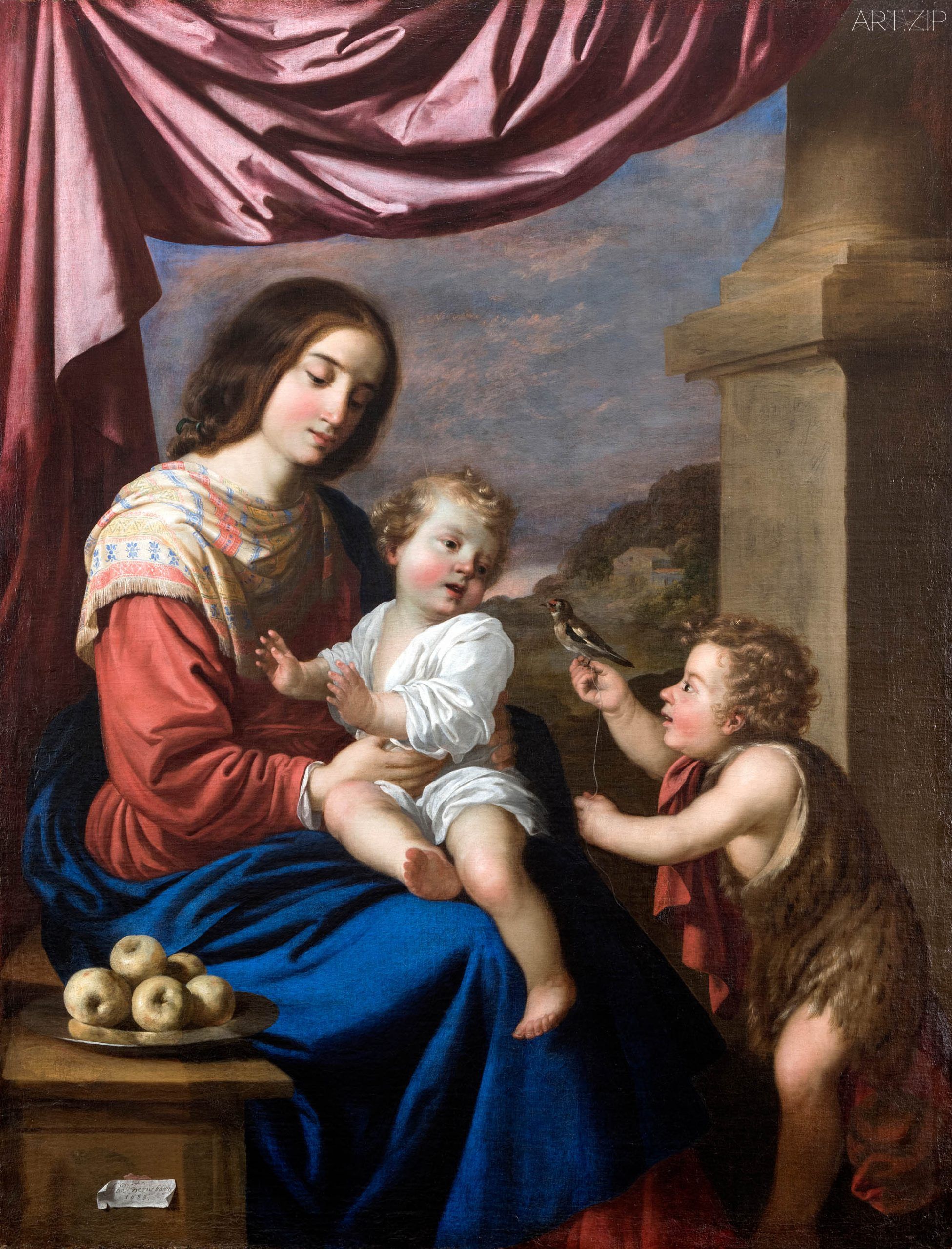
The Veil of Veronica, 1658 Oil on canvas, 105 × 83.5 cm Museo Nacional de Escultura, Valladolid © Museo Nacional de Escultura, Valladolid, Spain
在英國國家美術館的塞恩斯伯里翼樓,正在舉辦的是英國首個以西班牙巴洛克大師弗朗西斯科·德·蘇巴朗(Francisco de Zurbarán, 1598-1664)為主題的大型專題展《蘇巴朗》(Zurbarán)。作為與委拉斯凱茲和穆里略齊名的17世紀西班牙畫家,蘇巴朗以自然主義、直接有力的視覺語言與深沉的情感力量而著稱:既有氣勢恢宏的祭壇畫與真人尺幅的聖徒形象,也有供私人祈禱與沉思使用的小幅作品。
近五十幅繪畫被編排為七個單元,沿著時間與圖像題材兩條軸線,徐徐展開蘇巴朗的藝術生涯。從他為塞維利亞宗教團體完成的大型委託,到反覆描繪的聖徒與不同時期的「聖母無染原罪」,從供私人凝視的祈禱畫,到受邀前往馬德里,為西班牙國王腓力四世的布恩·雷蒂羅宮「王國廳」創作的赫拉克勒斯系列,展覽讓不同面貌的蘇巴朗在同一空間彼此映照。
在留白中,與作品單獨相處
相比過往的展覽,國家美術館此次的展陳對蘇巴朗作品的呈現近乎慷慨。偌大的展廳裡只安放少數幾幅巨作,作品與作品之間保留著充足的距離。沒有過度密集的資訊,也沒有急於將觀眾推向下一幅畫的動線,整個展覽因此形成了一種緩慢而沉靜的節奏。
觀者可以退後,看人物如何佔據整面牆壁;也可以走近,細看衣褶的起伏、皮革的厚度、羊毛的蓬鬆,以及器皿表面短暫停駐的光。這些留白不只是展陳上的空間,也延長了觀看的時間。每走進一個展廳,幾乎都有一幅作品令人猝然停下。它們不必彼此爭奪目光,而是在相對獨立的狀態中,逐漸顯露自身的尺度、重量與精神力量。
這種陳列方式尤其適合蘇巴朗。他經常將人物從複雜的敘事環境中抽離:聖徒獨自站在幽暗的背景前,臉孔、雙手與衣袍被集中的光線照亮,像是剛剛穿過黑暗,來到觀眾面前。展廳中的空白進一步放大了這種效果,使觀看不再只是閱讀一則宗教故事,而更像是與畫中人物進行一次正面的、近乎靜默的相遇。
在眾多巨作之中,1627年的《耶穌受難》(The Crucifixion)成為理解蘇巴朗最直接的入口。這幅由芝加哥藝術博物館借展的作品,也是他現存最早一幅帶有簽名與年份的作品。
畫面裡看不到遼闊的景觀 ,也沒有多餘的敘事線索,只有近乎全黑的空間、一道集中的強光,以及被推至觀眾眼前的基督身體。光線沿著胸膛、手臂與雙腿滑過,使這具身體獲得鮮明的體積與雕塑般的存在感。據國家美術館引述的一則18世紀記載,當時在塞維利亞聖保羅雷阿爾道明會修院昏暗的聖器室裡看到這幅畫的人,一度將它誤認為一尊雕像。
這幅畫幾乎預告了整場展覽的核心:蘇巴朗始終在試探圖像與實物、觀看與觸覺之間的界線。
壯麗的信仰,可觸的現實
蘇巴朗的宗教繪畫首先帶來的是一種壯麗與崇高。真人大小的聖徒、修士和受難中的基督,都具有沉重而真實的身體。他們並不飄浮於遙遠而抽象的神聖世界裡,而是帶著皮膚、重量、布料與呼吸,真切地進入我們所在的空間。
然而,這份崇高並不建立在華麗的場景或繁複的裝飾之上。恰恰相反,它來自畫面的克制與集中。蘇巴朗經常刪去不必要的敘事線索,讓一個人物、一襲白色長袍,甚至一隻四足被縛的羔羊,承載整幅畫的情感重量。深色背景壓縮了人物周圍的空間,集中的光線則使臉孔、雙手和厚重的衣袍從黑暗中浮現。畫面看似寂靜,內部卻凝聚著強烈的精神張力。
衣料在這裡不只是覆蓋身體的裝飾,也成為塑造人物精神氣質的重要部分。展覽以「聖徒的織物」為題的一節,正落在這一點上。蘇巴朗的父親是一名布商,或許這使蘇巴朗自幼便對織物格外敏感;17世紀塞維利亞的宗教遊行、儀仗與戲劇演出,也為他提供了豐富的視覺經驗。羊毛、刺繡、皮革與細繩,在蘇巴朗的筆下各自擁有不同的重量與觸感。厚重的修士袍彷彿會隨身體下墜,細密的刺繡在光線下微微隆起,粗糙的羊毛則顯現柔軟而溫暖的蓬鬆。正是這種對物質細節近乎執著的描繪,使他的聖徒不再只是宗教圖像,而成為彷彿來自我們這個世界的人物。
其後一節以「聖母無染原罪」為軸,將蘇巴朗不同時期對同一主題的處理並置呈現。在相同的圖像框架之中,人物的姿態、色彩、光線與空間不斷改變,觀眾因而得以看見,蘇巴朗如何一次次回到熟悉的主題,又如何一次次尋找新的路徑,喚起相似卻又不盡相同的情感。
從孤獨的聖徒,到充滿想像力的群像
如果說蘇巴朗最廣為人知的形象,是那些從黑暗中浮現的孤獨聖徒,那麼展覽中的大型群像與宗教敘事畫,則展現了他另一種更複雜、也更富想像力的才華。
在《阿隆索·羅德里格斯的異象》等作品中,人物不再被單獨抽離,而是在前景、中景與後景之間錯落展開。不同姿態、衣著和視線的人物彼此呼應,引導觀眾的目光緩慢穿過整個畫面。明亮的白、鮮紅、赭石與深藍從幽暗中逐層浮現,既區分人物的身份與位置,也建立起整幅作品的視覺節奏。
這些群像並不只是將更多人物填入同一個場景。前景中的人物將觀眾帶入畫面,中景承接故事的主要行動,遠處的建築、雲層或異象又將視線推向更深的空間。人物前後交疊,卻不顯得混亂;敘事內容豐富,視覺重心依然清晰。這也說明,蘇巴朗的藝術不能只被概括為簡潔、寂靜或克制。當題材需要時,他同樣能夠營造宏大的場面,以富有層次的色彩、錯落有致的人物關係和充滿想像力的構圖,讓秩序與戲劇性同時存在,使宗教異象與集體事件獲得震撼人心的力量。
1634年,蘇巴朗接到其藝術生涯中最具聲望的委託之一:前往馬德里,參與布恩·雷蒂羅宮的裝飾工程。他為長約35米的「王國廳」創作了十二幅作品,其中《赫拉克勒斯與刻耳柏洛斯》與《赫拉克勒斯與克里特公牛》此次一同展出。在這裡,神話英雄取代了聖徒,裸露的肌肉取代了厚重的修士袍;但蘇巴朗以光線將身體從黑暗中推向觀眾的方法,並沒有改變。
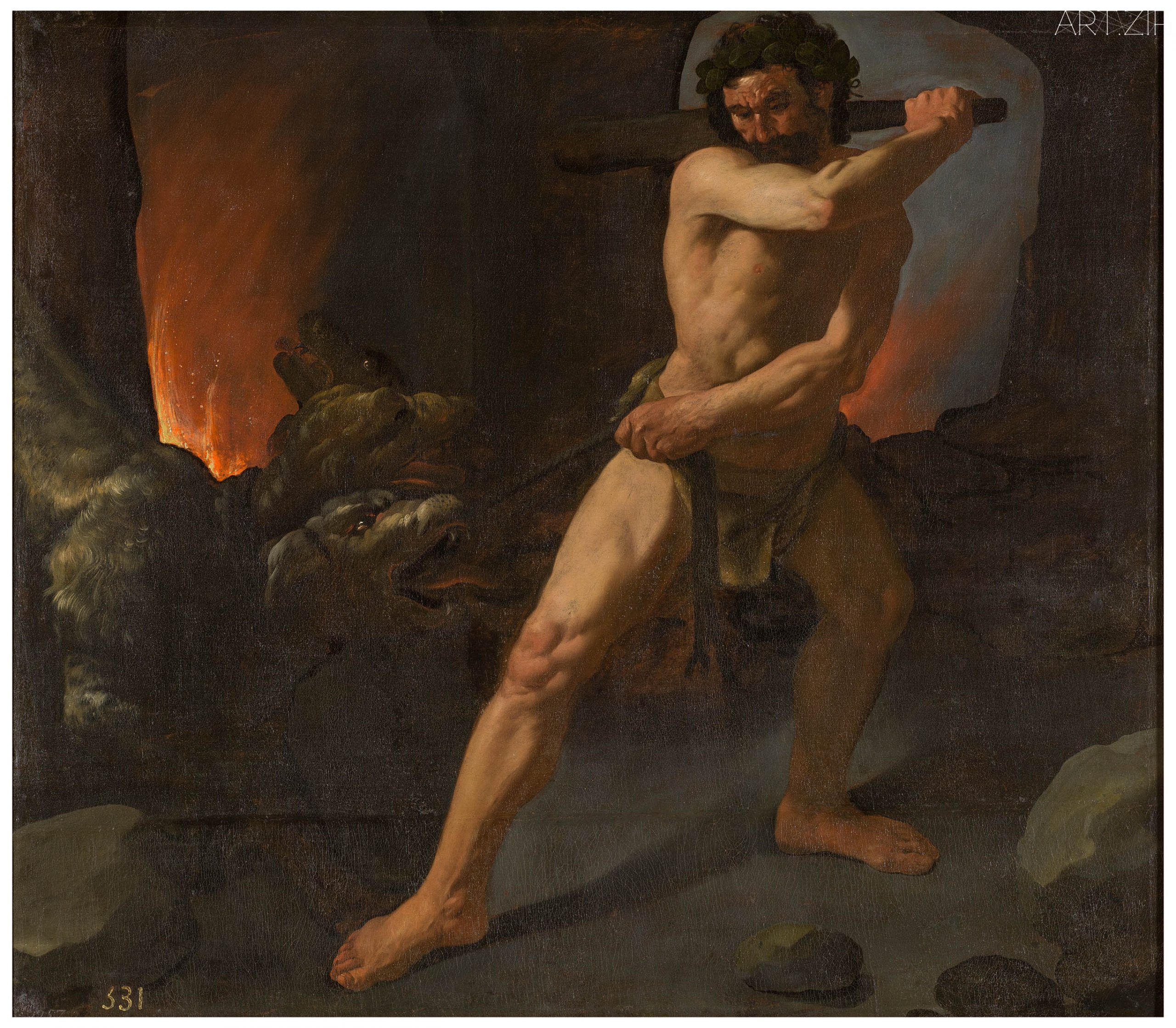
Francisco de Zurbarán Hercules and Cerberus, 1634 Oil on canvas, 132 x 151 cm Museo Nacional del Prado, Madrid © Photographic Archive Museo Nacional del Prado

寂靜而豔麗的日常之物
與宗教作品的莊嚴相比,蘇巴朗的靜物畫顯得更加精緻,也更加親密。據推測,他一生創作的靜物畫可能不超過十幅,因此展覽的第六部分提供了一次難得的觀看機會。諾頓·西蒙基金會收藏的《檸檬、橙子與玫瑰靜物》,首次與國家美術館的《一杯水與一朵玫瑰》並列展出。通過對光線、空間與構圖的精準控制,蘇巴朗使日常物件獲得安靜而近乎冥想般的強度。展廳中亦同時呈現其子胡安·德·蘇巴朗的四幅靜物作品,使父子二人對物質、光線與色彩的不同處理得以相互映照。
純白的瓷器、透明的水杯、成熟的果實與盛開的花朵,都被描繪得讓人幾乎忍不住想伸手觸碰。瓷器的冷硬、果皮的厚度、玻璃的透明和花瓣的柔嫩,在同一道光線中呈現出各自不同的質感。水果與鮮花色澤晶瑩飽滿,彷彿爭相展示生命最豔麗的一刻。
然而,這些豔麗並不喧嘩。物件之間總是保持著精確的距離,依次排列在簡潔的平面之上,像是被安放進一種無聲的秩序。即使色彩鮮明,畫面依然維持著一種近乎儀式性的寧靜。
在蘇巴朗筆下,觀看一隻杯子、一朵玫瑰或幾枚檸檬,也像是在進行一場緩慢的沉思。日常之物不再只是供人使用或欣賞的對象,而被賦予了一種近乎宗教性的莊嚴。
一團發亮的白
展覽進入尾聲,視線逐漸轉向蘇巴朗為私人祈禱與沉思創作的小幅繪畫。它們不再以巨大的尺寸壓倒觀眾,情感力量卻並未因此減弱。普拉多博物館收藏的《神的羔羊》(Agnus Dei)中,一隻羔羊四足被縛,靜臥於石台之上。犧牲尚未發生,卻已無可避免。畫面簡單到接近空無,羊毛卻被描繪得厚實而具體——一團微微發亮的白,壓在無盡的黑裡。它既是一隻被細緻觀察、如實描繪的動物,也是基督犧牲的象徵。正是在如此具體、柔軟而脆弱的肉身之中,宗教意義獲得了最直接的力量。
蘇巴朗受到卡拉瓦喬及其追隨者的現實主義影響,他以集中的光線、幽暗的背景與雕塑般的形體,使宗教人物獲得強烈的現實感。但他並不止於再現現實。他真正獨特之處,或許正在於他能夠通過物質的重量,讓人感受到精神的存在:越是精確地描繪一塊布、一束花、一隻羔羊或一具身體,畫面所指向的,反而越接近那些無法被直接描繪的事物。
國家美術館寬闊而克制的展陳,讓這股力量得以慢慢顯現。展覽呈現的並非一套固定的風格,而是一位畫家如何在壯麗與親密、現實與異象、物質與精神之間,反覆丈量那條幾乎不可見的界線。
Zurbarán
2 May 2026 – 23 August 2026
National Gallery
Text by Jackie Liu, Michelle Yu