
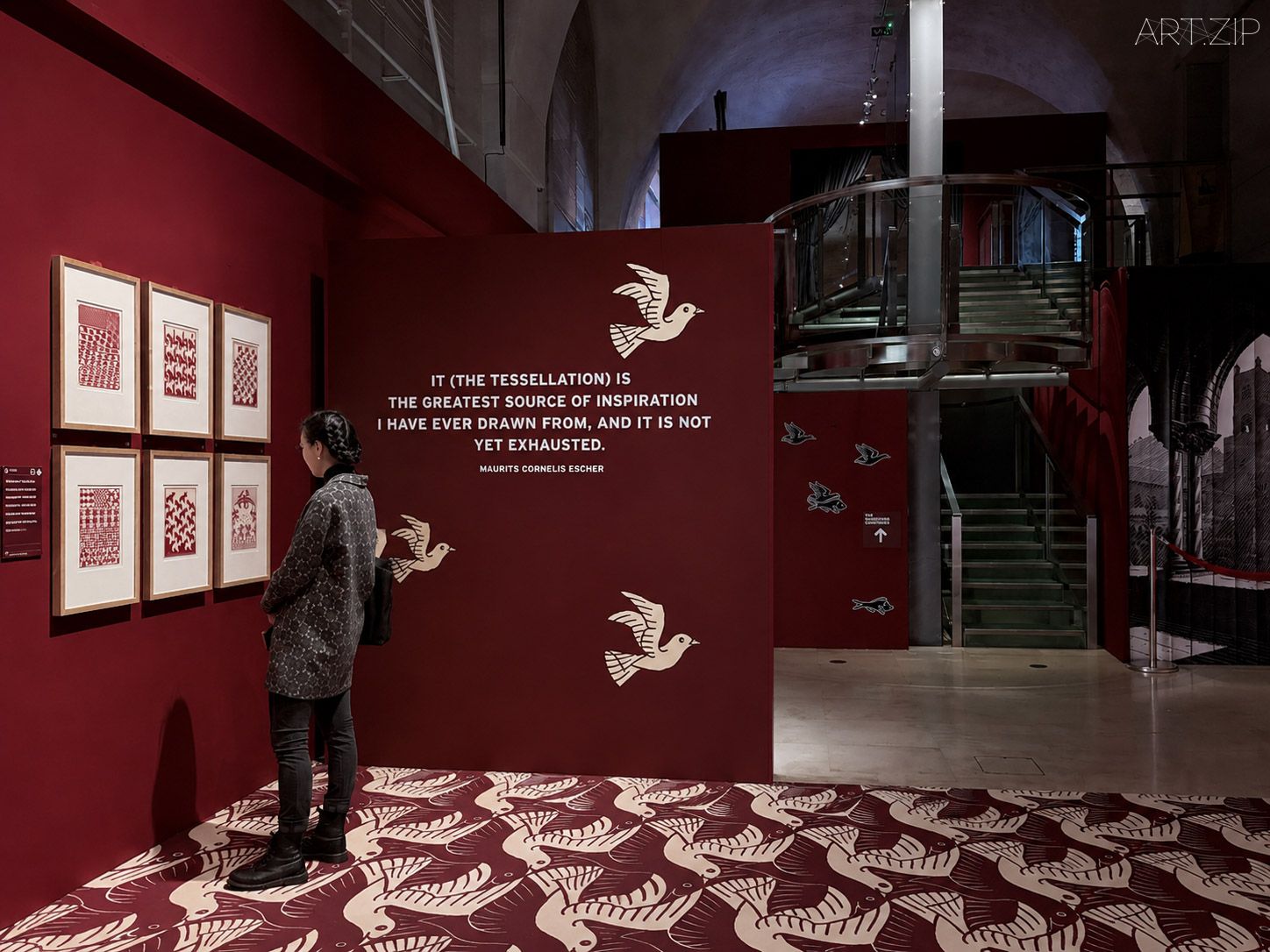
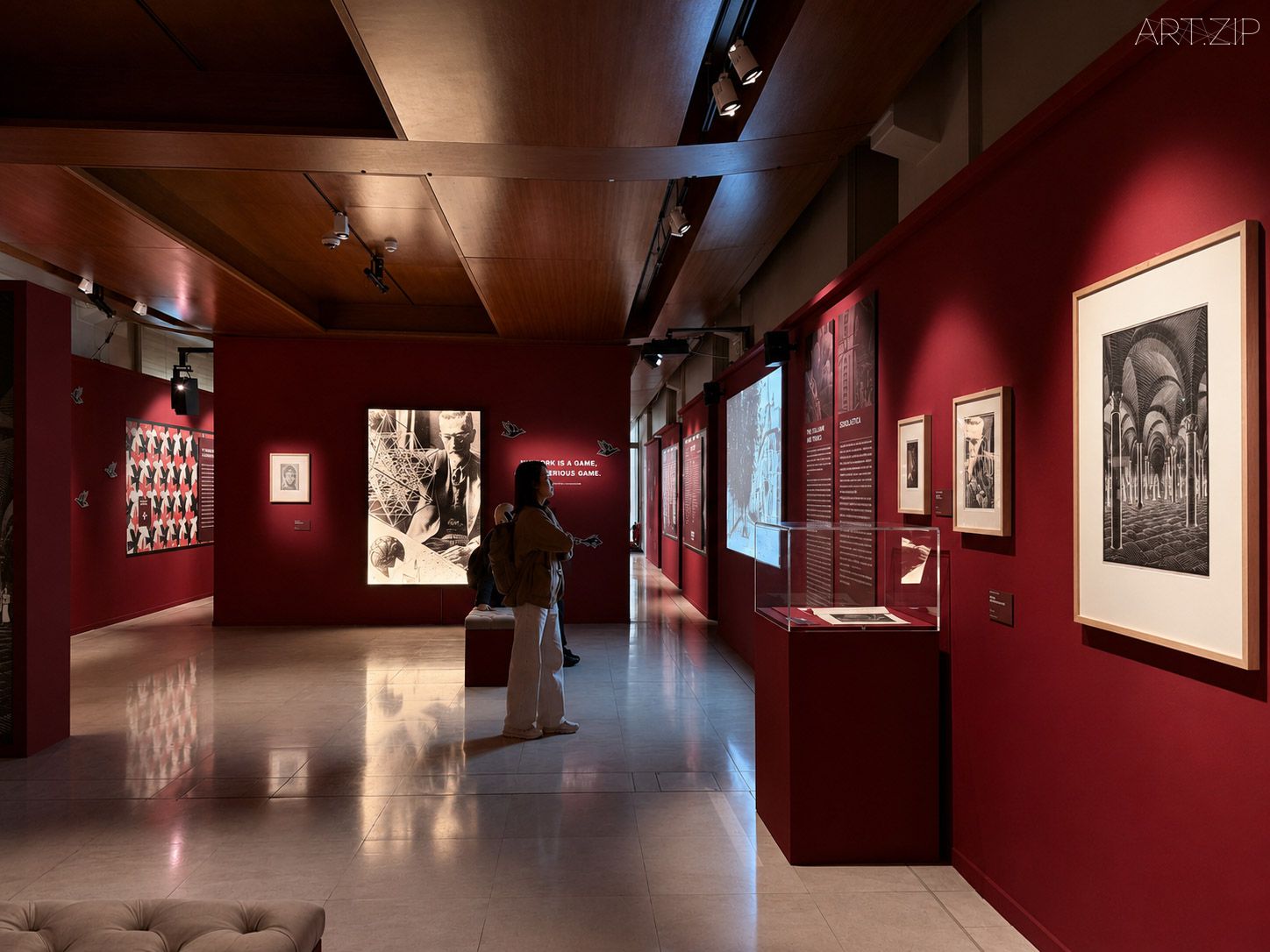
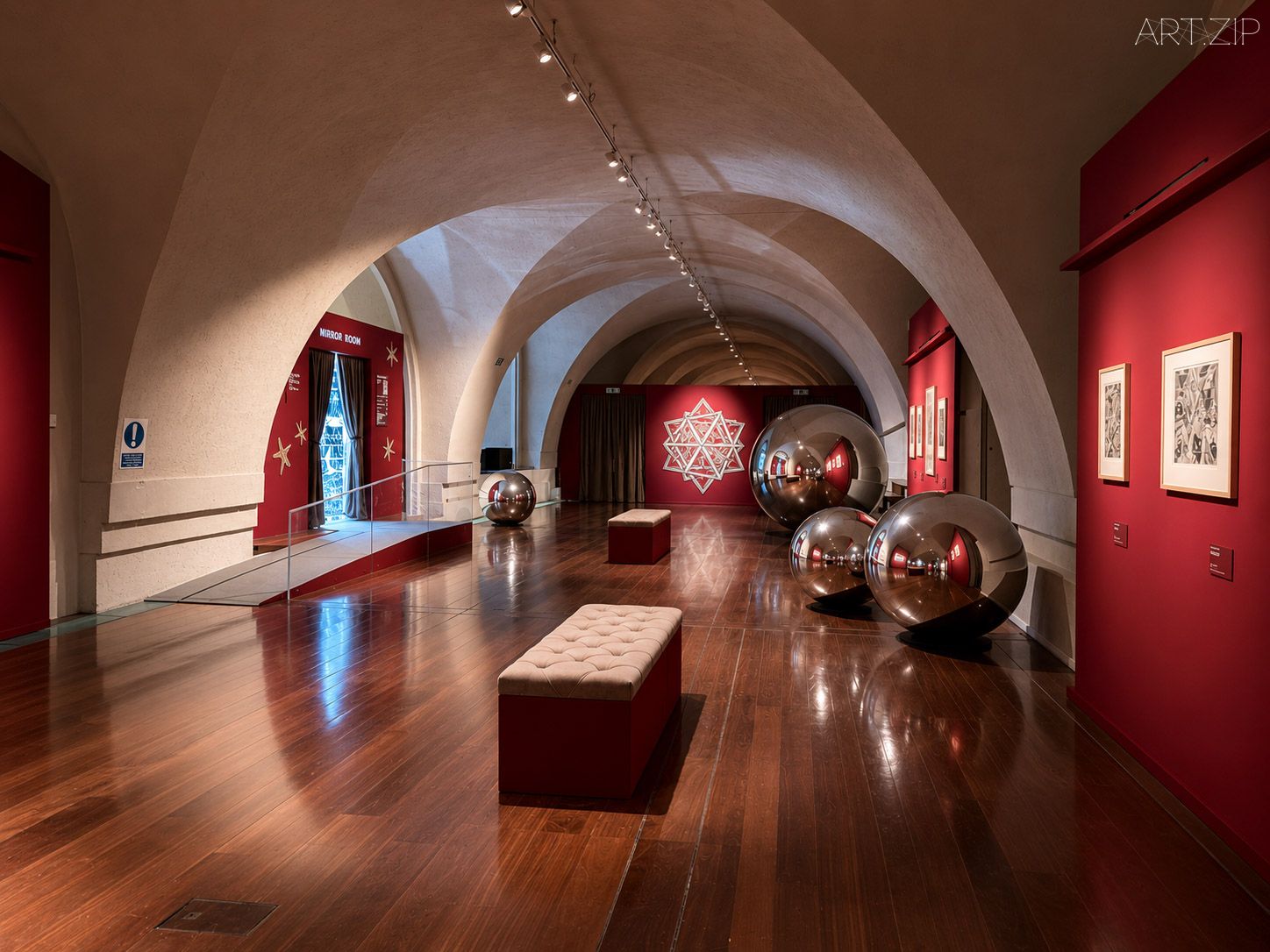
The first thing to greet you in Somerset House’s M.C. Escher: The Exhibition is the deep crimson of the galleries — a colour that deepens the mystery already surrounding Escher. What we tend to remember most readily about him are, of course, those vertiginous images: staircases that arrive nowhere, waterfalls that fold back into themselves, fish becoming birds, hands drawing hands, space quietly losing its authority under the pressure of perfect logic. This is the Escher most easily reproduced, and perhaps most easily circulated. His works seem, at first glance, like a succession of brilliant visual puzzles, naturally fated to migrate from posters to screens to the endless scroll of social media.
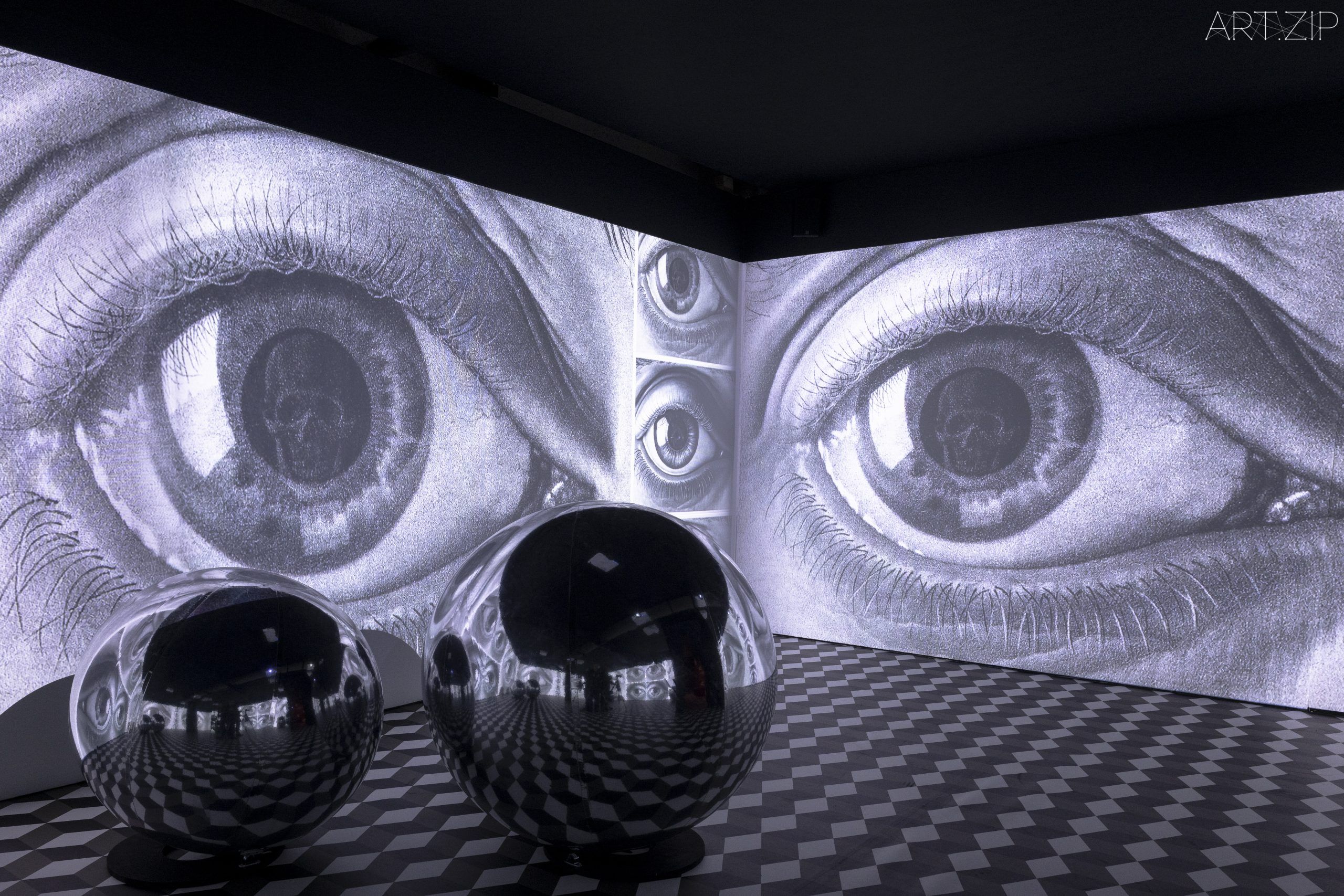
Installation shot. © Photo: Boyu Xiao ©ART.ZIP
Yet what interested me most in this exhibition was a different question: what happens when an artist whose work demands that we slow down, look again and again, and disstrust the evidence of our own eyes, is placed inside the language of contemporary exhibition-making: interactive, immersive, and designed to be photographed? Are his works being brought newly to life, or consumed all over again?
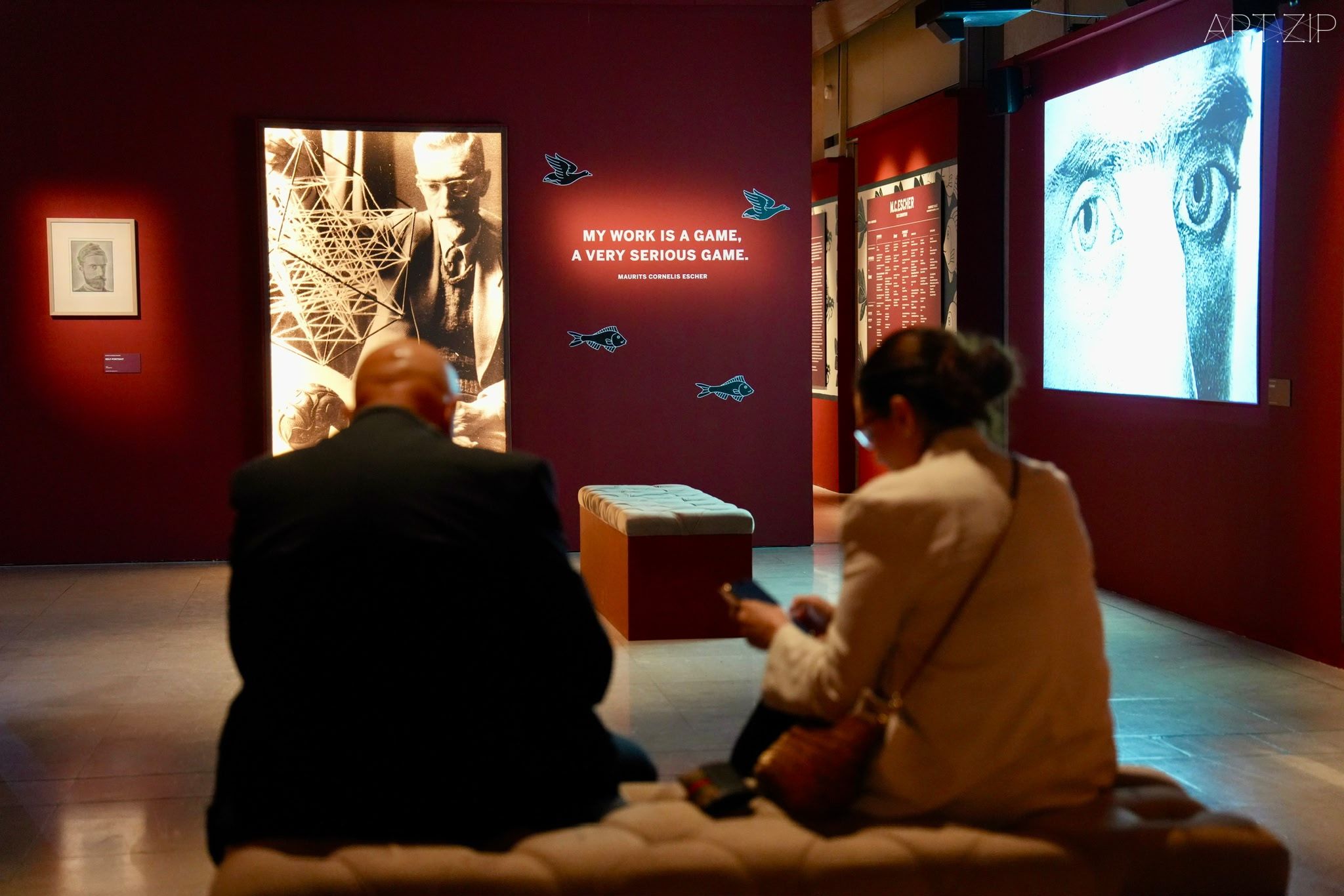
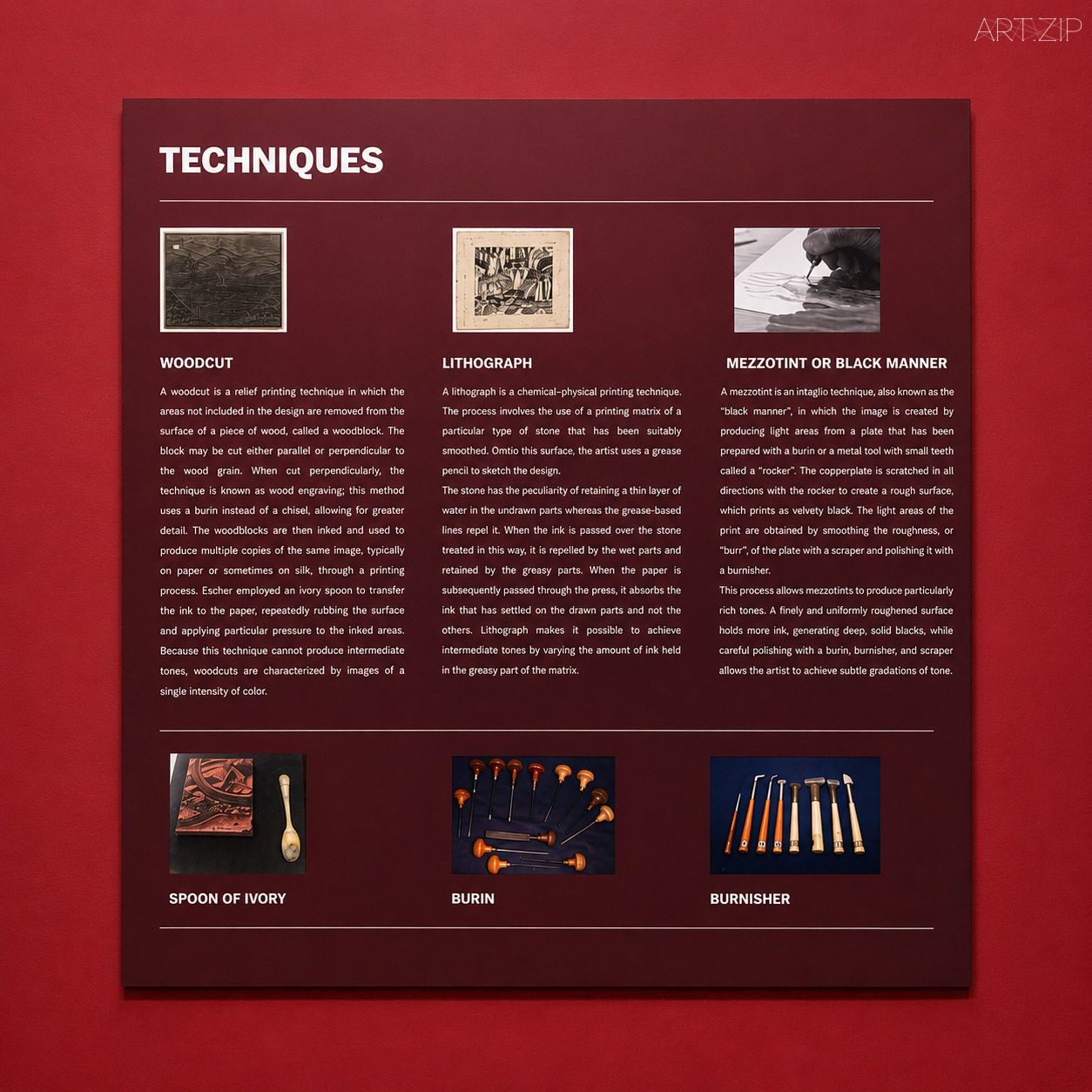
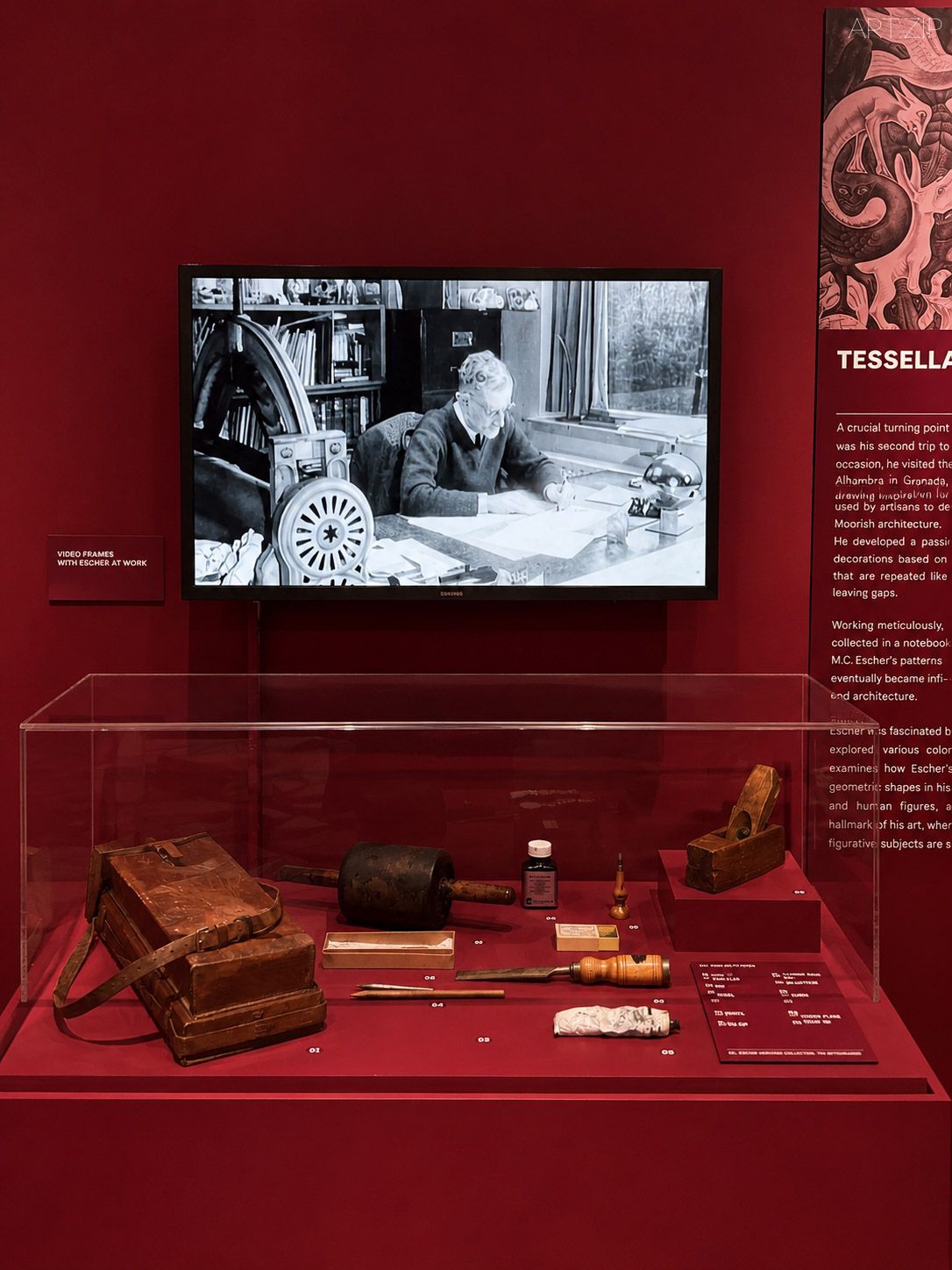
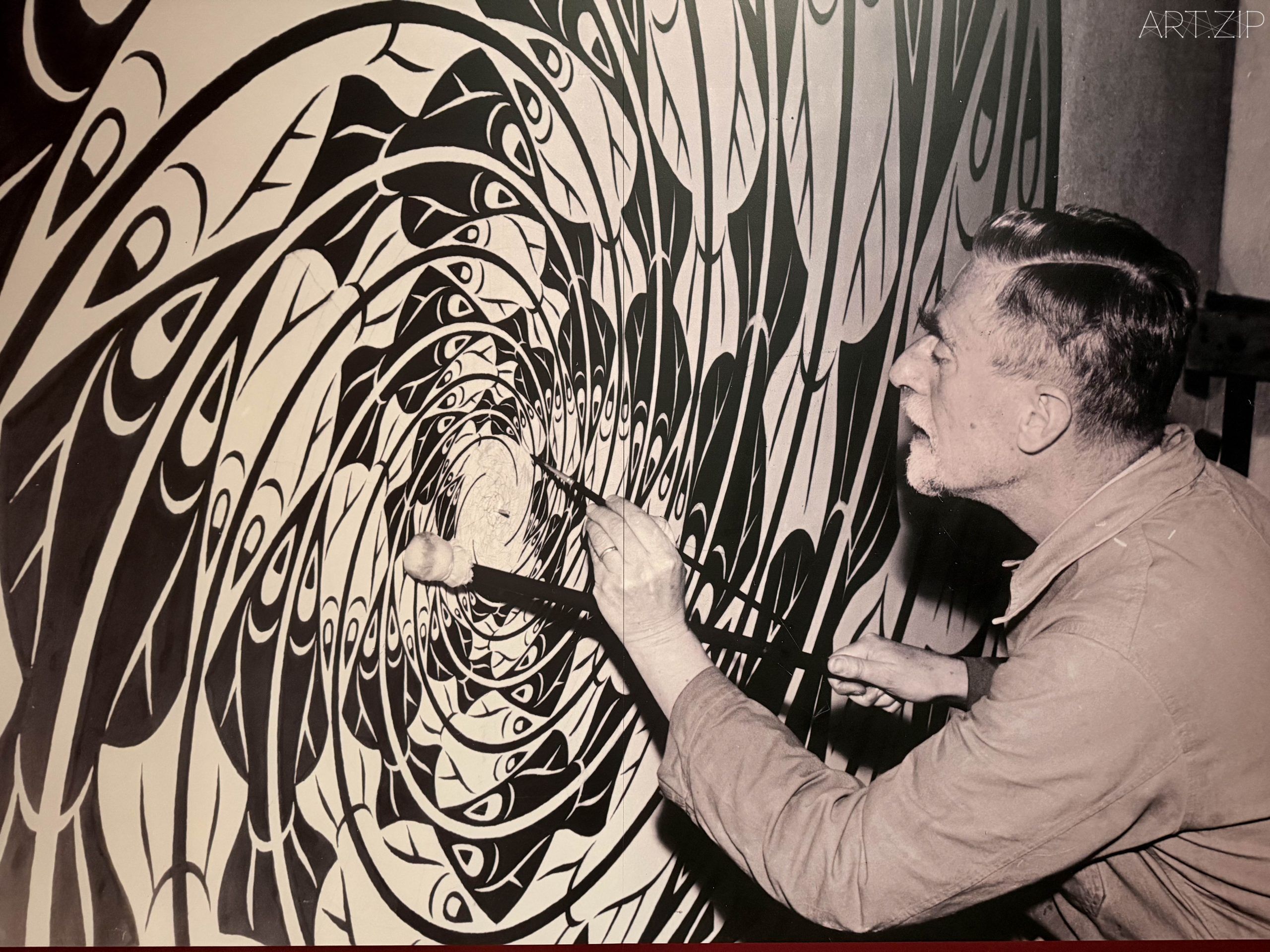
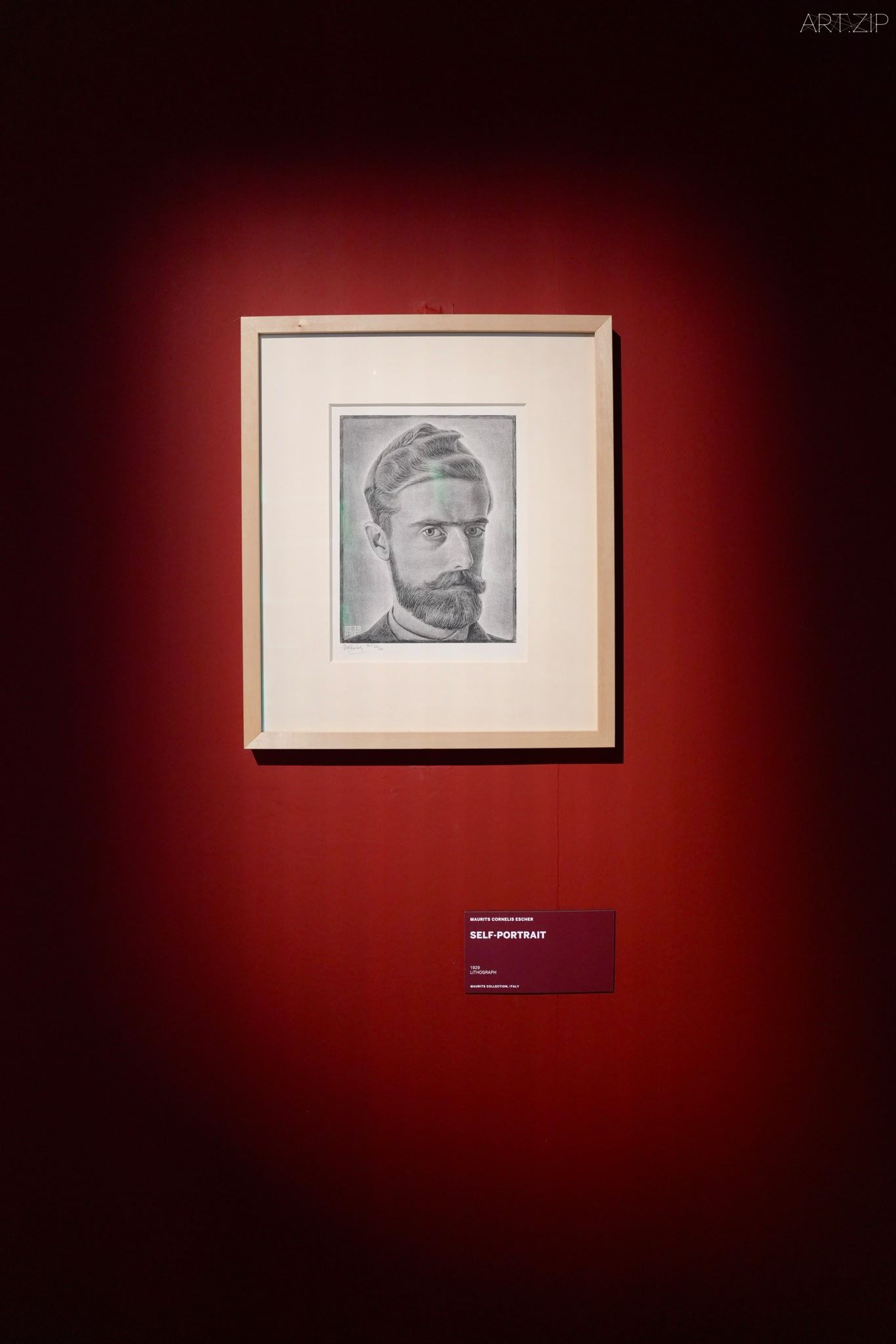
The exhibition does not begin by rushing the viewer towards Escher’s most familiar spectacles. Instead, it starts with his life, his tools, his travels, and the media he worked with. This may seem modest, but it matters. Escher is too easily reduced to a “master of illusion”, as though his achievement were simply the invention of a few clever visual riddles. Here, he is returned to printmaking, to the knowledge of the hand, and to a European visual tradition. Before the magic and optical phantoms truly appear, we are first asked to look first at his hand, those tools, the desk — and at the quiet, slow time through which an image comes into being.
Printmaking, and woodcut in particular, offers a fitting threshold. It demands patience, discipline, and restraint. The lines lie flat, almost pressed into stillness; the wooden block is carved away little at a time, the remaining surface receiving ink, the hollowed-out areas becoming light. Looking at these images, one becomes aware of an almost uncanny precision: every line carries the weight of a decision; every area of black must interlock with the white beside it. Beneath Escher’s later transformations, so light, strange, and ingenious in appearance, lies this harder knowledge of craft. Fantasy does not descend gracefully from nowhere. It grows stubbornly out of material, pressure, edges, and repetition.
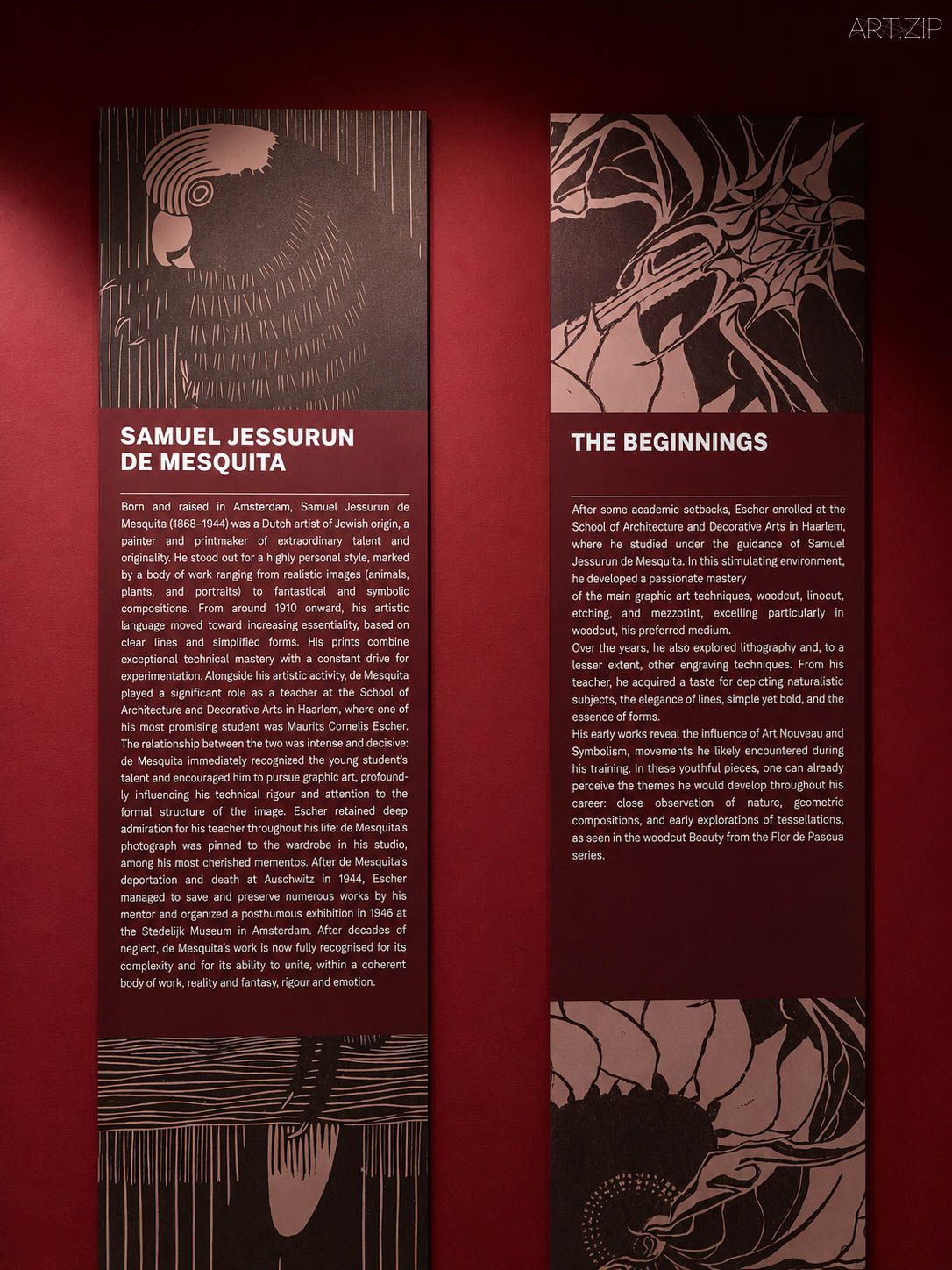
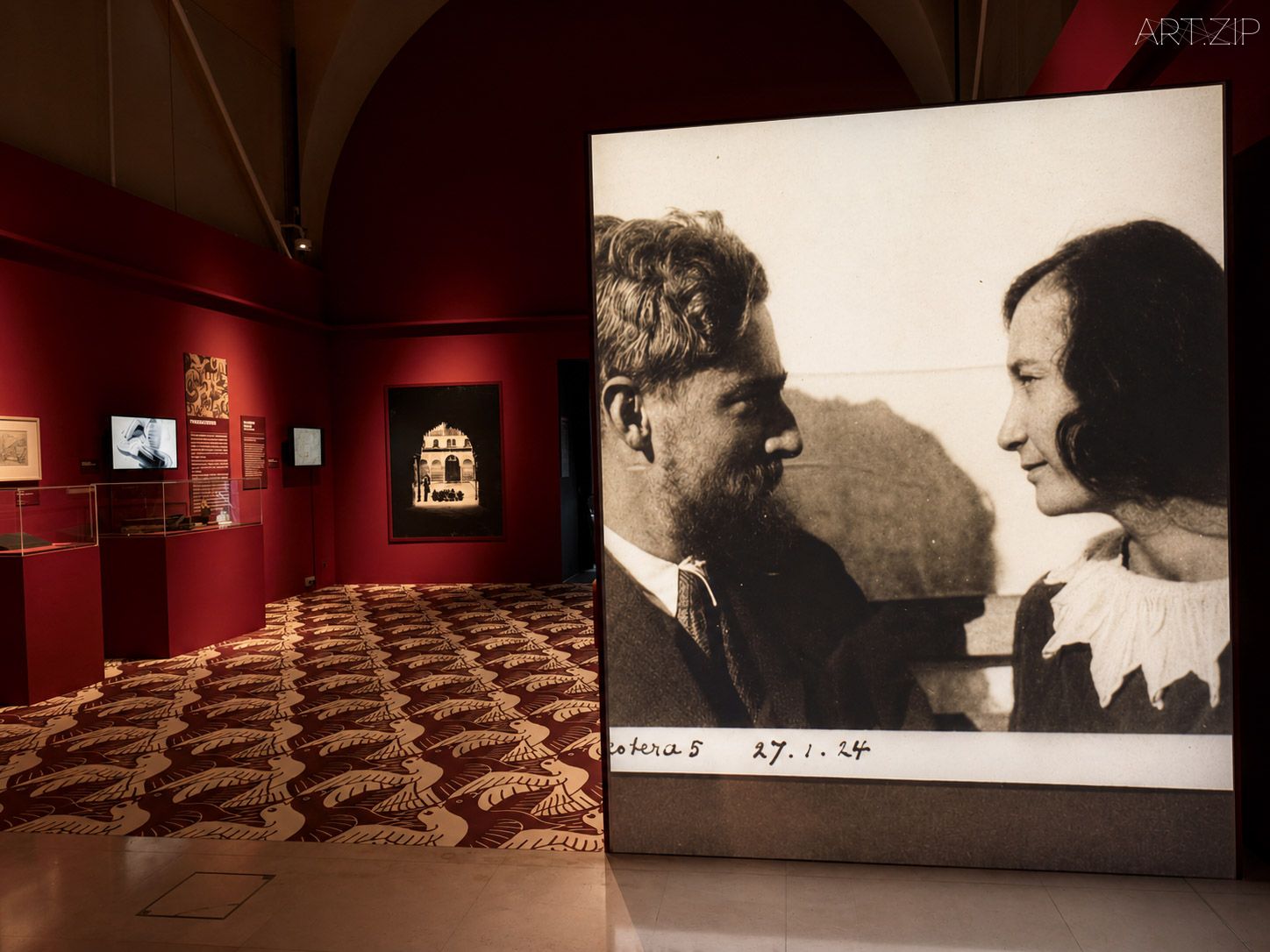
The first half of the exhibition follows this path without haste. The early landscapes, buildings, and natural forms are in no hurry to dazzle. They seem instead to train the eye, to teach the viewer how to attend to structure, shadow, repetition, and order. Across only a few rooms, a new logic of looking begins to take shape. Then transformation enters. Fish, birds, geometric patterns, and architectural spaces gradually refuse to stay where they belong. One form slips quietly into another; the background begins to compete with subject; flatness gathers volume; ornament turns into narrative. Escher’s images reveal their true temperament here. They are not content simply to be seen. They want to overturn the logic of seeing, and perhaps even to remake its rules.
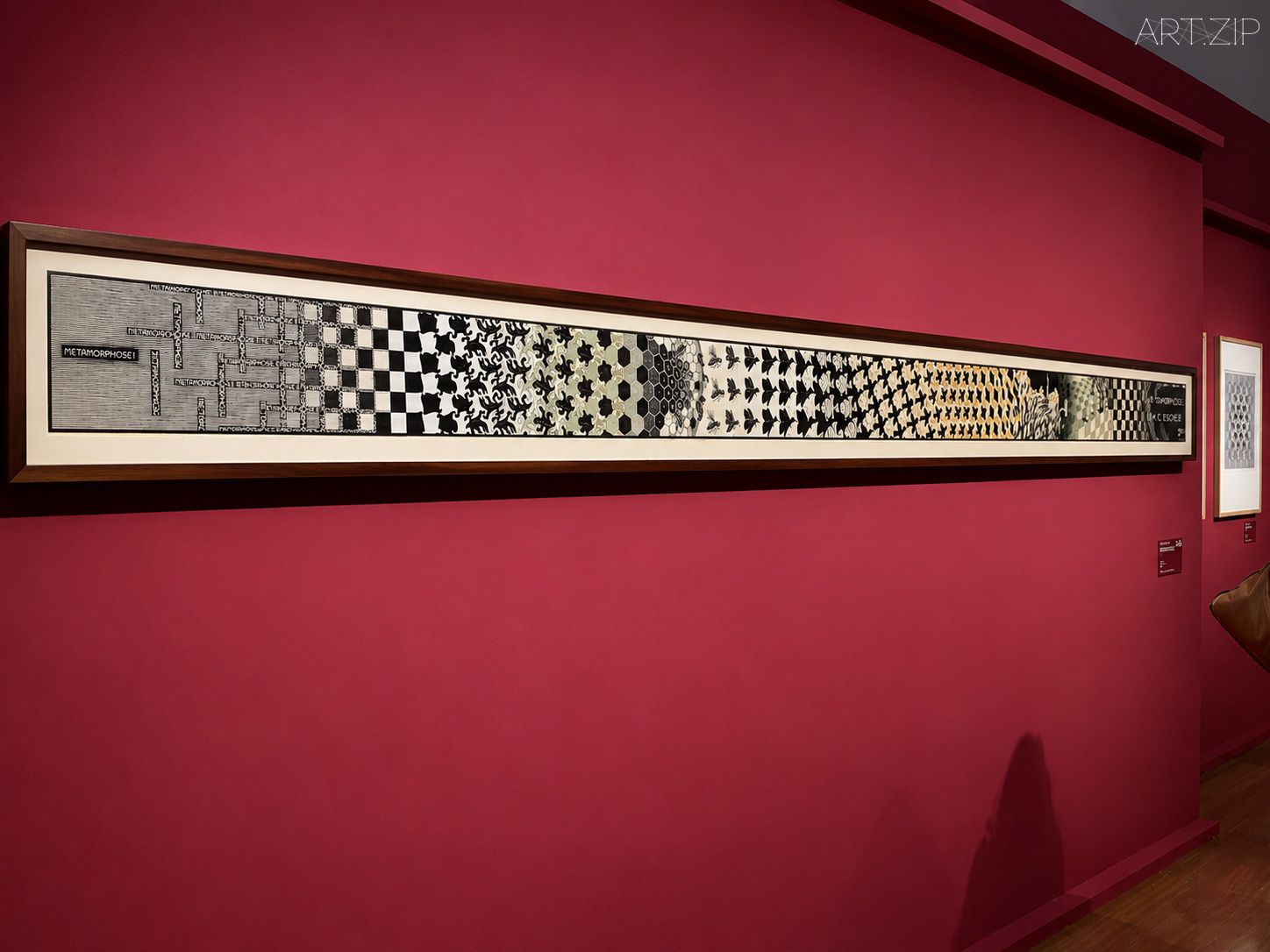
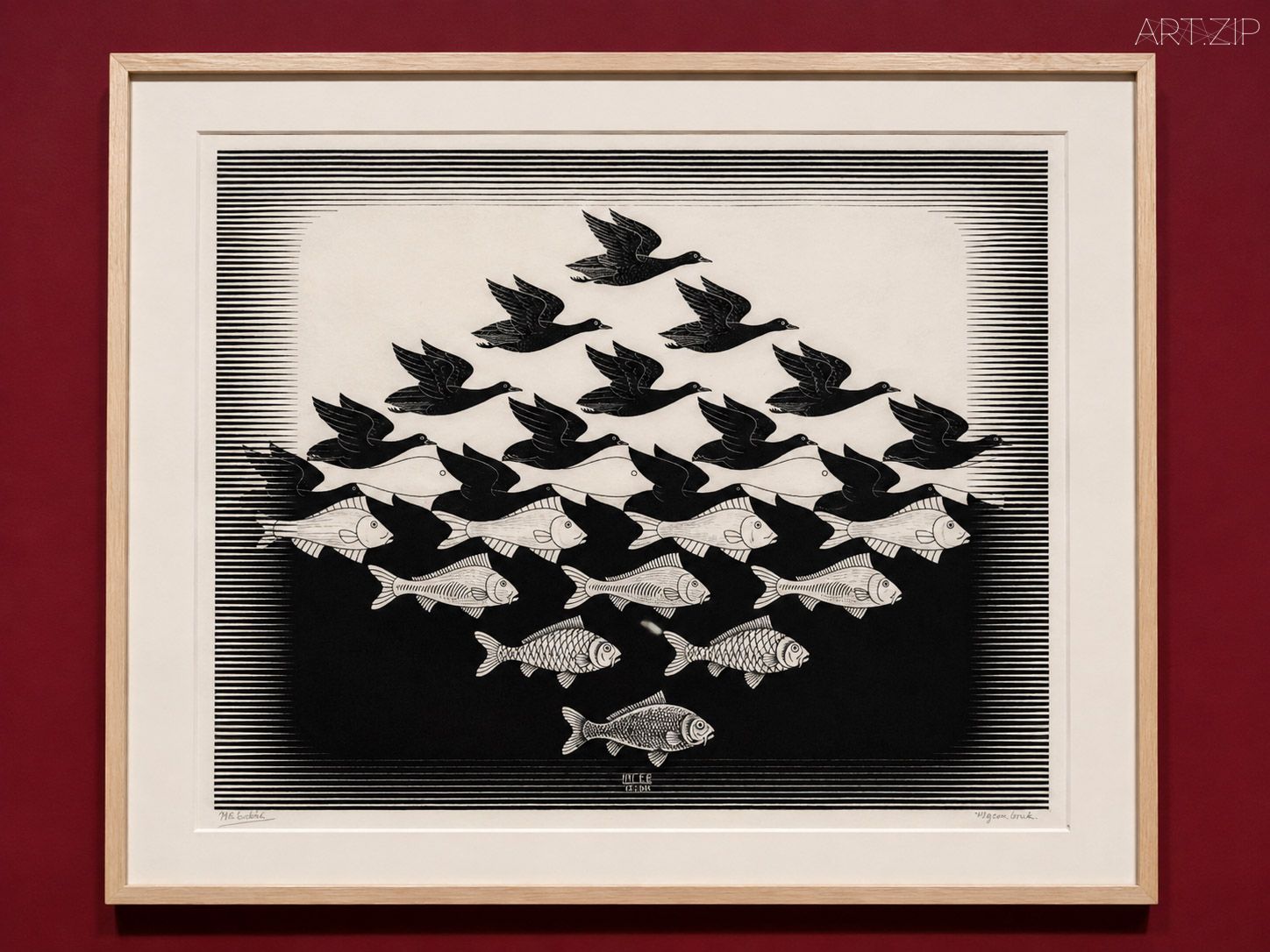
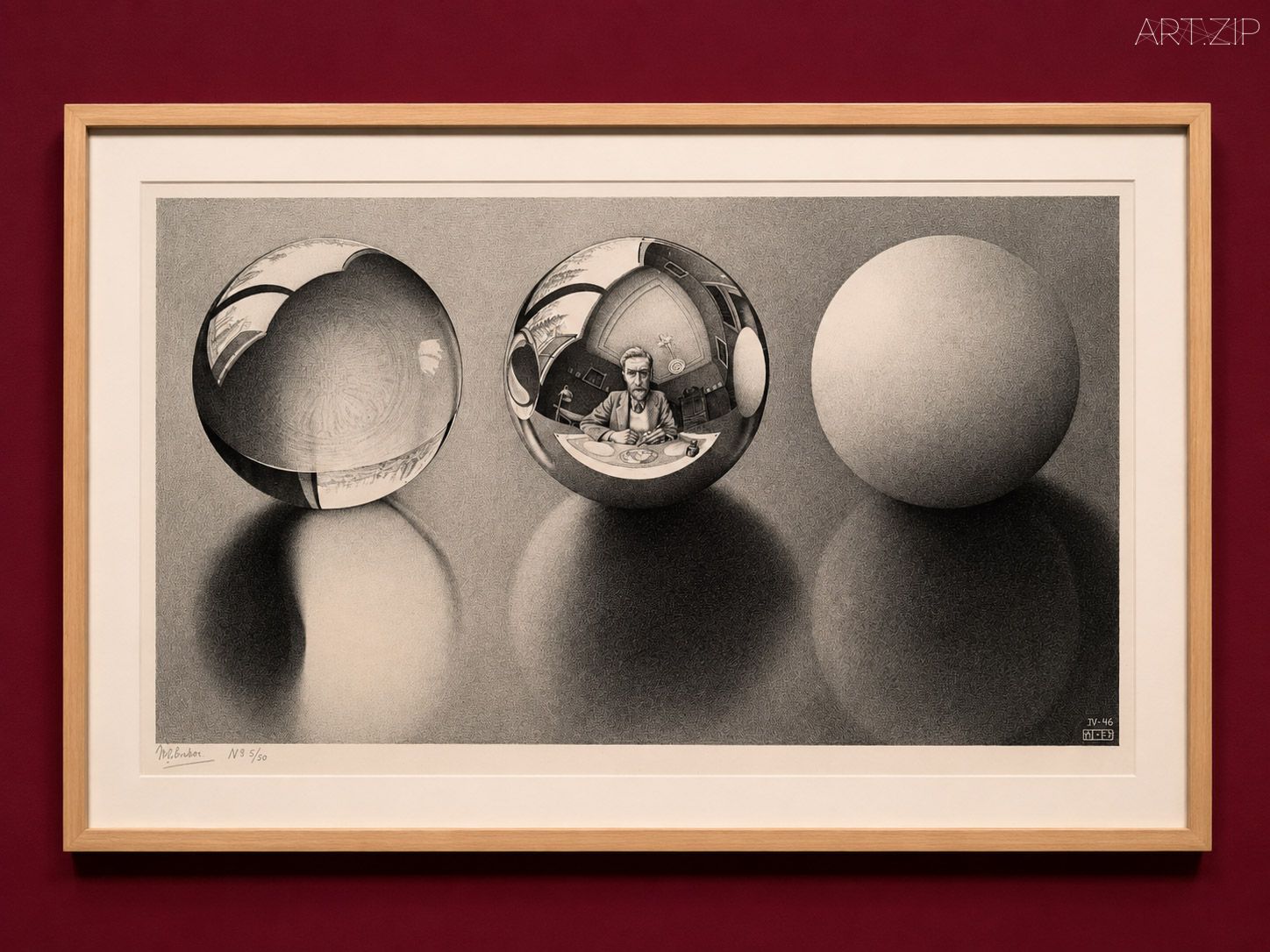
Looking at those images on the ground floor, I soon found myself thinking of Rubin’s vase: that classic black-and-white figure which may appear, in one moment, as a vase, and in the next, as two faces turned towards each other. I thought, too, of ambiguous images such as My Wife and My Mother-in-Law, where the same lines, under a different mode of looking, give birth to different figures. The fascination of such images does not lie in the small trick of ‘seeing two things at once’. Rather, they expose about the economy of vision itself: for one image to emerge, another must withdraw; for something to become figure, something else must agree to become ground. Foreground and background have no fixed identities. They hold their places only through the decision of the gaze.
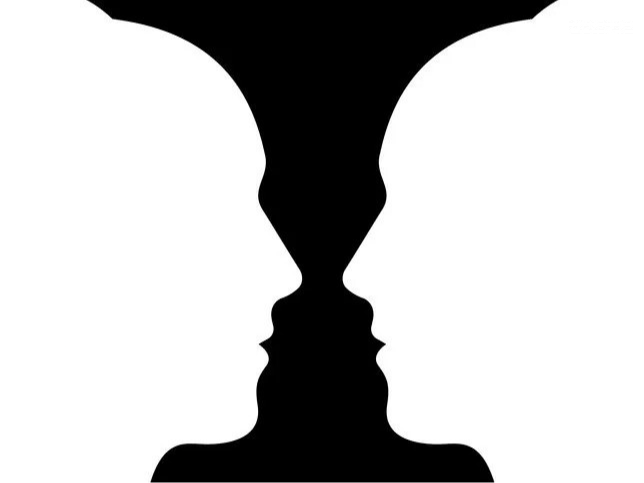
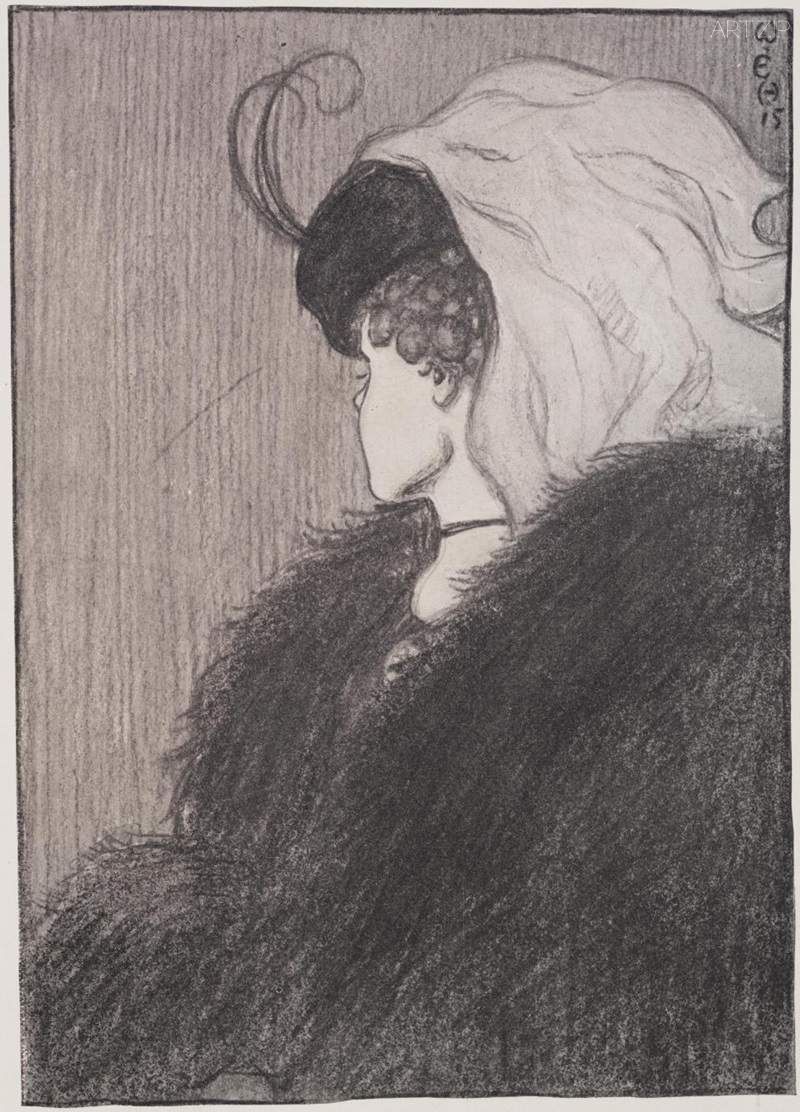
In Escher’s images, this decision is never innocent. Edges and empty spaces may, at any moment, turn around and claim the centre of the picture. We think we are looking at an object, while all the time we are also failing to see other forms in the act of becoming. The subjectivity of vision is not an abstract idea reserved for philosophy seminars; it happens here, in the narrow seam between what we call subject and what we call object.
Later in the exhibition, Rubin’s vase did indeed appear within the curatorial narrative itself. I felt a small shock of recognition. Not because I had guessed correctly, nor because the exhibition had merely confirmed a thought, but because its rhythm had allowed an intuition to arise first in front of the works, and only later gave that intuition a name. A good exhibition does not hurry to explain. It gives the viewer time to move with blur, hesitation, and instinct, before drawing those uncertain sensations into a clearer form.
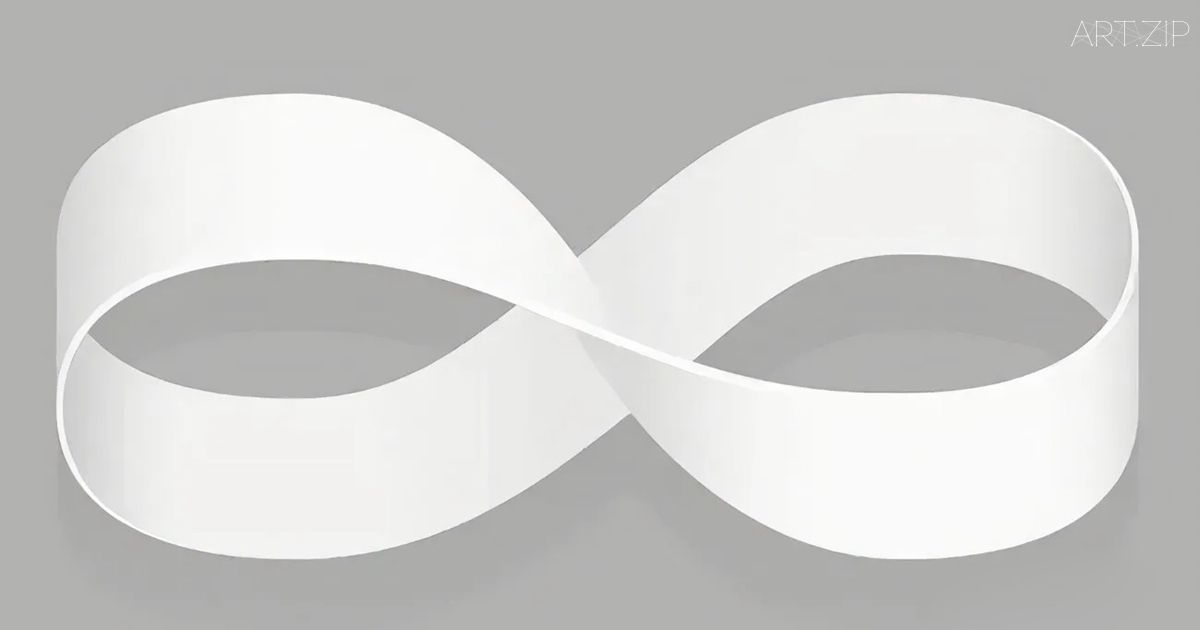
A similar experience returned later in the exhibition. Faced with Escher’s staircases, loops, and impossible spaces, I found myself thinking of the Möbius strip, of religious ideas of death and rebirth, of the endless turning of samsara, of logic loosening at its joints. And before long, the exhibition move towards these themes as well.
Escher’s impossible architectures do not derive their power from chaos. Quite the opposite: every stair, every channel of water, every perspectival relation appears perfectly reasonable. Each part makes sense on its own; it is the whole that collapses into paradox. The effect is like an intensely rational nightmare. Every element obeys the rules, and only when the rules are connected do you realise you have entered a dream: something in the world has gone wrong.
We move through space according to assumptions we almost never question. Up and down, inside and outside, near and far, cause and effect, direction itself — these habits run so deep we have all but forgotten they are habits. Escher gives them the slightest twist, and the floor of reality begins to tilt, cave in, even finally vanish beneath you.
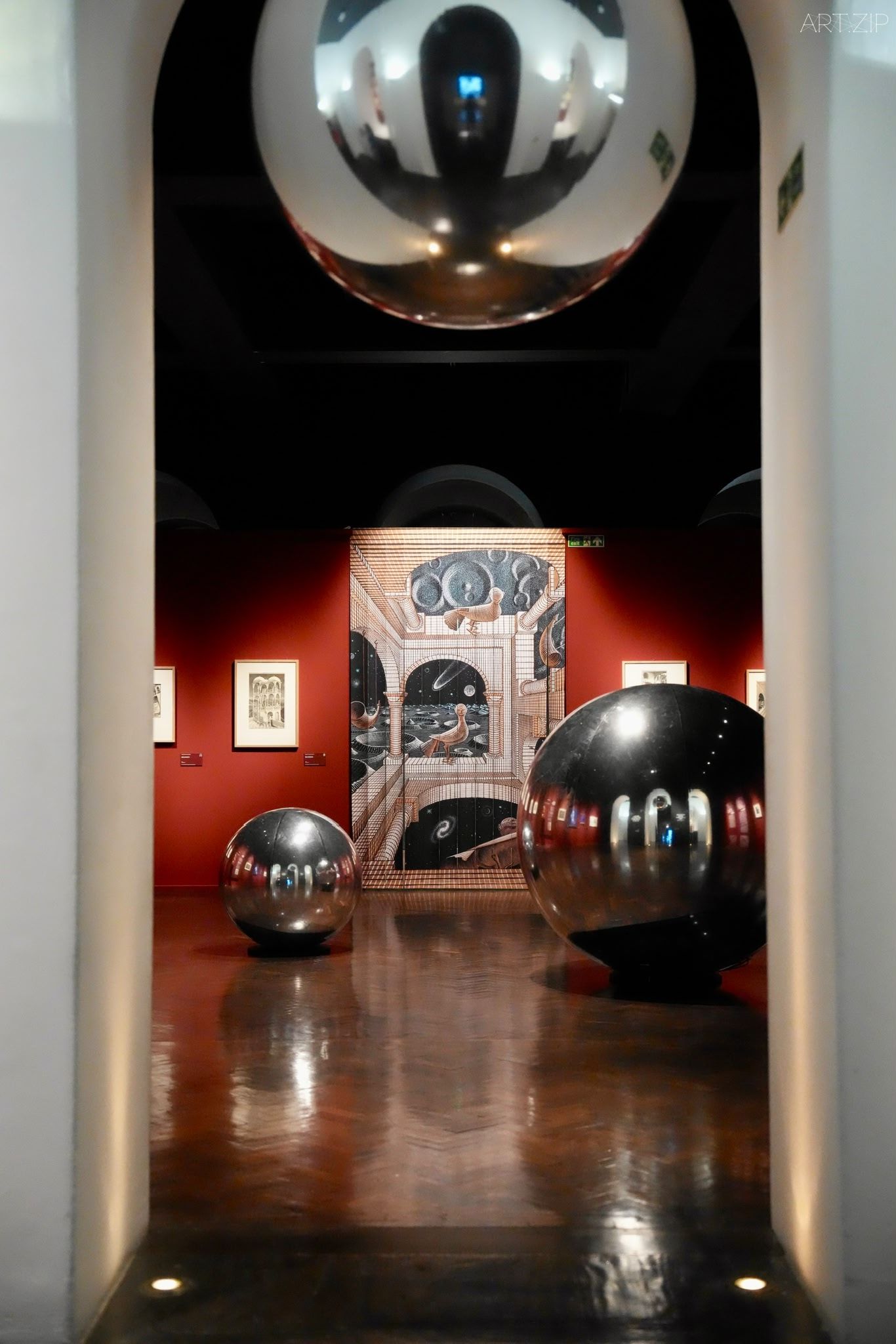
The presence of Bach’s Goldberg Variations in the galleries made all of these experience still more intricate. The music was not simply an elegant soundtrack laid over the images. Once Bach entered the space, the exhibition acquired another order entirely. Different pianists’ interpretations seemed to move from room to room; the same theme was taken apart, turned back on itself, folded and returned, each time with a new speed, weight, and centre of gravity. The relationship between Escher and Bach need not be hurried into the familiar frame of “art and mathematics”. What binds them more deeply is their shared absorption in structure: how a theme may vary, how a line may pursue itself, how order may generate pleasure, and how repetition may make us lose our way.
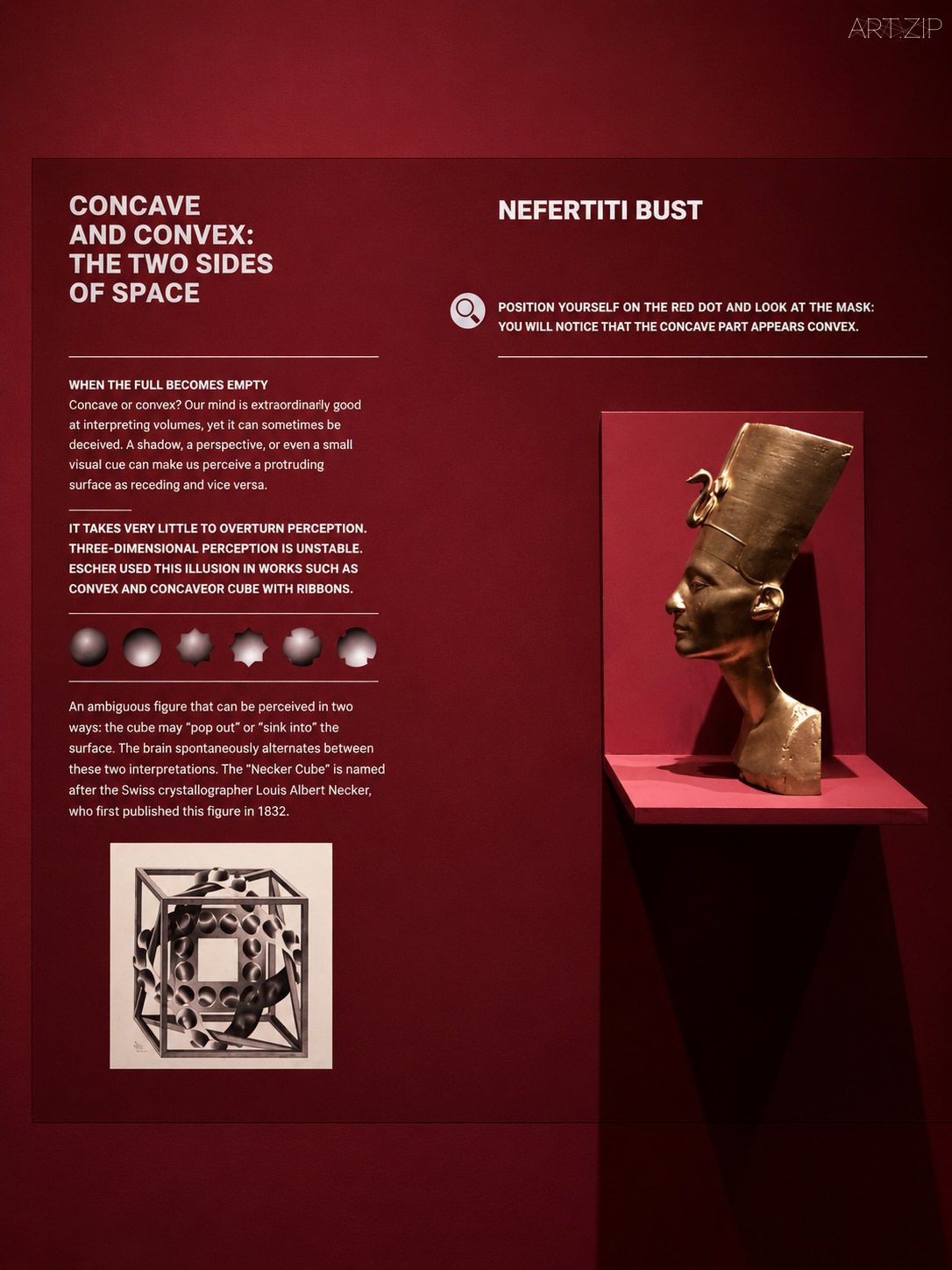
Installation shot. © Photo: Michelle Yu ©ART.ZIP
When I stood before the concave Nefertiti mask, the seventh variation of the Goldberg Variations — Variatio 7 a 1 ô vero 2 Clav. al tempo di Giga — was playing in the gallery. It is my favourite variation in the whole work: bright, light-footed, propelled by something almost dance-like. Before me, the Egyptian queen was not presented as an ordinary bust, but as a golden concave mask. From the designated viewing point, the face that was physically hollowed inward was reinterpreted by the brain as if it were projecting outward. Physical emptiness became visual fullness; recession became relief. In that moment, a quiet correspondence seemed to form between Bach’s variation, the golden mask, and the deep crimson of the gallery: music changed direction through repetition, the image changed identity between concavity and convexity, and looking itself moved back and forth between certainty and misrecognition.
Like the Nefertiti mask, the other dynamic installations in the exhibition are not especially complex. They function more as prompts left by the exhibition, reminding us that vision is never the passive reception of reality, but its active production of it. We do not simply see first and understand afterwards. Very often, it is an understanding already formed in advance that decides, on our behalf, what there is to see.
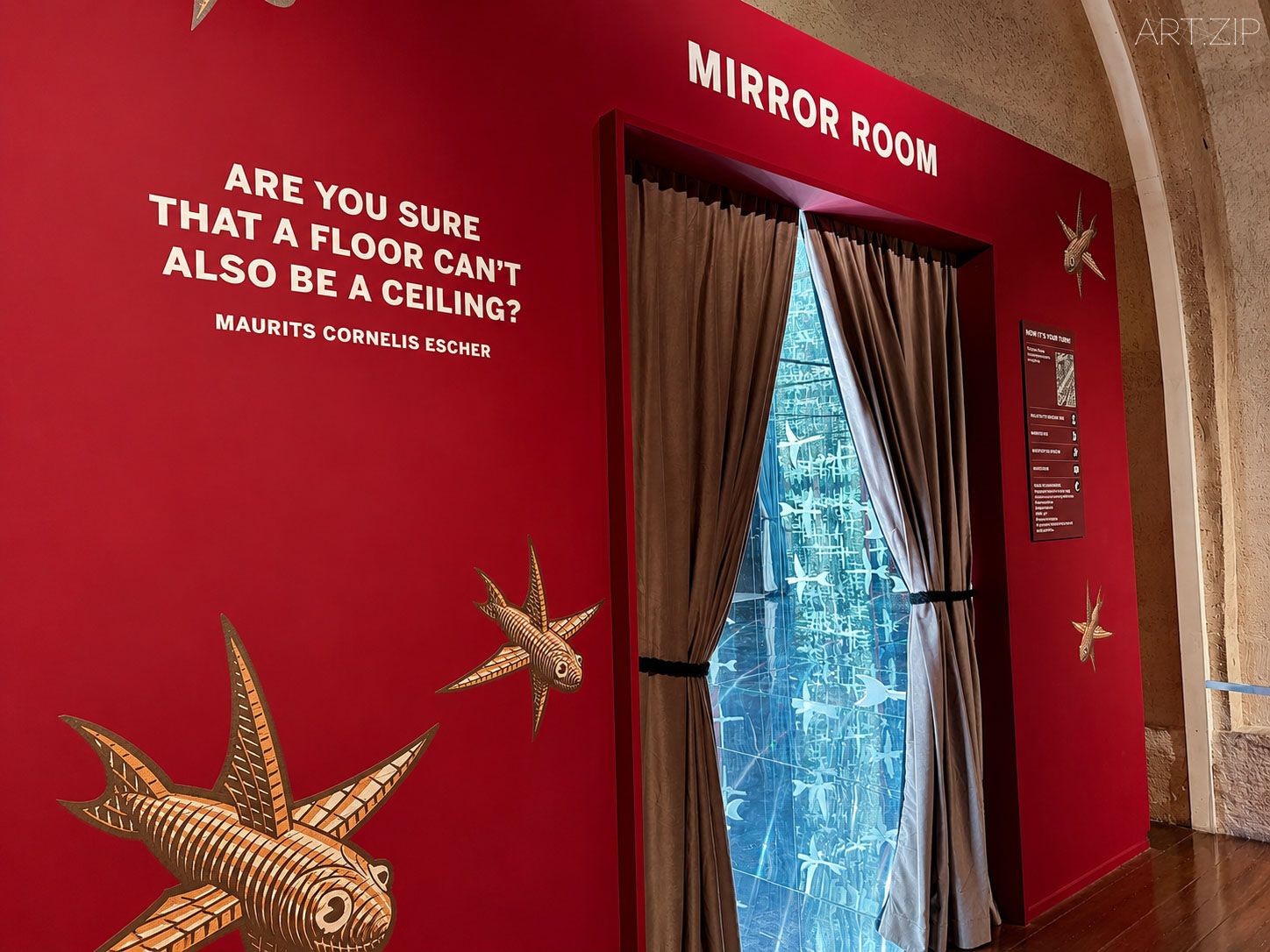
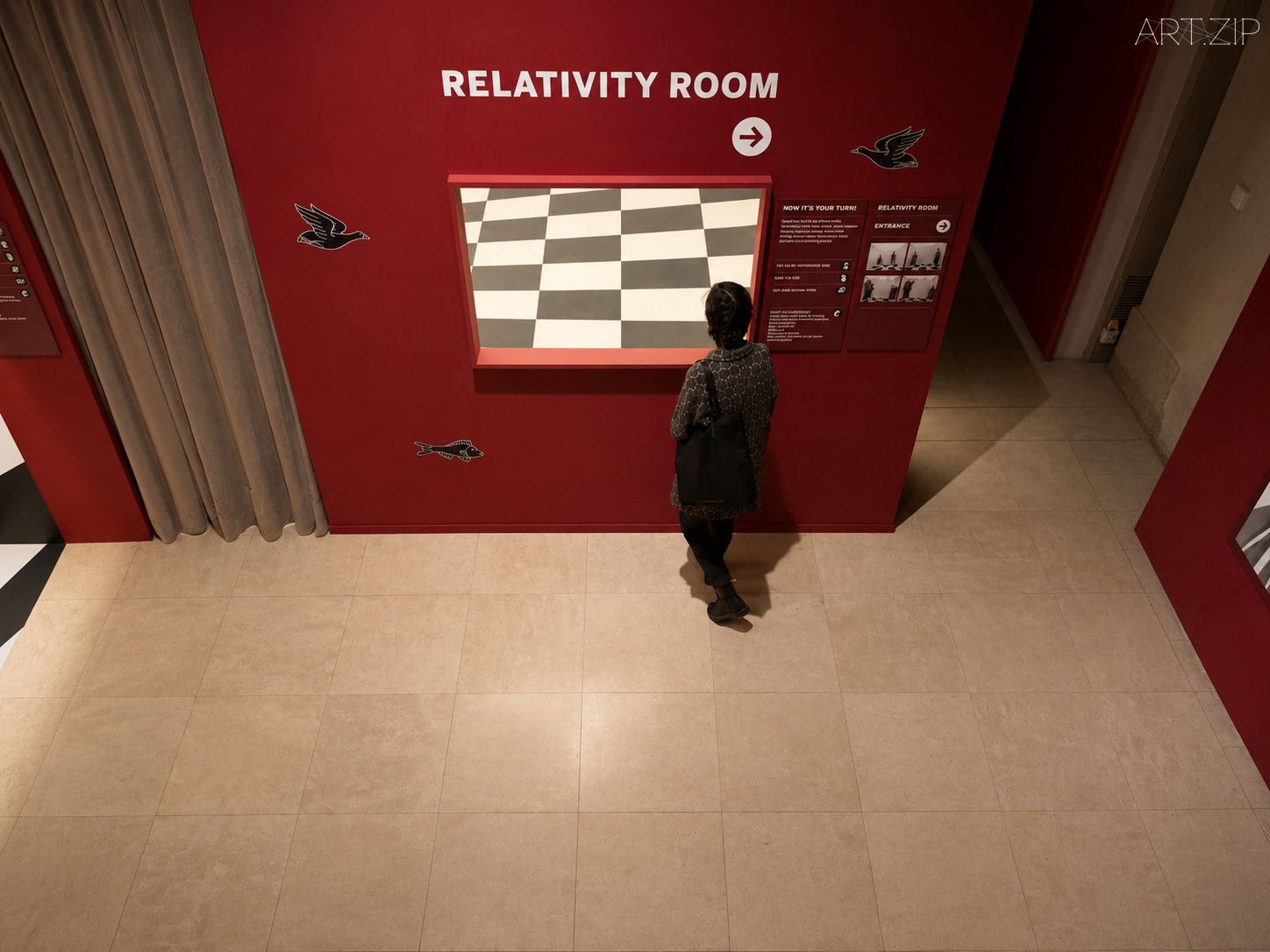
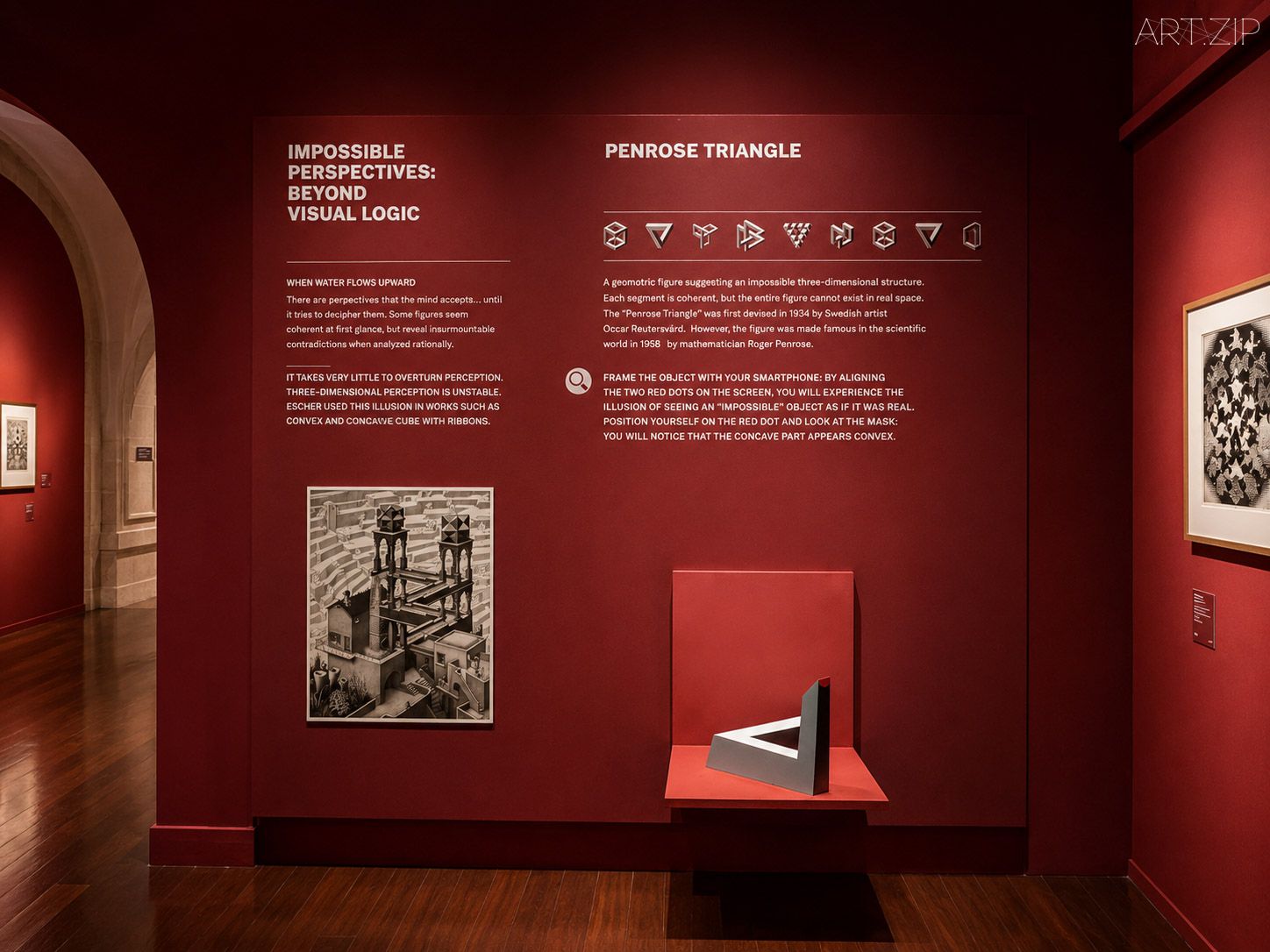
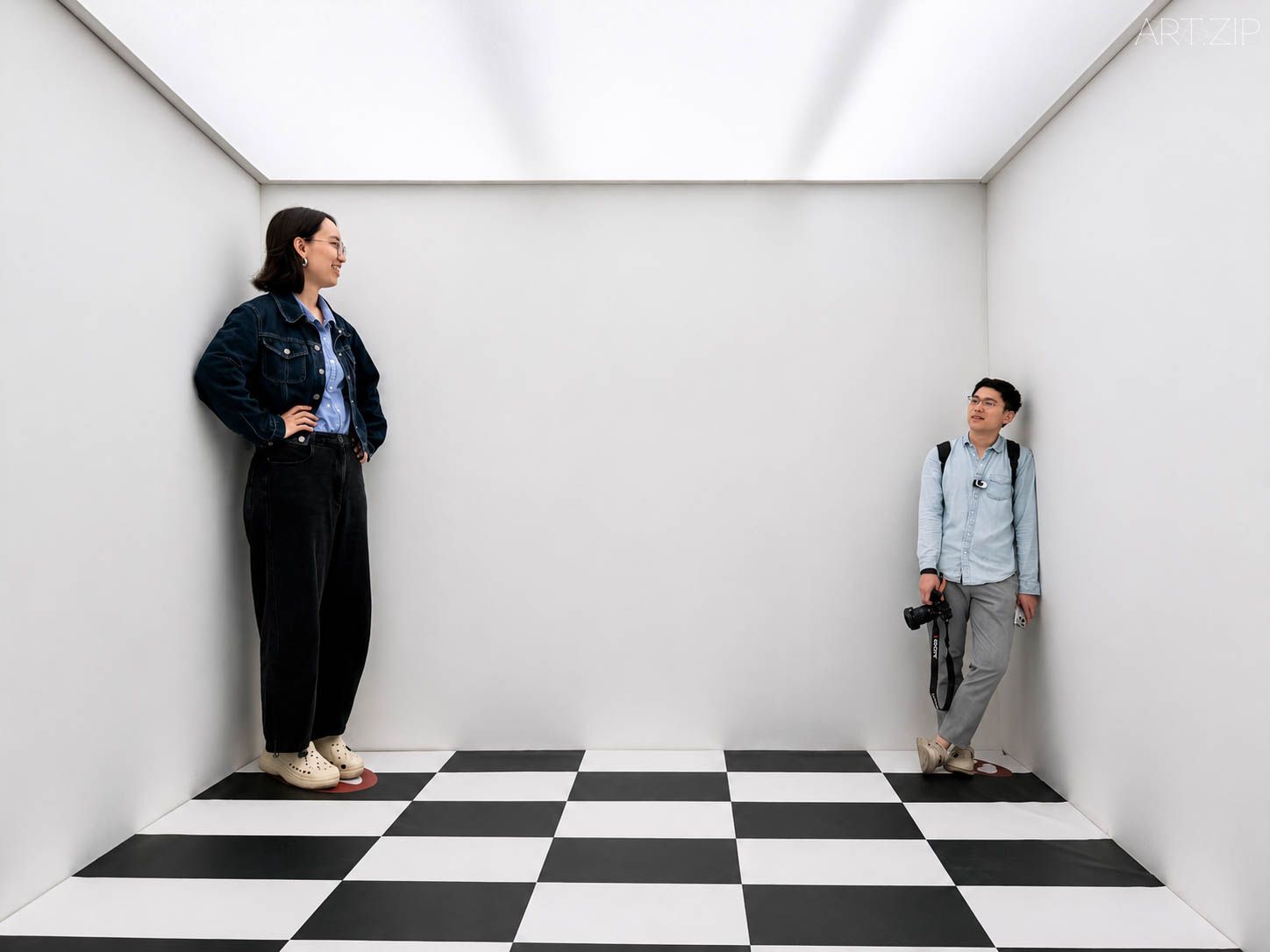
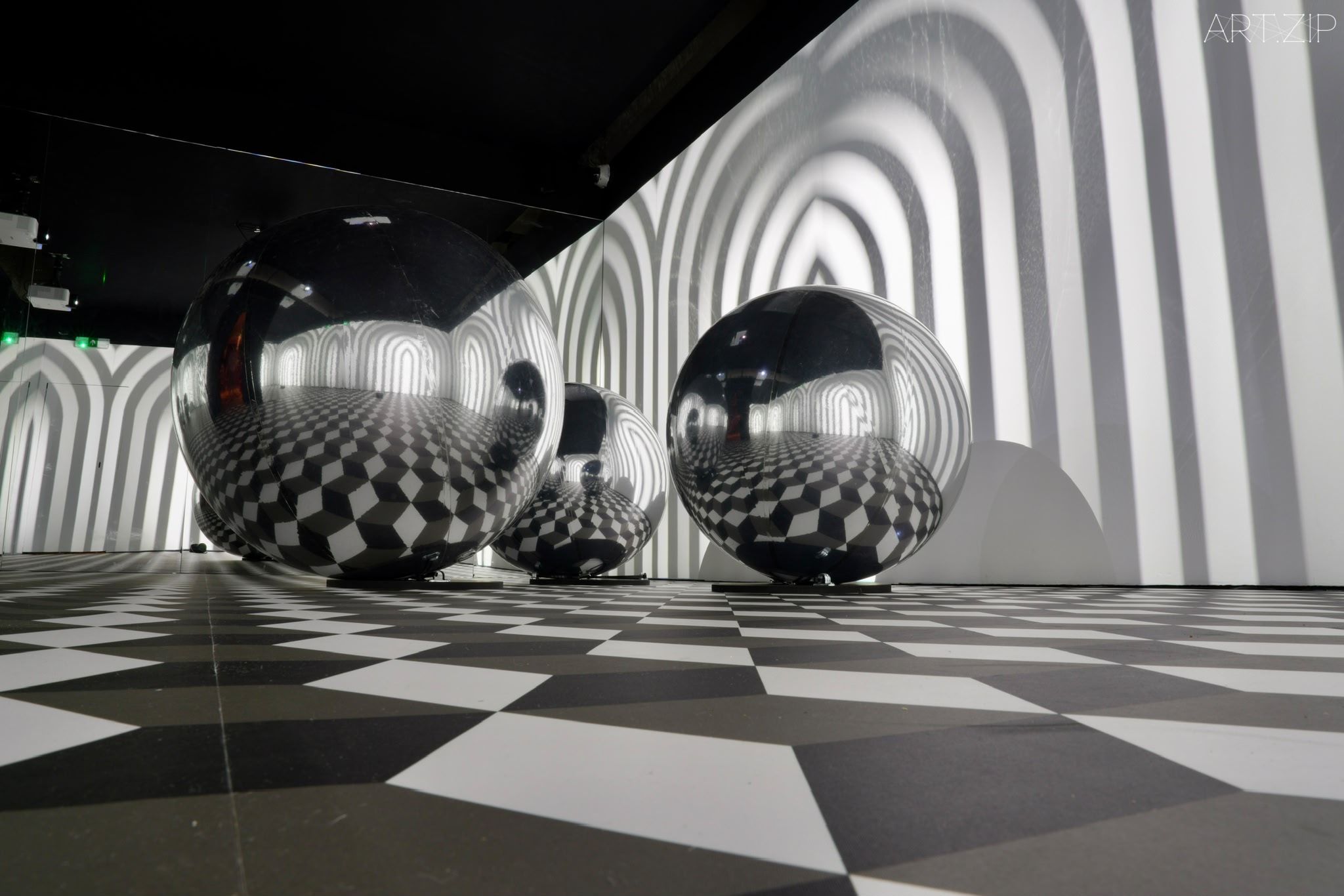
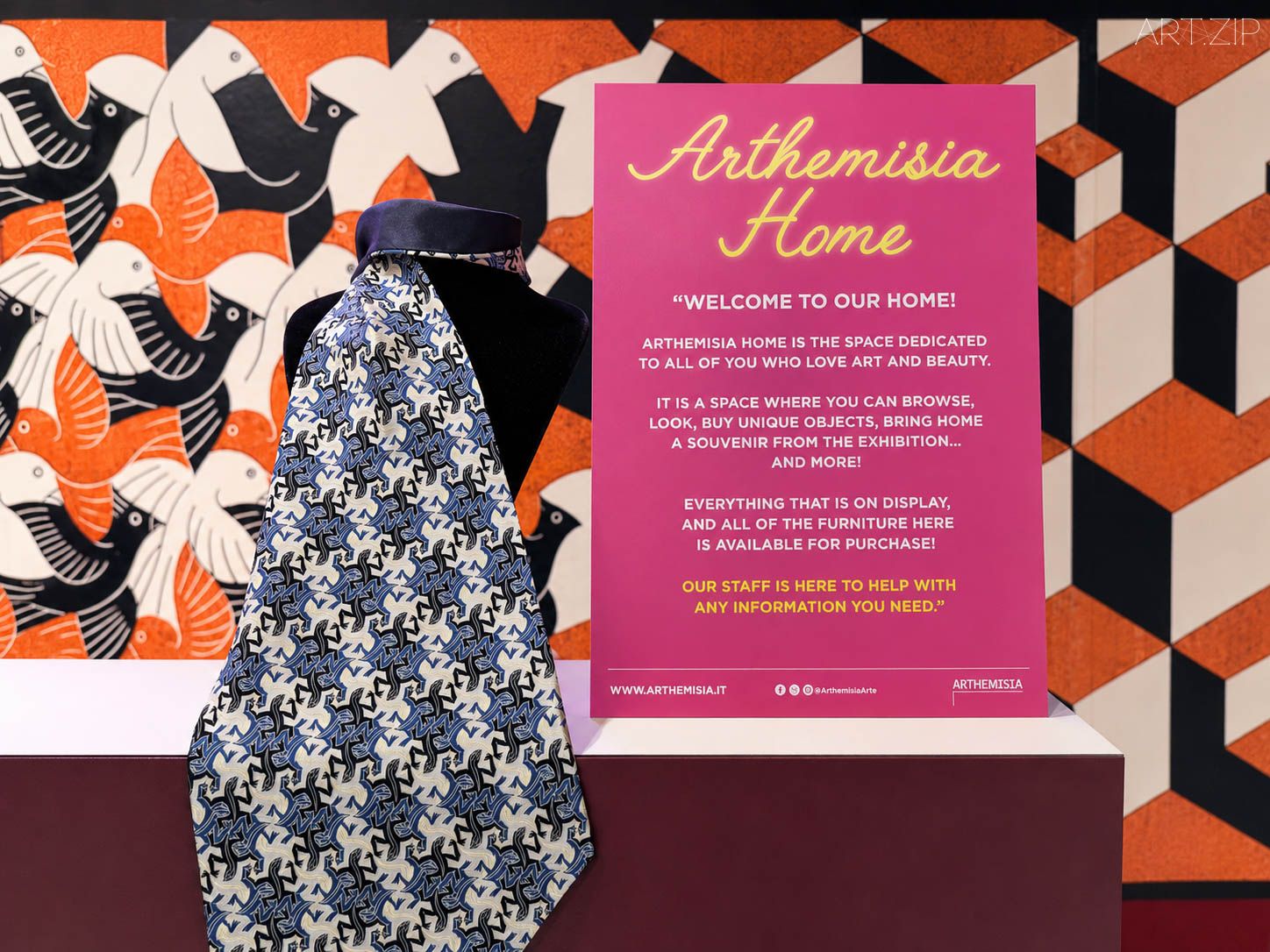
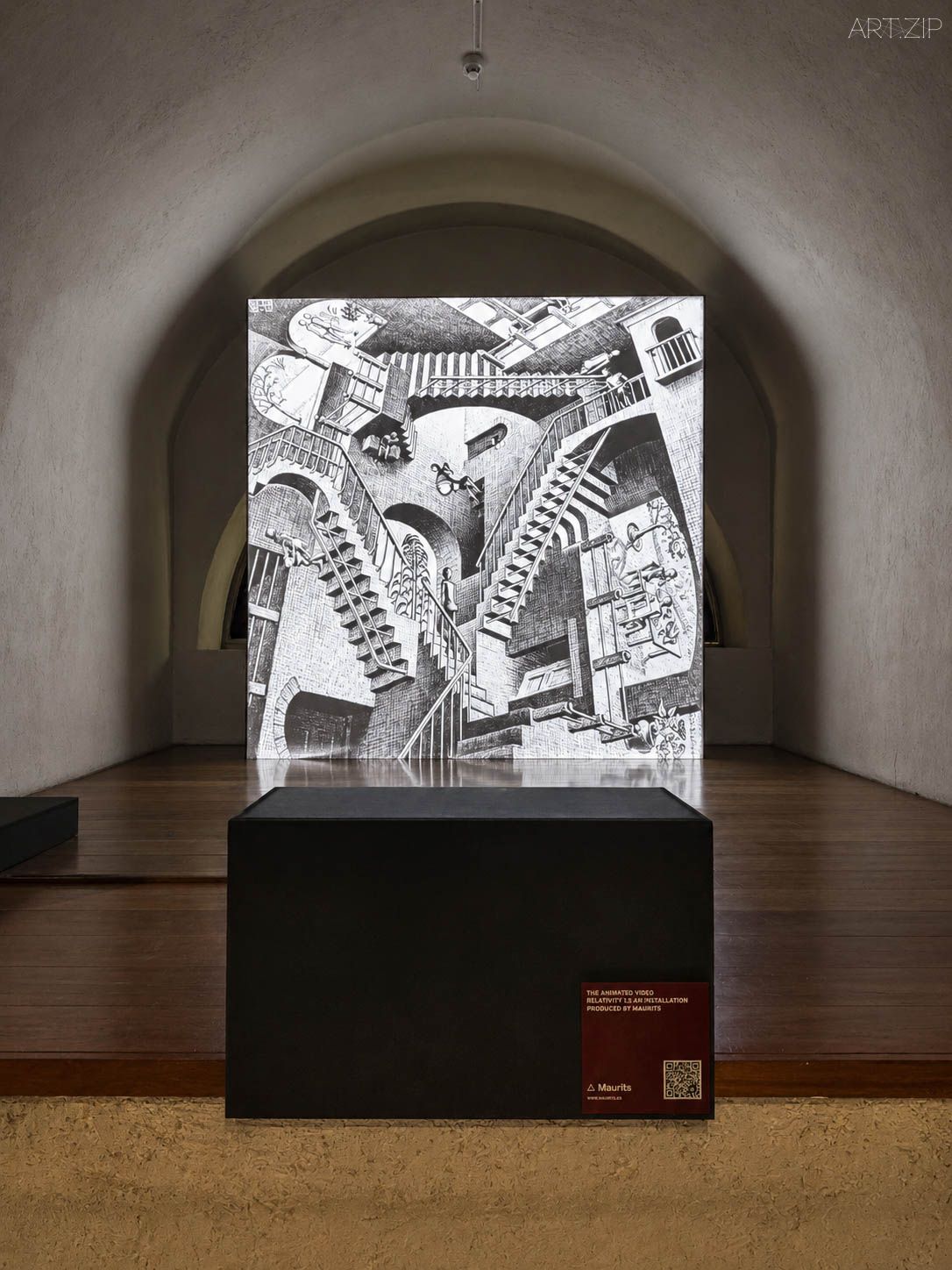
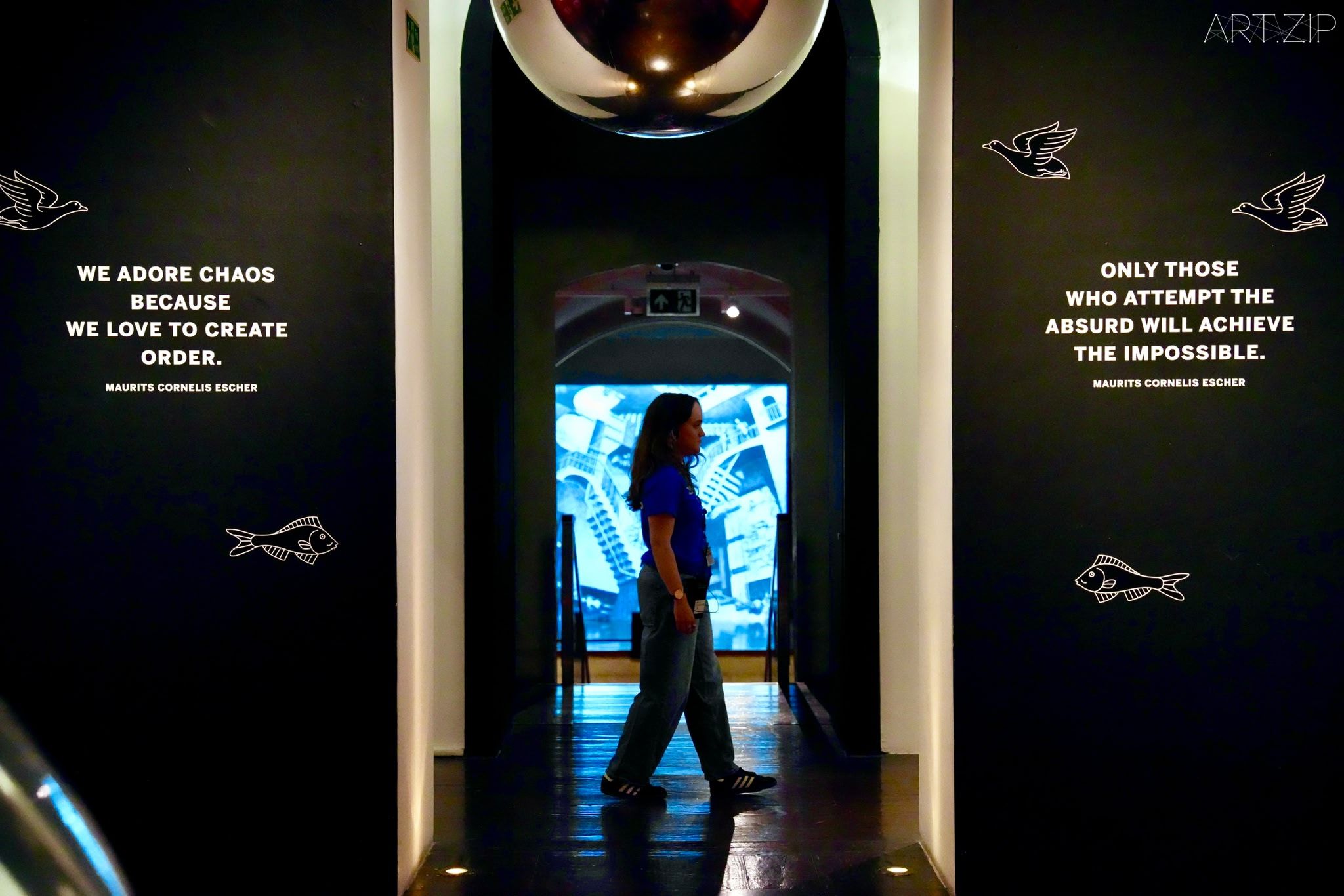
The dynamic visual installations in the galleries perform a similar task. On the screens, lines flow like water from one form to another; patterns seem to breathe; transformations that once belonged to paper are enlarged into spatial rhythm. Several sets of patterned blinds extend the exhibition’s sense of movement and invitation, drawing the viewer deeper into the illusion. The Mirror Room, the Relativity Room, the Penrose Triangle, and the various interactive installations that invite visitors to “step into” the images all make Escher more tangible — and inevitably more photographable. They explain illusion, but they also anticipate how illusion might be shared. The viewer is no longer simply standing before a work, trying to decipher its mechanism; they are drawn into a rhythm of repetition, variation, symmetry, and imbalance. Escher’s world seems, for a moment, to have come alive.
It was here that my hesitation began.
I do not think these interactive installations exist merely for photographs. Many of them are effective. They do make Escher more accessible to viewers who are unfamiliar with printmaking or art history. Children will enjoy them; general audiences will enjoy them; anyone encountering these images for the first time is likely to feel curiosity almost immediately. An exhibition that speaks only to those who already know Escher would become another kind of enclosure. Interactivity carries its own democratic force. It lowers the threshold. It releases a rigorous pictorial logic from the surface of paper, allowing viewers to approach with their bodies the paradoxes that would otherwise have to be traced slowly, with the eye, in front of a print.
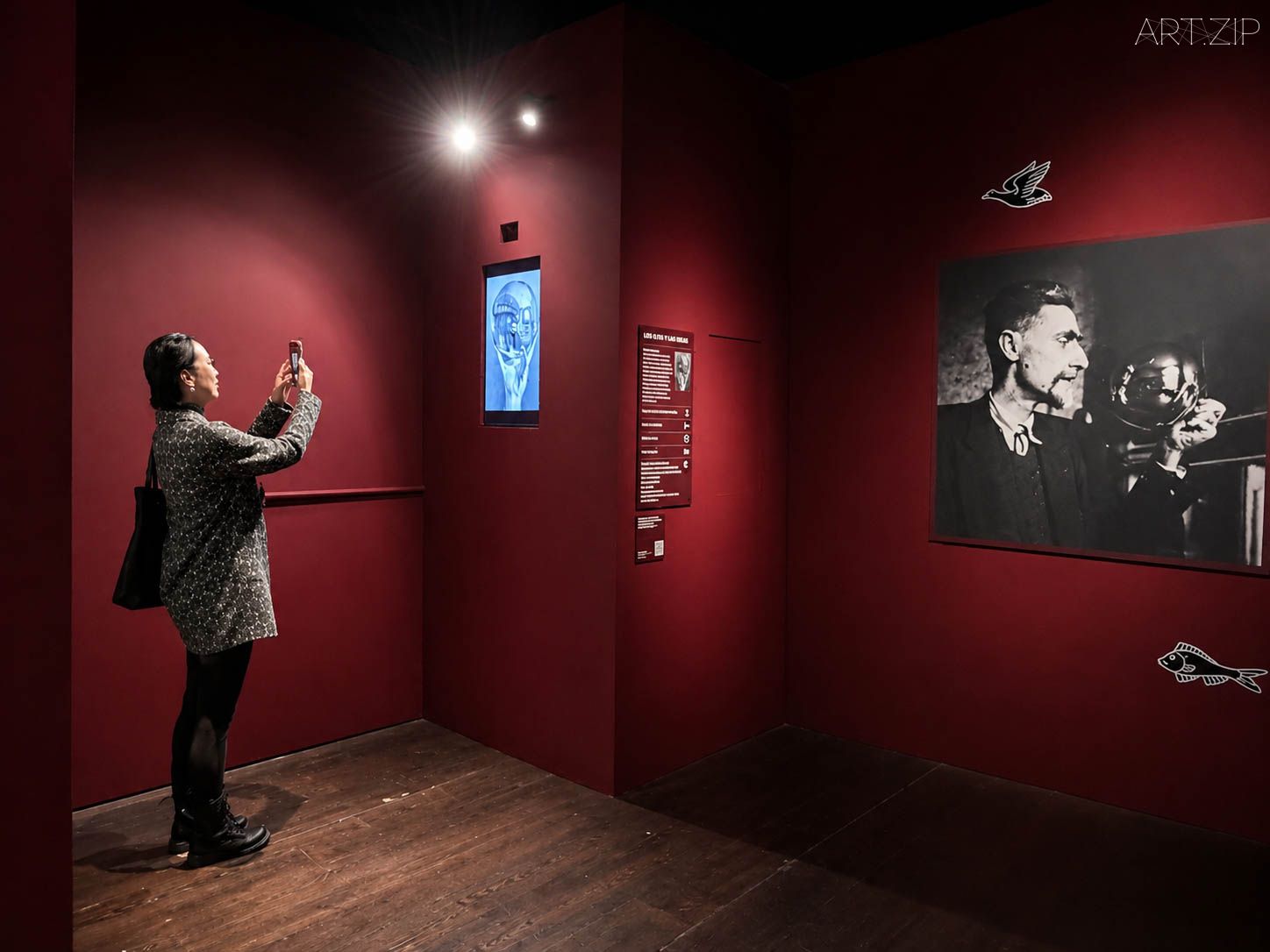
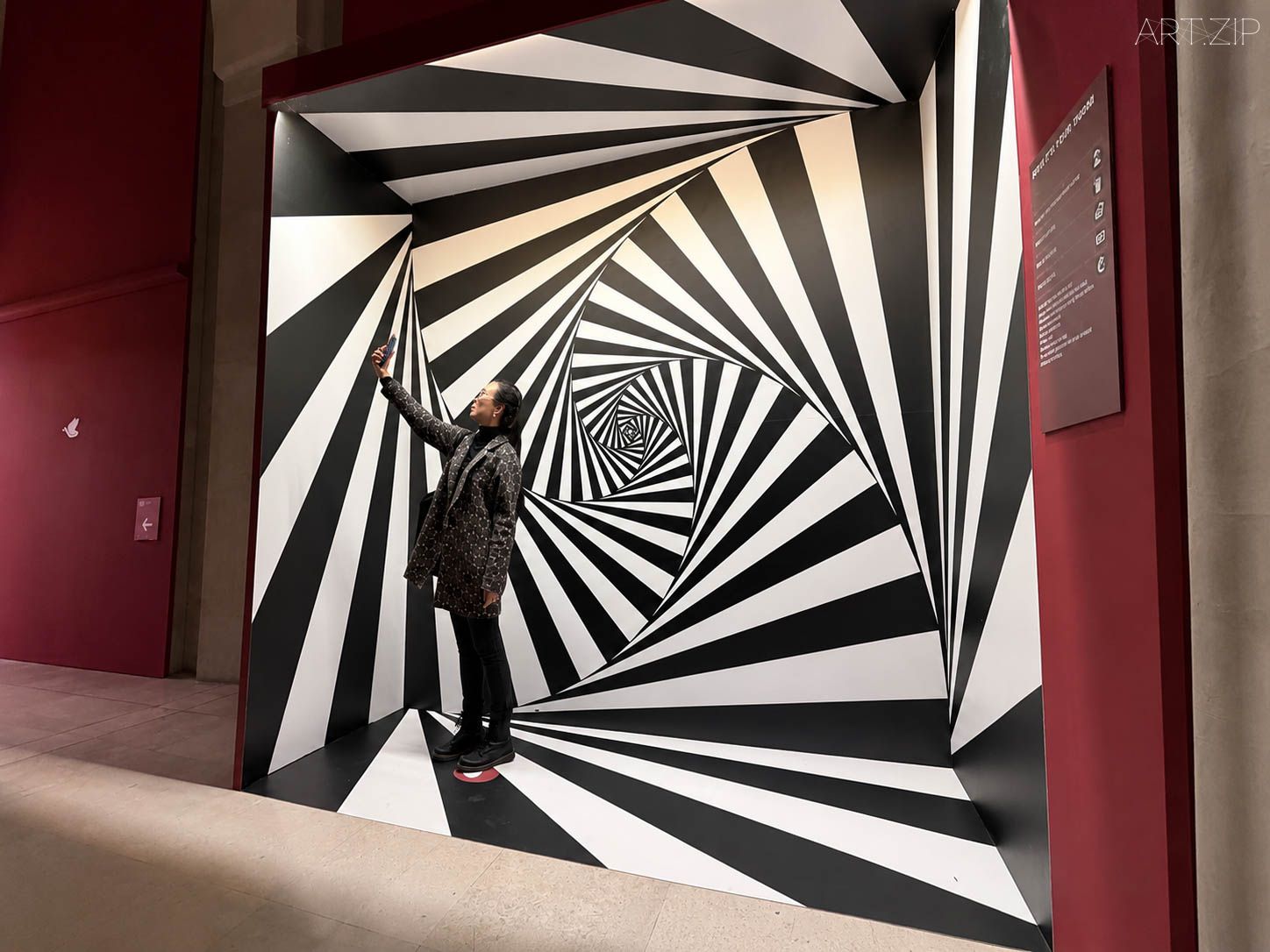
But the problem begins precisely here. In today’s exhibition ecology, “entering” is no longer an innocent act. A visual paradox one can step into can easily become, at the same time, a photographable moment, a node ready to be posted, circulated and consumed. When a work is amplified through dynamic effects, when an impossible space is turned into a room one can enter, when a complex mechanism of looking is translated into immersive experience, the exhibition begins to operate according to a different logic. Those mirrors, marked viewing positions, projections, and interactive rooms already anticipate how today’s visitors might move, how they might raise their phones, how an act of looking might be converted into an image fit for circulation.
The difficulty is that the exhibition’s strengths and its risks spring from almost the same place. The more successfully it makes Escher audible, visible, and bodily accessible, the more easily it places an artist who demands for slow looking and sustained thought inside the very language contemporary exhibitions know best: participation, image-making, circulation. Escher makes looking suspect; the exhibition industry, by contrast, is remarkably skilled at turning suspicion into experience, hesitation into a marked standing position, bewilderment into one photograph after another, each ready to be posted almost without thought.
Escher’s works ask us to slow down. They ask the eye to walk through the image, to test its own judgement again and again, to move back and forth between “What am I seeing?” and “Why am I seeing it this way?” Their pleasure is delayed. The first glance brings surprise; the second, confusion; only the third begins to approach a certain unease. Contemporary exhibition culture rarely encourages such delay. It favours quick entry, quick confirmation, quick production of images. Before a work has had time to alter the way one looks, the viewer is already searching for the best angle to photograph it.
There is a cruel irony here. Escher draws the viewer into the image in order to make them aware that they are not fully in command of looking. Social media-oriented interactive installations draw the viewer into the image too, but often in order to reaffirm the self: I was here; I saw this; I possessed this moment. The former makes looking uncertain; the latter makes looking publishable. One produces a pause for thought; the other produces the speed of circulation.
The problem, of course, is not that viewers take photographs. To place the blame on the audience would be the easiest, and cheapest, response. What deserves scrutiny is the exhibition mechanism itself. When an exhibition is organised as a sequence of photographable moments, the act of looking has already been designed in advance. People may appear to move freely through the space , yet they often complete their participation through similar angles, similar poses, and similar routes of circulation. Each person appears to be having a private experience; yet these seemingly private experiences so often flow back into the same system of image production. The exhibition thus becomes a vast spectacle: dispersed bodies, each raising a phone, all moving within the same visual system.
Installation shot. © Photo: Boyu Xiao ©ART.ZIP
This, too, bears an uncanny resemblance to Escher. Escher draws loops, nested structures, images that generate and replicate themselves; social media, in its own way, also lives by loops, nesting, and self-replication. The difference is that Escher allows us to see the paradox of the loop, while the logic of spectacle asks us to become part of its traffic. His images are cool, precise traps. They compel us to stop and admit that we do not quite understand the world. Contemporary image consumption, by contrast, decorates the trap until it looks welcoming. We step into it gladly, and hand ourselves over as content with astonishing fluency.
Escher’s works did not set out to satirise the spectacle of consumption today. He could not have foreseen the rise of social media, nor the flourishing industry of immersive exhibitions. Yet when his works are placed inside an exhibition ecology so highly interactive, photographable, and shareable, they acquire a strange, almost abrasive clarity. When his mirrors, windows, staircases, and infinite loops are turned into spaces designed to be entered and photographed, what finally appears is not only Escher’s visual paradox, but also the habits of looking that have already grown into our daily lives, and our near-instinctive pull towards becoming part of the spectacle.
A mirror may be a window; a window may be a mirror. Escher had long made the boundary between the two unreliable. A mirror does not merely reflect the self, and a window does not necessarily open onto the outside. Both may become fissures in the visual system, leading us to believe we are looking through to the other side when in fact we remain enclosed within the same structure. The phone screen works in much the same way. It is a window onto the world, and also a mirror that keeps returning the viewer to the centre of the image. We think we are documenting the exhibition; in fact, the exhibition has already folded us into its own predictable choreography of looking.
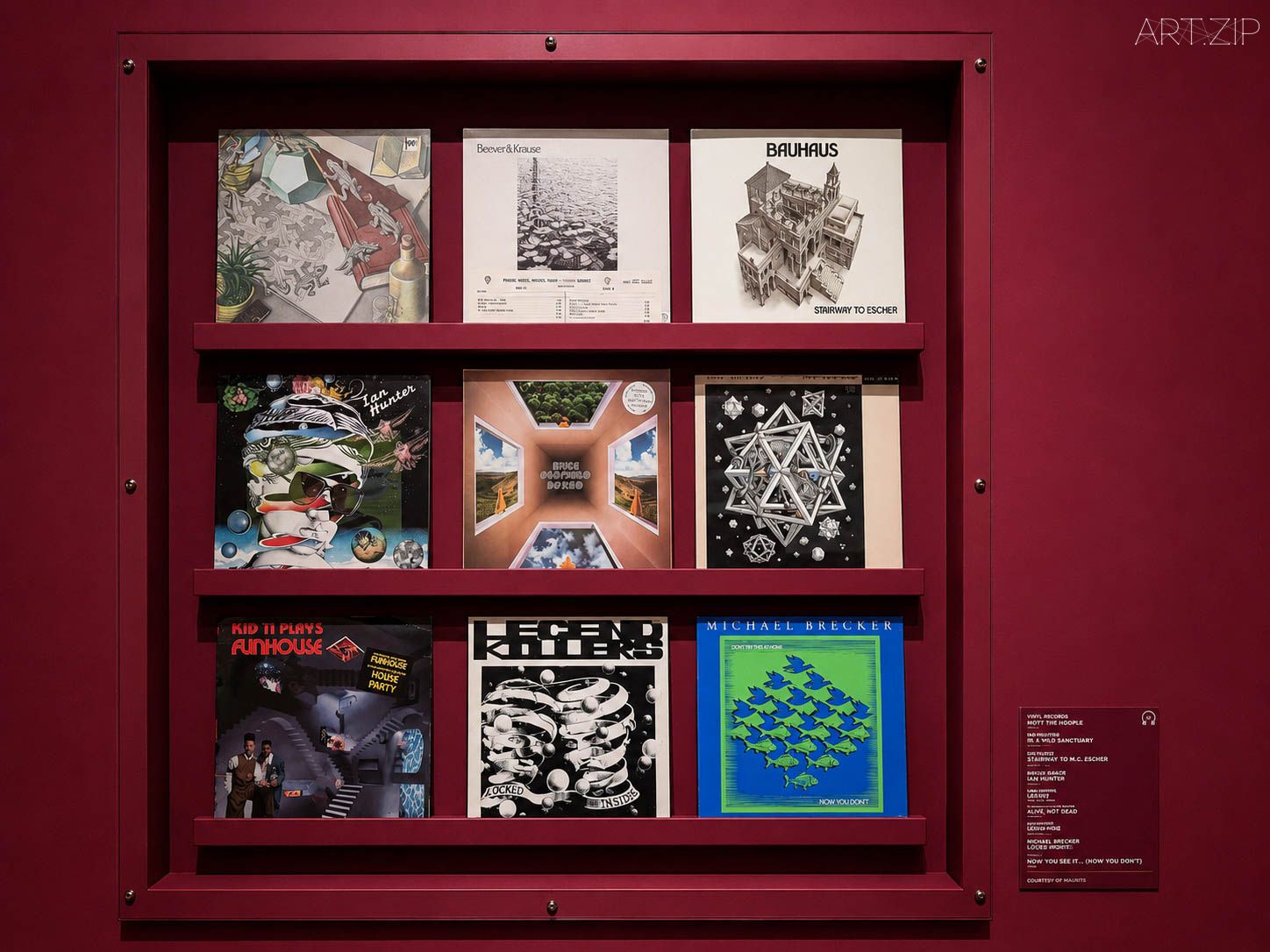
Leaving the galleries, I found myself thinking not of any single work, nor of any particular interactive room, but of a simple question: do we still know how to look slowly at an image? In front of Escher, the question feels especially sharp. His works look, on the surface, so perfectly suited to circulation — so easily copied, enlarged, printed on posters and T-shirts, folded into album covers and immersive spaces. Yet what they truly ask of us is the opposite of speed. They ask for staying. For doubt. For an admission of the limits of the eye and the mind.
Perhaps this is why Escher still matters now. His images have not grown outdated precisely because we are more saturated with images than ever, and more easily swept along by them. Every day we slide past countless visual fragments, fluent in the gestures of judging, liking, saving, sharing. Escher sets a small resistance in that flow. He makes an image impossible to consume and be done with. Just when you think you have already seen it, he makes you realise that looking has only just begun.
走進薩默塞特宮的《M.C. 埃舍爾:展覽》(M.C. Escher. The Exhibition),暗紅色的展廳色調,更襯出埃舍爾的神秘。關於埃舍爾,最容易被記住的當然是那些令人眩暈的圖像:走不到盡頭的樓梯,循環回自身的瀑布,魚變成鳥,手畫出手,空間在嚴密的邏輯中悄然失效。這樣的埃舍爾太適合被複製,也太適合被傳播。他的作品表面上像一個個聰明的視覺謎題,天然帶著被海報、屏幕和社交媒體不斷轉發的命運。
可我在這場展覽里更在意的,是另一個問題:當一個要求人慢下來、反復觀看、懷疑自己視覺經驗的藝術家,被放進今天高度互動、可進入、可拍攝的展覽語言里,他的作品究竟被激活了,還是被重新消費了?
展覽並沒有一開始就把觀眾推向那些最熟悉的視覺奇觀,而是從他的生平、工具、旅行和媒介講起。這個開端看似樸素,卻很必要。埃舍爾太容易被概括為「錯覺大師」,彷彿他的成就只是製造了幾張聰明的圖像謎題。展覽把他放回到版畫、手工經驗和歐洲視覺傳統中;在魔術與視幻真正出現之前,先讓觀眾看見他的手、那些工具、那張桌子,看見一幅圖像在成形之前所經歷的安靜、緩慢的時間。

版畫,尤其是木刻,是一個很好的入口,它要求耐心與克制。線條平整,猶如被熨帖過一般,木板被刻刀一點點挖開,留下的部分承受油墨,空出來的地方成為光。觀看這樣的圖像時,人會意識到一種近乎反常的精確:每一道線都帶有決定性,每一塊黑色都必須和旁邊的白色相互咬合。埃舍爾後來那些看似輕盈、詭異、機巧的變形,底部其實有這樣一種很硬的工藝經驗。幻想並非翩然降臨,它從板材、壓力、邊緣和反復中倔強地生長出來。
展覽的前半段順著這個脈絡慢慢推進。早期作品里的風景、建築、自然形態從不急著炫技。它們像是在訓練一雙眼睛,訓練觀看者如何注意結構、陰影、重復和秩序,並在短短幾個展廳里建立起一套新的觀看的邏輯。之後,變形開始出現。魚、鳥、幾何圖案、建築空間漸漸不再安分地停在各自的位置上。一個形狀向另一個形狀悄然滑去,背景開始爭奪主體的位置,平面冒出體積,裝飾變成敘事。埃舍爾的圖像在這裡顯出真正的性格:它們不滿足於被看見,它們還要推翻觀看的邏輯,甚至重建觀看的規則。
我在一樓看那些圖像時,很快想到魯賓花瓶:那只經典的黑白花瓶,既可以被看成花瓶,也可以被看成兩張相對的臉。我也想到《我的妻子與我的岳母》(My Wife and My Mother-in-Law)那類多義圖像:同一組線條,在不同的觀看方式里生成不同的人物。這些圖像迷人的地方不在於「一圖兩看」這個小把戲,而在於它暴露了觀看中的取捨。一個形象浮出來,另一個形象就暫時退後。前景與背景沒有絕對身份,它們依靠視線的選擇來維持各自的位置。
在埃舍爾的圖像里,這種選擇總是引人入勝。邊緣與空白隨時可能翻身成為圖像的主角。我們以為自己看見了一個對象,其實也在同時忽略另一些正在形成的東西。視覺的主觀性並不是哲學課上的抽象概念,它就發生在這些所謂的主體與客體的交界處。走到後面的展區,魯賓花瓶真的出現在了展覽的敘事中。那一刻我感受到一種輕微的驚訝。不是因為自己猜中了什麼,也不是因為策展敘事驗證了某個想法,而是因為展覽的節奏讓我先在作品前產生了直覺,再在隨後的空間里看見這個直覺被證實與命名。好的展覽從不急著解釋。它給觀者時間與空間,帶著模糊與直覺行走其中,再被鼓勵著推向更清楚的方向。
類似的經驗在後面反復出現,看見那些樓梯、回環和不可能的空間時,我想到了莫比烏斯環,想到了宗教中的生死循環,六道輪回,想到邏輯的鬆動與失靈。很快,展覽也緩緩地進入了這些主題。埃舍爾的不可能建築並不靠混亂取勝。恰恰相反,每一級台階、每一道水渠、每一個透視關係都顯得有理有據。局部都說得通,整體卻塌進悖論里。它像一種極端理性的噩夢:所有環節都遵守規則,規則連接起來之後,你才會發現自己深陷夢魘,這個世界好像出了問題。
我們太過於習慣在自己默認的空間經驗里行走。上下、內外、遠近、因果和方向,習慣到幾乎忘了這些只是觀看世界時依賴的規則。埃舍爾把規則輕輕扭了一下,現實的地板便開始傾斜、坍塌,甚至消失不見,墮入深淵。
Installation shot. © Photo: Michelle Yu ©ART.ZIP
展覽中播放的巴赫(Johann Sebastian Bach)的《哥德堡變奏曲》(Goldberg Variations)使這種觀看經驗變得更複雜。它不是附加在圖像上的優雅背景音。巴赫的音樂進入展廳之後,整個空間有了另一種秩序。不同鋼琴家演奏的版本在展廳里流動,同一個主題被拆開、轉向、折返,又以新的速度和重心重新出現。埃舍爾與巴赫的關係不必被匆忙歸入「藝術與數學」的框架。真正相近的是他們對結構的迷戀:主題如何變奏,線條如何追逐自身,秩序如何產生愉悅,重復如何讓人失去方向。
當我站在娜芙蒂蒂凹面面具裝置(Nefertiti bust)前,廳里正響起第七變奏《吉格舞曲速度(Variatio 7 a 1 ô vero 2 Clav. al tempo di Giga)》。那是我在《哥德堡變奏曲》里最喜歡的一段,明亮、輕快,帶著一種近乎舞蹈的推進感。眼前的埃及王后並不是一尊普通的頭像,而是一張凹面的金色面具。站到指定的位置看去,原本向內塌陷的面部,卻被大腦重新解釋成向外凸出的臉。物理上的空,變成了視覺里的滿;凹陷,變成了隆起。那一刻,巴赫的變奏、金色面具和暗紅色展廳之間形成了一種微妙的呼應:音樂在重復中改變方向,圖像在凹凸之間改變身份,觀看也在確定與誤判之間來回擺動。
和娜芙蒂蒂凹面面具裝置一樣,展廳里的其他動態裝置並不複雜,它們像是展覽留下的一組提示,提醒觀眾:視覺從來不是被動接收現實,而是在主動製造現實。我們並不是先看見,再試圖理解;很多時候,是預先構建的理解,替我們決定了應該看見什麼。
展廳里的動態視覺裝置,也在做類似的事情。電子屏幕中,線條像水一樣從一種形態滑向另一種形態,圖案像有了呼吸,紙上的變形被放大成空間里的節奏。幾處百葉簾也延續著埃舍爾式的圖案,在整體敘事上成全著一種流淌,一種邀請,引人走入更深的幻覺之中。鏡像房間(Mirror Room)、相對性房間(Relativity Room)、彭羅斯三角(Penrose Triangle),以及那些邀請觀眾「進入畫中」的互動裝置,讓埃舍爾變得可感,變得可拍攝;它們解釋了錯覺,也預設了錯覺如何被分享。觀眾不只是站在畫前辨認機關,也被帶進一種由重復、變奏、對稱和失衡組成的節奏中。埃舍爾的世界看起來,似乎活了起來。
Installation shot. © Photo: Boyu Xiao ©ART.ZIP
也正是在這裡,我開始感到遲疑。
我並不認為這些互動裝置只是為了拍照,它們常常,也可以是有效的裝置,也確實讓不熟悉版畫和藝術史的觀眾更容易進入埃舍爾。孩子會喜歡,普通觀眾會喜歡,第一次面對這些圖像的人也會很快感到好奇。倘若一個展覽只能服務於已經懂埃舍爾的人,會變成另一種封閉。互動裝置有它的民主性,它降低門檻,把嚴密的圖像邏輯從紙面上釋放出來,讓觀看者用身體去接近那些原本需要在版畫前慢慢追蹤的悖論。
可問題也正在這裡,在今天的展覽生態里,「進入」本身已經不再天真。一個可以站進去的視覺悖論,很容易同時成為一個可以被拍攝、被發佈、被消費的圖像節點。當一件畫作被動態效果放大,當一個不可能空間被做成可進入的房間,當一套關於觀看的複雜機制被轉化為沉浸式體驗,展覽也開始接近另一種邏輯。那些鏡面、站位、投影和互動房間,預設了今天的觀眾可能如何移動,如何舉起手機,如何把一次觀看轉化成一張適合流通的照片。
這裡的複雜之處在於,展覽的優點和危險幾乎來自同一個地方。它越成功地讓埃舍爾變得可聽、可見、可進入,也越容易把一個要求慢慢觀看、反復思考的藝術家,放進今天最擅長製造參與感和傳播圖像的展覽語言中。埃舍爾讓觀看變得可疑;展覽工業卻太擅長把可疑變成體驗,把遲疑變成站位,把困惑變成一張又一張可以隨手發佈的照片。
埃舍爾的作品要求人慢下來。它要求眼睛在圖像里走路,要求觀看者反復檢查自己的判斷,要求人在「我看見了什麼」和「我為什麼這樣看」之間來回移動。它的快樂帶有延遲性。第一眼是驚奇,第二眼是困惑,第三眼才可能接近某種不安。可是今天的展覽消費往往不鼓勵這種延遲。它鼓勵快速進入,快速確認,快速生產圖像。人還沒有真正被作品改變觀看方式時,已經在急不可耐地尋找最適合拍照的位置。
這裡有一種殘酷的諷刺:埃舍爾的作品把觀眾捲入圖像,是為了讓觀眾意識到自己並不完全掌控觀看。社交媒體式的互動裝置也把觀眾捲入圖像,卻常常讓人重新確認自我:我在這裡,我看過,我擁有了這個瞬間。前者讓觀看變得可疑,後者讓觀看變得可發佈。前者製造的是思考的停頓,後者製造的是流通的速度。
問題當然不在於觀眾拍照,把責任推給觀眾最容易,也最廉價。真正值得批評的是展覽機制本身。當一個展覽被組織成一連串適合拍攝的節點,觀看行為就已經被提前設計好了。人們看似自由地進入空間,實際上按照相似的角度、相似的姿勢、相似的傳播路徑完成參與。每個人都在進行私人化體驗。遺憾的是,這些看似私人化的體驗,最後往往共同匯入同一套圖像生產流程。展覽因此構成一個龐大的景觀:分散的人群,各自舉起手機,卻在同一個視覺系統里行動。
這件事和埃舍爾有一種詭異的相似,打個比方來說,埃舍爾畫循環、嵌套、自我複製;社交媒體也依靠循環、嵌套和自我複製。究其差別,埃舍爾讓人看見循環的悖論,景觀消費讓人參與循環的流量。埃舍爾的圖像像一個冷靜的陷阱,逼人停下來承認自己看不懂世界;今天的圖像消費則把陷阱裝飾得很友好,讓人愉快地走進去,再把自己作為內容迅速而敏捷地交出去。
埃舍爾的作品沒有諷刺今天的消費景觀,他也無從預言社交媒體的盛行,也無從得知今日蒸蒸日上的沉浸式展覽工業。可是當他的作品被放進今天這種高度互動、可拍攝、可分享的展覽生態中,有一種很刺耳的清醒。當他的鏡子、窗、樓梯和無限循環被做成適合進入和拍攝的空間,最後顯現的,並不只是埃舍爾的視覺悖論,而是早已長進我們日常生活里的觀看模式,以及我們無從掙脫成為景觀的一部分的慣性。
鏡子可能是窗,窗也可能是鏡子。埃舍爾早就把這兩者之間的界線弄得不可靠。鏡子不只反射自己,窗也不一定通向外部。它們都可能是視覺系統里的裂縫,讓人以為看見另一邊,實際仍被困在同一個結構中。手機屏幕也是如此。它像窗,通向外部世界;它也像鏡子,把觀看者自己不斷送回圖像中央。我們以為自己在記錄展覽,其實也在被展覽記錄為一種可預測的行為。
離開展廳時,我想到的不是某一件作品,也不是某一個互動房間,而是那個很簡單的問題:我們到底還會不會慢慢看一張圖?在埃舍爾面前,這個問題顯得格外尖銳。因為他的作品表面上如此適合傳播,如此適合被複製、被放大、被做成海報、T恤、專輯封面和沉浸式空間;可它真正要求的,卻是和傳播速度相反的東西。它要求停留,要求懷疑,要求承認眼睛與思維的局限。
也許,這才是埃舍爾在今天仍然有效的原因。他的圖像沒有過時,因為我們比以往更熟悉圖像,也比以往更容易被圖像帶著走。我們每天在屏幕上滑過無數視覺碎片,熟練地判斷、喜歡、保存、轉發。埃舍爾卻在這些流動中設置了一塊阻力。他讓一張圖無法被輕易消費完。你以為自己已經看見,它卻讓你意識到,觀看才剛剛開始。
Text by 撰文 x Dr Hening Zhang 張鶴寧
Edited by 編輯 x Michelle Yu 余小悅